


Apartment complexes must provide a specific number of accessible parking spaces based on the total number of parking spaces provided in each parking facility, as defined by the Americans with Disabilities Act (ADA).
For example, a parking lot with 1 to 25 spaces requires at least one accessible space, while a 400-space lot requires at least 8 accessible spaces.
This guide explains the specific number of accessible parking spaces required, the design and construction requirements for van accessible spaces and signage, how the Fair Housing Act differs from ADA requirements, and how property managers can maintain compliance.
Key Takeaways
- The number of accessible spaces required scales with the total number of parking spaces provided. One space for facilities with four or fewer spaces, and 20 plus one for each 100 spaces in facilities with 1,001 or more spaces.
- One out of every six accessible parking spaces must be designated as van accessible to accommodate vehicles with side-mounted ramps or lifts.
- Accessible parking spaces must connect to accessible entrances via the shortest accessible route, with pathways at least 36 inches wide.
- The Fair Housing Act governs parking for residents (tenants), while the ADA applies to public accommodations like leasing offices and visitor parking at apartment complexes.
How Many Accessible Parking Spaces Do Apartments Need?
The number of accessible parking spaces required is determined by the total number of
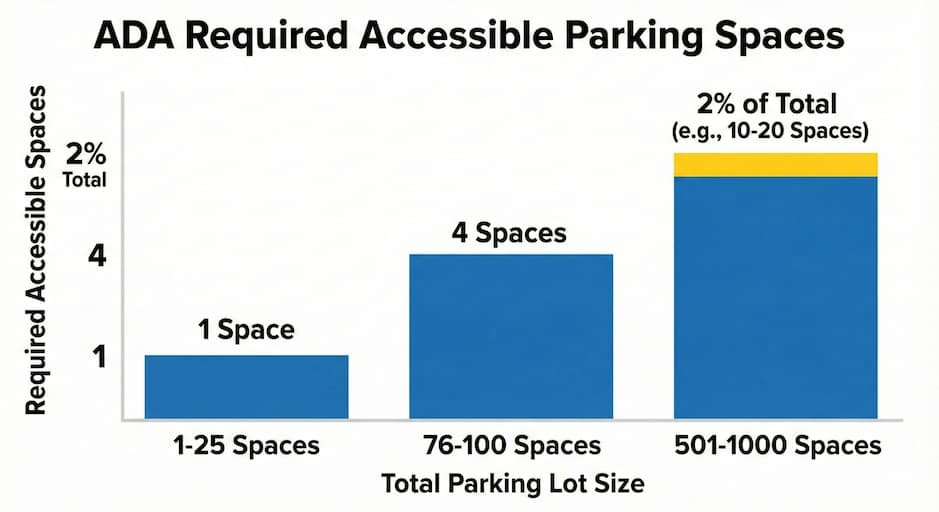
parking spaces provided in a specific parking lot or garage, not the total for the entire property. The 2010 ADA Standards (Section 208.2) mandate a scaling ratio based on facility size.
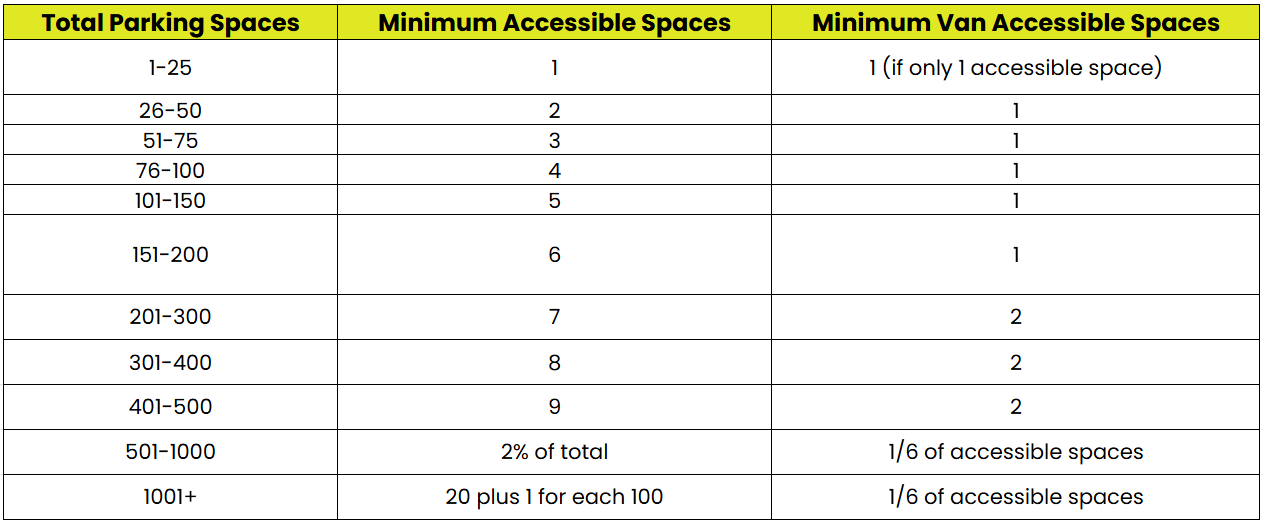
A parking facility with 1 to 25 spaces needs one accessible space, while a lot with 301 to 400 spaces needs eight accessible spaces. For parking facilities with 1,001 or more spaces, the requirement is 20 accessible spaces plus one for each 100 spaces (or fraction thereof) over 1,000.
This per-facility calculation ensures that accessible parking spaces are distributed and available near the specific buildings or entrances they serve, rather than clustered in a single distant location.
For apartment complexes with separate parking facilities serving different buildings, each parking area must be evaluated independently to determine the number of accessible spaces required.
Here is the complete accessible parking spaces table showing the minimum requirements:
For visitor parking areas at apartment complexes, property managers should consider designating at least 20% of visitor parking spaces as accessible to ensure that guests with disabilities have adequate access.
This recommendation goes beyond the minimum ADA requirements and creates a more inclusive environment for all visitors to the property.
What Are the Requirements for Van-Accessible Spaces?
The ADA requires that one out of every six accessible parking spaces be designated as van accessible. This means if a parking lot requires a total of eight accessible spaces, at least two of those spaces must be van accessible.
If a parking facility only requires one accessible space, that single space must be van accessible. This rule ensures that parking is available for residents and visitors who use larger vehicles equipped with side-mounted ramps or lifts, which require more space to deploy.
Van accessible spaces accommodate mobility devices and the side-entry equipment that many people with disabilities rely on for independent access. These spaces have specific dimensional requirements to accommodate side-entry ramps and mobility aids. The 2010 ADA Standards (Section 502) provide two configuration options.
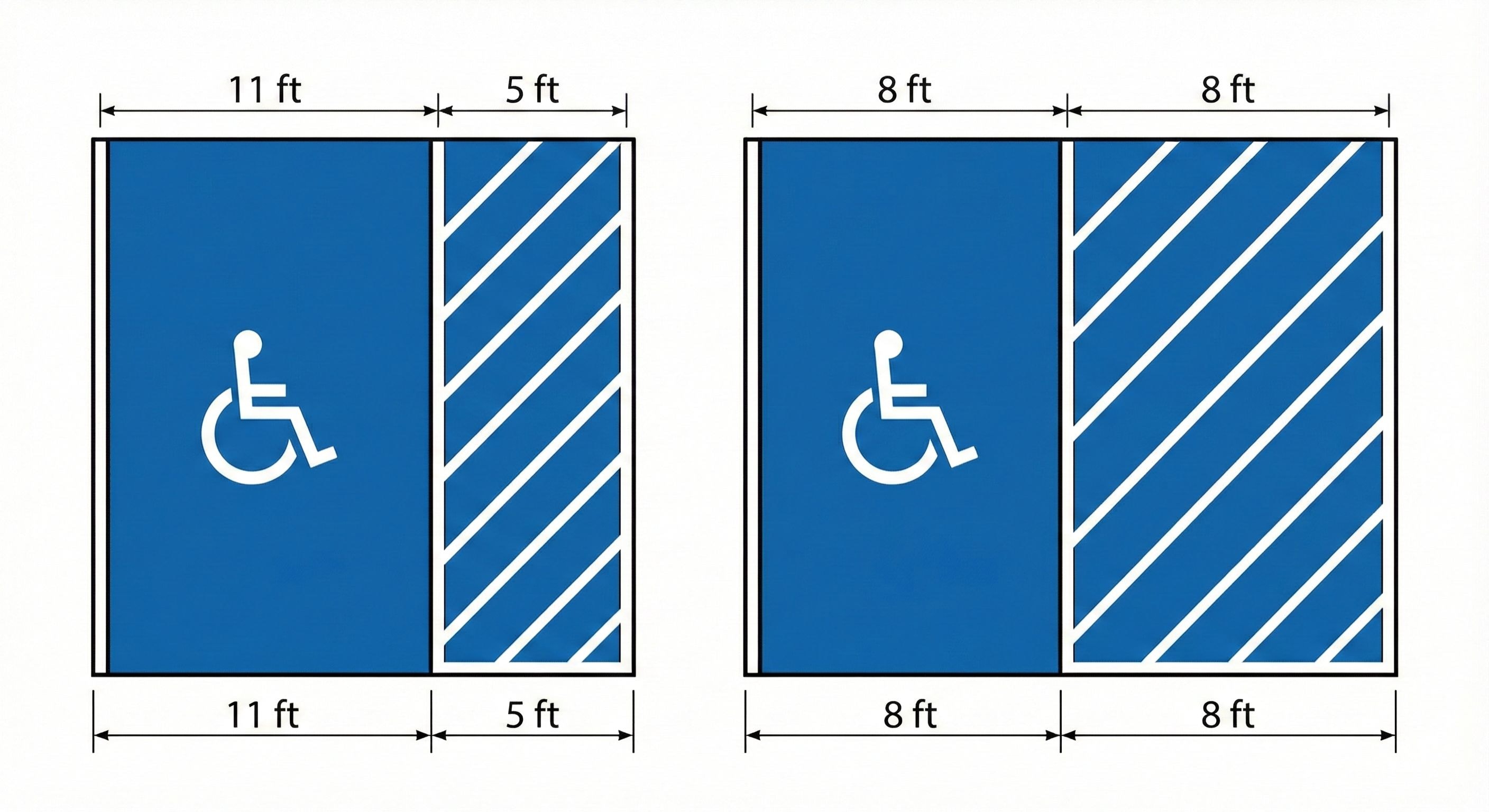
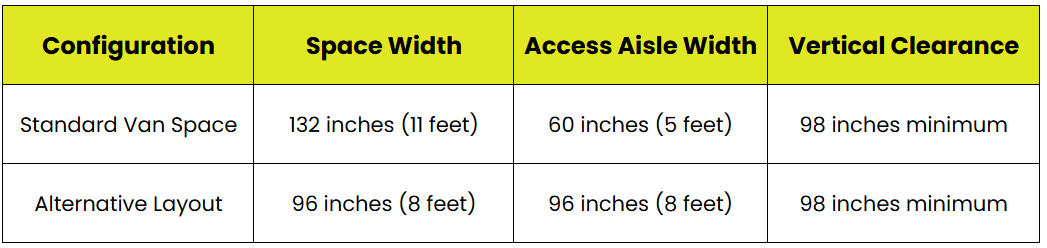
Property managers can choose either a parking stall that is at least 132 inches (11 feet) wide with an adjacent 60-inch (5-foot) access aisle, or a stall that is 96 inches (8 feet) wide with an adjoining 96-inch (8-foot) access aisle.
In both configurations, access aisles must be clearly marked with diagonal hatch marks to discourage parking and prevent other vehicles from blocking the ramp deployment area. These access aisles provide the clear floor space necessary for wheelchair users and people with mobility impairments to enter and exit their vehicles safely.
Vertical clearance is another critical requirement for van accessible spaces. Parking garages and parking structures must provide at least 98 inches of clearance along the entire vehicle route, the accessible parking space, access aisles, and the vehicular route to the exit.
Here is a quick reference table summarizing the dimensional requirements:
Do you need help designing or restriping ADA-compliant parking spaces? Bart’s Asphalt specializes in accessible parking layout and compliant striping for apartment complexes.
Request ADA Compliance Assessment
What Is an “Accessible Route” and Why Does It Matter?
An accessible route is a continuous, unobstructed path connecting accessible parking spaces to the accessible entrances they serve. The 2010 ADA Standards (Section 206) require this route to be at least 36 inches wide, have a firm, slip-resistant surface, and be free of snow, debris, and overhanging branches.
For locations where wheelchair users must pass each other or make turns, the route must widen to at least 60 inches to provide adequate clear floor space. The ADA does not specify a maximum length for the accessible route, but it must be the shortest accessible route to the entrance.
Property managers cannot require people with disabilities to take longer routes or detours that non-disabled individuals do not have to navigate. The route’s running slope cannot exceed 1:12 (approximately 5%), and the cross slope must be no more than 1:48 (about 2.08%) to ensure stability for wheelchair users and people with mobility aids.
The accessible route is a critical component of ADA compliance because it ensures that people with mobility impairments can safely travel from their vehicle into the apartment building. Curb ramps must be provided wherever the accessible route crosses a curb, with smooth transitions free of abrupt changes that could tip or trap wheelchair casters.
The route must also be maintained year-round, which means property managers must prioritize clearing snow and ice from accessible parking spaces, access aisles, and the connecting pathways during winter months.
For apartment complexes with multiple buildings, the accessible route must connect accessible parking spaces to accessible entrances using the shortest path available.
This ensures that residents and visitors do not face unnecessary barriers or longer travel distances simply because accessible parking spaces are located in some regions of the parking lot.
Where Must Accessible Parking Spaces Be Located?
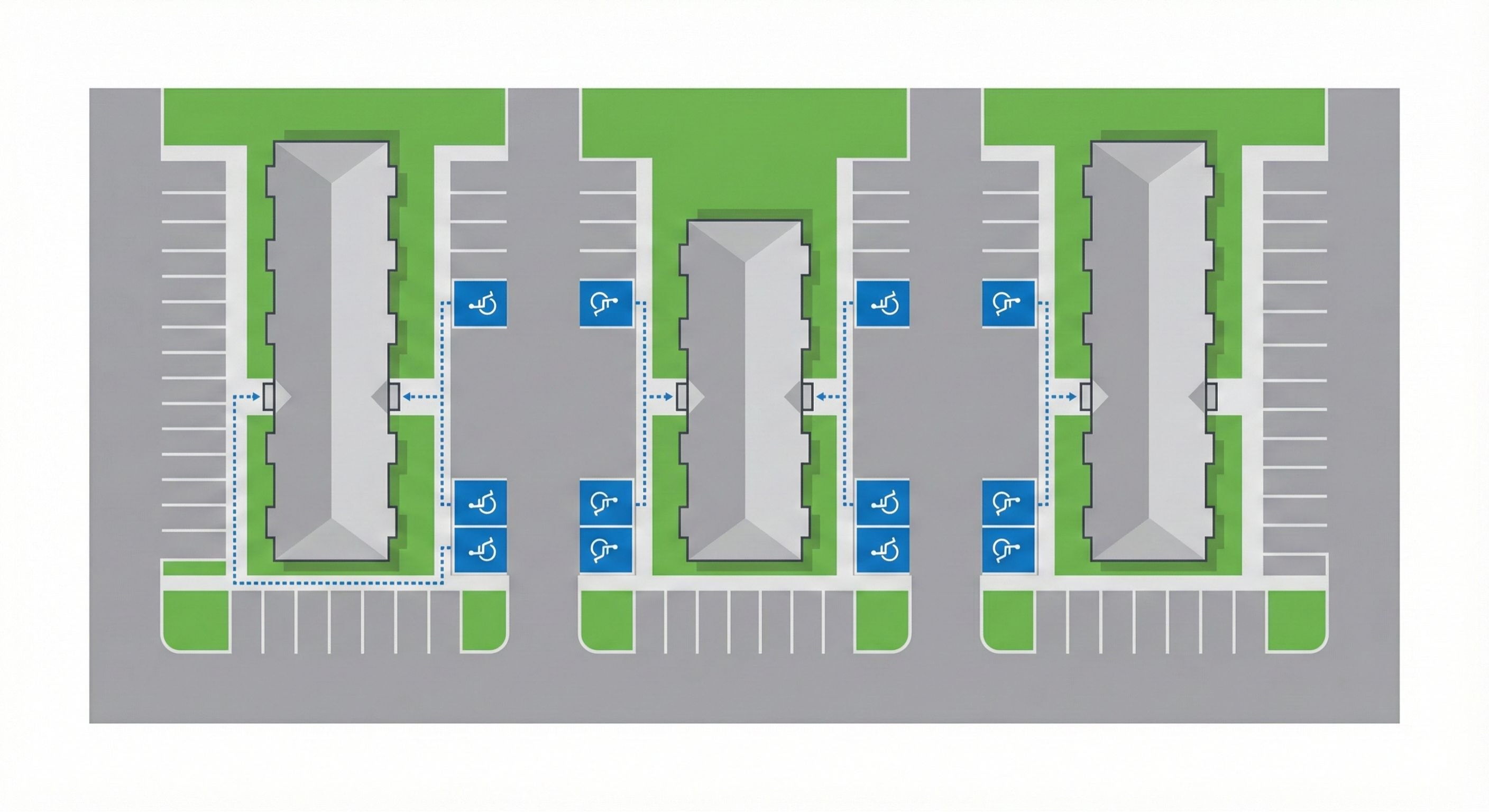
Accessible parking spaces must be located on the shortest accessible route to an accessible entrance of the facility they serve. The 2010 ADA Standards (Section 208.3.1) establish this requirement to minimize travel distance for people with disabilities.
For apartment complexes with multiple buildings, this means each building cluster should have its own calculation for accessible parking spaces, with spaces positioned near the entrances that residents and visitors use regularly.
The slope of the accessible route from parking spaces to accessible entrances cannot exceed 1:48 (2.08%). Slopes steeper than this can pose serious challenges for wheelchair users and people using mobility aids, making the route difficult or unsafe to navigate.
Property managers should carefully evaluate site grading and drainage patterns to ensure compliance with this requirement. For parking garages and parking structures, accessible spaces must be located on the level closest to the accessible entrance, ideally within 100 feet of that entrance.
This placement reduces travel distance and eliminates the need for people with disabilities to navigate multiple levels or complicated circulation paths. Security features, such as adequate lighting along the accessible route, enhance safety and provide peace of mind, particularly in covered garage parking areas.
Where parking facilities serve a particular building or entrance (such as surface parking designated for specific dwelling units), accessible parking spaces must be distributed among the separate parking facilities to ensure equitable access.
The ADA prohibits concentrating all accessible spaces in a single remote parking lot while leaving other parking areas without any accessible spaces. Site plans that visually map accessible parking locations, access aisles, the accessible route, and accessible entrances are invaluable tools for property managers.
These plans help demonstrate compliance during inspections and make it easier to communicate parking policies to residents and visitors. The plans should clearly show how parking spaces connect via the shortest accessible route to building entrances, laundry rooms, and other common areas residents need to access.
What Are the Rules for Accessible Parking Signs and Markings?

The 2010 ADA Standards (Section 502.6) require accessible parking spaces to be identified by signs displaying the International Symbol of Accessibility. These signs must be mounted at least 60 inches above the ground, measured to the bottom of the sign, to ensure visibility from a distance and prevent them from being obscured by parked vehicles.
Van-accessible spaces must include an additional designation, typically a separate sign reading “van-accessible,” to distinguish them from standard accessible spaces.
The International Symbol of Accessibility is the universal icon that marks all compliant accessible parking spaces at apartment buildings, commercial facilities, medical facilities, and other facilities covered by the Disabilities Act.
While the ADA Standards do not mandate a specific color (such as blue) for pavement markings, high-contrast colors improve visibility. Many state and local government jurisdictions require reflective blue backgrounds for signs to enhance visibility in low-light conditions.
Signs should be positioned directly in front of the accessible space or above the access aisle to clearly distinguish each space from standard parking. The placement ensures that drivers can quickly identify available accessible spaces, and the elevated mounting height prevents vehicles from blocking the sign’s visibility.
Access aisles must be marked with diagonal hatch marks or cross-hatching to discourage parking in these critical areas. These markings communicate that the access aisle is not a parking space but rather the clear floor space needed for wheelchair users and people with mobility devices to enter and exit vehicles.
Enforcement notices on signs, typically warning of fines ranging from $250 to $500 for unauthorized use, help protect accessible parking availability for people with disabilities. In apartment complexes, clear and authoritative signage helps maintain accessible parking and promotes respectful use of designated areas.
Property managers should regularly inspect signs for fading, damage, or obstruction, and replace or repair them as needed to maintain compliance with accessibility standards.
Ensure your property meets all ADA signage and marking requirements. Bart’s Asphalt provides professional parking lot striping with proper access aisle markings and compliant layouts.
What Are Access Aisles and How Wide Must They Be?
Access aisles are marked spaces adjacent to accessible parking spaces that provide the clear floor space necessary for people using wheelchairs, walkers, and other mobility devices to safely enter and exit their vehicles. The 2010 ADA Standards (Section 502.3) require access aisles to be at least 60 inches (5 feet) wide for standard accessible spaces.
For van-accessible spaces, access aisles can be 60 inches wide if the parking space is 132 inches wide, or 96 inches wide if using the alternative configuration with a 96-inch-wide parking stall.
Access aisles can be shared between two adjacent accessible parking spaces to maximize parking lot efficiency. When two spaces share an access aisle, the aisle must be positioned between the spaces and clearly marked to prevent vehicles from parking in this critical area.
The surface of access aisles must be stable, firm, and slip-resistant, providing confident footing and smooth wheelchair travel in all weather conditions. The slope of access aisles cannot exceed 1:48 (2.08%) in any direction. This gentle slope ensures stability for wheelchair users and prevents mobility aids from rolling unexpectedly.
Access aisles must be the same length as the parking spaces they serve and must connect to an accessible route leading to the accessible entrance. Diagonal hatch marks are the required marking pattern for access aisles. These visual cues clearly communicate that the space is not for parking but is instead the maneuvering area for people with disabilities.
Studies show that proper marking and consistent enforcement of access aisle restrictions reduce misuse by nearly 30%, keeping these spaces clear when residents and visitors need them most.
For parking garages and parking structures, access aisles must comply with the exact dimensional and slope requirements as surface parking. Property managers should ensure that garage lighting adequately illuminates access aisles to enhance visibility and safety, particularly during evening hours when residents return home.
Who Is Responsible for Maintaining Accessible Spaces?
Property managers and landlords are responsible for maintaining accessible parking spaces, access aisles, and the accessible route connecting these spaces to accessible entrances. The 2010 ADA Standards establish that maintenance obligations are ongoing, not one-time requirements.
Accessible parking is only as functional as its maintenance, and neglecting upkeep can result in ADA-related complaints, lawsuits, and fines totaling thousands of dollars per incident.
Regular maintenance ensures stable, smooth surfaces; visible markings; clear access aisles; and unobstructed routes that residents and visitors rely on daily. Research indicates that poor maintenance causes approximately 20% of ADA-related complaints in apartment communities.
Common maintenance failures include faded pavement markings, cracked or uneven surfaces, snow accumulation blocking access aisles, and debris obstructing the accessible route.
Property managers should implement a proactive maintenance schedule to prevent accessibility barriers:
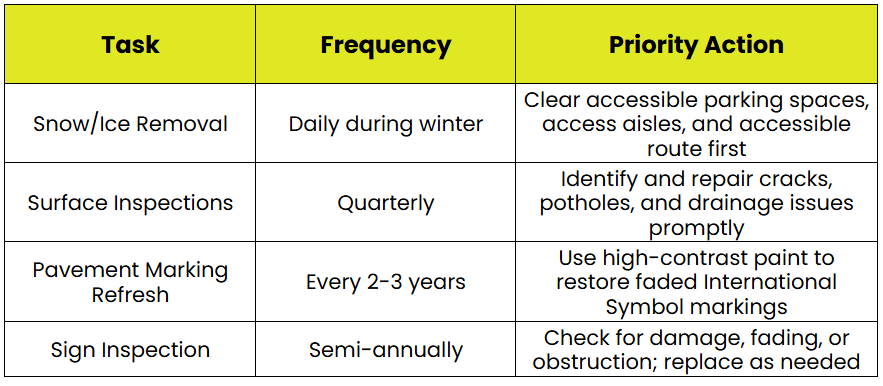
Snow and ice removal is a compulsory maintenance task during the winter months. Property managers must prioritize clearing accessible parking spaces, access aisles, and the accessible route before addressing other parking areas.
Allowing snow accumulation in these designated areas creates barriers that prevent people with mobility impairments from accessing their homes. Quarterly surface inspections help identify pavement deterioration early, including cracks, settling, or ponding water that could create tripping hazards or impede wheelchair travel.
Prompt repairs prevent minor issues from becoming significant accessibility barriers and extend the lifespan of parking areas. Refreshing pavement markings every 2-3 years maintains clear boundaries for accessible parking spaces and access aisles.
Faded markings contribute to unauthorized parking in accessible spaces and access aisles, reducing availability for people with disabilities. High-contrast paint improves visibility and reinforces the designated purpose of these spaces.
Don’t risk ADA violations due to poor maintenance. Partner with Bart’s Asphalt for regular inspections, surface repairs, and marking refresh services.
Get Your Free Maintenance Quote
Do Accessible Routes Need to Connect to Common Areas?
Yes, accessible routes must extend beyond parking areas to connect accessible parking spaces to all common areas and residential facilities that residents use.
The Fair Housing Act’s design and construction requirements (for buildings with four or more dwelling units built after March 13, 1991) mandate that accessible routes connect to public and everyday use areas within apartment complexes.
This includes laundry rooms, recreational facilities, mailbox areas, and building entrances serving covered dwelling units. For laundry rooms, the accessible route must provide sufficient clear floor space for wheelchair users to maneuver, typically requiring a turning radius of at least 60 inches.
Doorways along the accessible route must meet accessible reach ranges and door hardware requirements, ensuring that people with mobility impairments can independently open and pass through doors without assistance.
Swimming pools at apartment complexes must be equipped with pool lifts or other approved means of accessible entry, as required by the 2010 ADA Standards (Section 242). The accessible route must connect accessible parking spaces to the pool area, and the path must remain clear and well-maintained year-round.
Fitness centers and exercise facilities must feature accessible routes that are at least 36 inches wide, allowing wheelchair users to navigate between equipment. The route must provide adequate circulation space and turning areas for people with mobility devices to use the facilities comfortably.
For apartment buildings with one or more elevators, the accessible route must connect accessible parking spaces to the elevators, which in turn provide access to dwelling units on upper floors.
Ground floor units in buildings without elevators must still be connected to accessible parking via an accessible route that meets all dimensional and surface requirements.
Common areas like community rooms, business centers, and package delivery areas must also be connected to accessible parking spaces via accessible routes. These connections ensure that residents with disabilities can fully participate in community life and access all amenities without encountering architectural barriers.
Site plans showing how accessible routes extend from accessible parking spaces throughout the property help property managers visualize compliance and identify accessibility gaps. These plans are also valuable during inspections by local government officials or when responding to reasonable accommodations requests from residents.
What Is the Difference Between ADA and FHA Parking Rules?
A common source of confusion for property managers is

understanding the difference between the Americans with Disabilities Act (ADA) and the Fair Housing Act (FHA) and how each law applies to parking at apartment complexes.
The ADA’s Title III requirements apply to public accommodations, which at an apartment complex typically include the leasing office, clubhouse, visitor parking areas, and any facilities open to prospective tenants. The parking spaces and residential facilities designated for current residents (tenants) are primarily governed by the Fair Housing Act.
The Fair Housing Act (42 U.S.C. 3604) establishes two key requirements for multifamily housing. First, for new construction, apartment buildings with four or more dwelling units, constructed for first occupancy after March 13, 1991, must have at least 2% of parking spaces accessible to covered dwelling units.
These are dwelling units required to have accessible features, including ground-floor units in buildings without elevators and all units in buildings with one or more elevators.
Second, the Fair Housing Act requires housing providers to grant reasonable accommodations to residents with disabilities.
This means a tenant can request that a specific accessible parking space be reserved exclusively for their use and positioned near their dwelling unit, even if the apartment complex maintains a first-come, first-served parking policy.
Property managers must grant such requests unless doing so would create an undue financial or administrative burden or fundamentally alter the nature of the housing.
For example, suppose a resident with mobility impairments requests an accessible parking space closer to their apartment entrance. In that case, the property manager must evaluate whether creating or designating such a space is reasonable.
The FHA’s reasonable accommodations requirement often extends beyond the ADA’s minimum standards, potentially requiring property managers to provide more accessible parking spaces than the ADA prescribes for public accommodations.
State and local government regulations may impose additional requirements. Some jurisdictions require a higher percentage of accessible spaces in residential facilities or establish specific rules for parking garages at apartment buildings.
Property managers must comply with whichever standard, federal ADA, federal FHA, or local law, is most protective of people with disabilities.
Understanding the distinction between ADA and FHA requirements helps property managers correctly allocate accessible parking spaces between visitor parking (governed by ADA) and resident parking (governed by FHA), while also preparing to respond appropriately to reasonable accommodations requests.
Do Local Laws Change ADA Parking Requirements?
Yes, state and local government regulations frequently add requirements beyond the federal ADA standards, and property managers must comply with whichever standard is most stringent.
The 2010 ADA Standards establish the federal baseline for accessible parking spaces at commercial facilities, public accommodations, and other covered facilities under the ADA. However, local laws governing residential facilities and apartment buildings may mandate additional accessible spaces or impose stricter design requirements.
For example, New York State requires that at least 5% of parking spaces at multifamily housing developments be accessible, exceeding the ADA’s scaling ratio for many facility sizes.
California’s Assembly Bill 434 mandates additional van-accessible spaces specifically for senior housing facilities, recognizing the higher proportion of residents who may need wheelchair-accessible vehicles.
Local government jurisdictions may also establish specific requirements for parking garages, parking structures, and surface parking at apartment complexes. Some cities require wider access aisles than the federal minimum, additional vertical clearance in covered parking, or enhanced lighting and security features along accessible routes.
Property managers should consult with local building departments and accessibility offices to identify applicable state and local regulations. Many jurisdictions publish compliance guides specific to multifamily housing that outline how local requirements interact with federal ADA standards.
Conducting dual-compliance audits, checking both federal ADA standards and local codes, helps ensure full compliance and reduces the risk of violations.
The 2025 enforcement landscape shows a 15% increase in local government audits focused on accessible parking at apartment complexes. These audits examine not only the number of accessible parking spaces provided but also the quality of signage, the condition of access aisles and accessible routes, and the adequacy of maintenance practices.
Property managers who proactively address both federal and local requirements are better positioned to pass these inspections and avoid costly retrofits.
Some jurisdictions maintain dedicated ADA resource websites featuring guidance documents, training materials, and technical assistance for property managers. Leveraging these resources simplifies navigating the complex intersection of federal ADA requirements, Fair Housing Act obligations, and local accessibility standards.
How Can a Property Manager Ensure Full Compliance?
Ensuring complete compliance with the ADA and the Fair Housing Act at apartment complexes requires a proactive strategy that combines regular maintenance, professional audits, staff training, and responsive accommodation procedures.
Property managers should begin by conducting a comprehensive accessibility assessment of all parking facilities: surface, garage, and parking structures, to identify gaps in the number of accessible parking spaces, signage, access aisles, or accessible routes.
Hiring certified ADA consultants or accessibility specialists provides an expert evaluation of compliance with both the ADA standards and the Fair Housing Act design and construction requirements. These professionals can identify risks before they become violations and provide detailed recommendations for correcting deficiencies.
Many consultants offer ongoing monitoring services to help property managers stay up to date with evolving accessibility standards and enforcement priorities. Implementing a systematic maintenance program is essential for keeping accessible parking spaces functional year-round.
This program should prioritize snow removal from accessible parking spaces and access aisles, quarterly inspections of pavement surfaces and markings, and semi-annual reviews of signage displaying the International Symbol of Accessibility.
Property managers should document all maintenance activities to demonstrate ongoing compliance efforts during inspections or in response to complaints.
Staff training ensures that leasing agents, maintenance personnel, and property management teams understand both ADA requirements for public accommodations (such as the leasing office and visitor parking) and Fair Housing Act obligations regarding reasonable accommodations for residents.
Training should cover how to respond to accommodation requests, how to identify accessibility barriers, and the importance of prioritizing maintenance of accessible parking spaces and accessible routes. Technology tools can streamline compliance management.
Mobile apps designed for accessibility inspections allow maintenance staff to document conditions, photograph deficiencies, and track repairs in real time. These tools create auditable records that demonstrate a property manager’s commitment to maintaining accessible design.
Responding promptly to reasonable accommodation requests is a critical Fair Housing Act obligation. When a resident with mobility impairments requests a reserved accessible parking space near their dwelling unit, property managers should evaluate the request promptly and grant it unless doing so would create an undue burden.
Documentation of the accommodation process protects both the resident’s rights and the property manager’s compliance efforts. Property managers should also develop relationships with local disability advocacy organizations and accessibility consultants who can guide best practices.
These relationships demonstrate a commitment to accessibility that extends beyond minimum legal requirements and helps create apartment communities where people with disabilities feel genuinely welcome.
The return on investment for proactive ADA compliance includes reduced legal risk, higher occupancy rates (studies show well-designed accessible housing can increase occupancy by approximately 5%), longer resident retention, and enhanced property reputation.
Accessible design benefits all residents, not just those with disabilities, by creating safer, more navigable parking areas and building entrances.
Property managers ready to strengthen their compliance programs should schedule a professional ADA assessment, review their maintenance protocols, train staff on accessibility requirements, and establish a system for tracking and responding to reasonable accommodations requests.
Protect your property from ADA complaints and ensure accessibility for all residents. Contact Bart’s Asphalt for expert parking lot design, striping, and maintenance services that meet all federal and local requirements.
Frequently Asked Questions About ADA Parking at Apartments
Navigating ADA parking requirements at apartment complexes can be complex for both residents and property managers. This section answers the most frequently asked questions to help clarify the rules and ensure accessible parking for all.
What is the difference between ADA and FHA parking rules for apartments?
The ADA (Title III) applies to public accommodations at apartment complexes, including leasing offices, clubhouses, and visitor parking. The Fair Housing Act (FHA) governs residential facilities and parking for current residents (tenants).
The FHA requires at least 2% of parking spaces serving covered dwelling units to be accessible and mandates that property managers grant reasonable accommodations, such as reserved accessible parking spaces near a resident’s unit.
Does my apartment have to give me a reserved handicap spot?
Under the Fair Housing Act, residents with disabilities can request reasonable accommodations, including a reserved accessible parking space explicitly designated for their use and located near their dwelling unit.
Property managers must grant such requests unless doing so would create an undue financial or administrative burden or fundamentally alter the housing program. If you have mobility impairments and need a reserved space, submit a written reasonable accommodations request to your property manager explaining your disability-related need.
Can my landlord charge me for an accessible parking space?
Generally, no. Suppose you are requesting an accessible parking space as a reasonable accommodation under the Fair Housing Act due to a disability. In that case, the landlord cannot charge an additional fee for providing the accommodation. However, if all residents pay for parking spaces, the landlord may charge the same fee they charge other residents.
The landlord cannot impose a surcharge specifically because the space is accessible or because you have a disability.
Are older apartment buildings exempt from accessible parking rules?
Older apartment buildings are not exempt from the Fair Housing Act’s reasonable accommodations requirement.
Even if a building was constructed before the 1991 effective date of the FHA’s design and construction requirements (which mandate accessible features in new construction), landlords must still provide reasonable accommodations to residents with disabilities.
This may include creating accessible parking spaces, installing curb ramps along accessible routes, or designating spaces closer to accessible entrances.
The ADA’s requirements for public accommodations (such as leasing offices) apply regardless of building age. However, some flexibility may be available for alterations that are not readily achievable in historic properties.
How many accessible parking spaces are required for medical facilities?
Medical facilities, including hospital outpatient facilities, outpatient physical therapy facilities, and rehabilitation facilities, follow the same ADA-accessible parking spaces table as other facilities, but also have additional requirements.
For outpatient physical therapy facilities and hospital outpatient facilities that specialize in treating mobility impairments, 20% of the total parking spaces provided must be accessible (rather than following the standard scaling ratios).
This higher percentage ensures adequate accessible parking for patients with disabilities who regularly visit these medical facilities. At least one out of every six accessible parking spaces must be van accessible.
What about parking at commercial facilities versus residential facilities?
Commercial facilities (retail stores, restaurants, office buildings) must comply with ADA Title III requirements for the number of accessible parking spaces, based on the total number of parking spaces provided.
Residential facilities (apartment buildings, condominiums) are primarily governed by the Fair Housing Act, which requires 2% of parking spaces serving covered dwelling units to be accessible and mandates reasonable accommodations for residents with disabilities.
Some apartment complexes have both residential and commercial components (e.g., ground-floor retail space); in these mixed-use properties, parking must be evaluated separately for each use to determine compliance with the applicable law.
Do parking requirements differ for law enforcement vehicles or delivery vehicles?
Standard accessible parking requirements do not apply to parking areas designated exclusively for law enforcement vehicles, delivery vehicles, or vehicular impound facilities. These are considered specialized parking areas that serve operational rather than public accommodation purposes.
However, a facility provides both public parking and spaces for law enforcement or delivery vehicles. In that case, the publicly accessible parking areas must include the required number of accessible parking spaces, based on the total number of parking spaces in those areas.