
Commercial asphalt paving in Southeast Michigan typically costs between $2.50 and $4.50 per square foot for straightforward installation with proper base preparation. For lots requiring full-depth reconstruction due to failing subgrades or severe freeze-thaw damage, costs range from $6.00 to $10.00 per square foot.
For commercial parking lots in Southeast Michigan, the honest planning range is $2.50–$4.50 per square foot for straightforward new asphalt paving with proper base preparation, with the statewide Michigan average sitting around $3.11 per square foot based on 2024–2025 market data.
This guide provides exact 2026 cost engineering for facilities directors, answering critical questions including:
- Why is it so hard to find accurate commercial paving costs online?
- What are the typical commercial asphalt paving costs in Michigan?
- Should you choose new construction, overlays, or repairs?
- Which Michigan-specific climate factors affect your final price?
Key Takeaways
- Commercial parking lot paving in Southeast Michigan typically runs $2.50–$4.50 per square foot, with the statewide installed average around $3.11/sq ft (range $2.43–$3.79) based on 2024–2025 reports.
- Small commercial lots under 1,000 sq ft often cost $3,000–$8,000 total, while larger lots around 10,000 sq ft can run $25,000–$50,000+, depending on base prep and drainage requirements.
- Michigan’s freeze–thaw cycles from November through April, and heavy road salt use are major hidden cost drivers that generic national guides routinely ignore.
- Commercial asphalt projects in Michigan range from simple 2-inch overlays (~$1.43/sq ft) to full-depth reconstruction ($6–$10/sq ft), depending on the condition of the existing surface.
- Prices in 2026 are under upward pressure from oil volatility, labor shortages, and rising material costs — treat online ranges as planning numbers and get a custom estimate from a local commercial specialist.
Why Is It So Hard to Find Accurate Commercial Asphalt Paving Costs Online?
“Property managers frequently receive commercial paving bids with price variances exceeding $40,000 for the exact same parking lot.
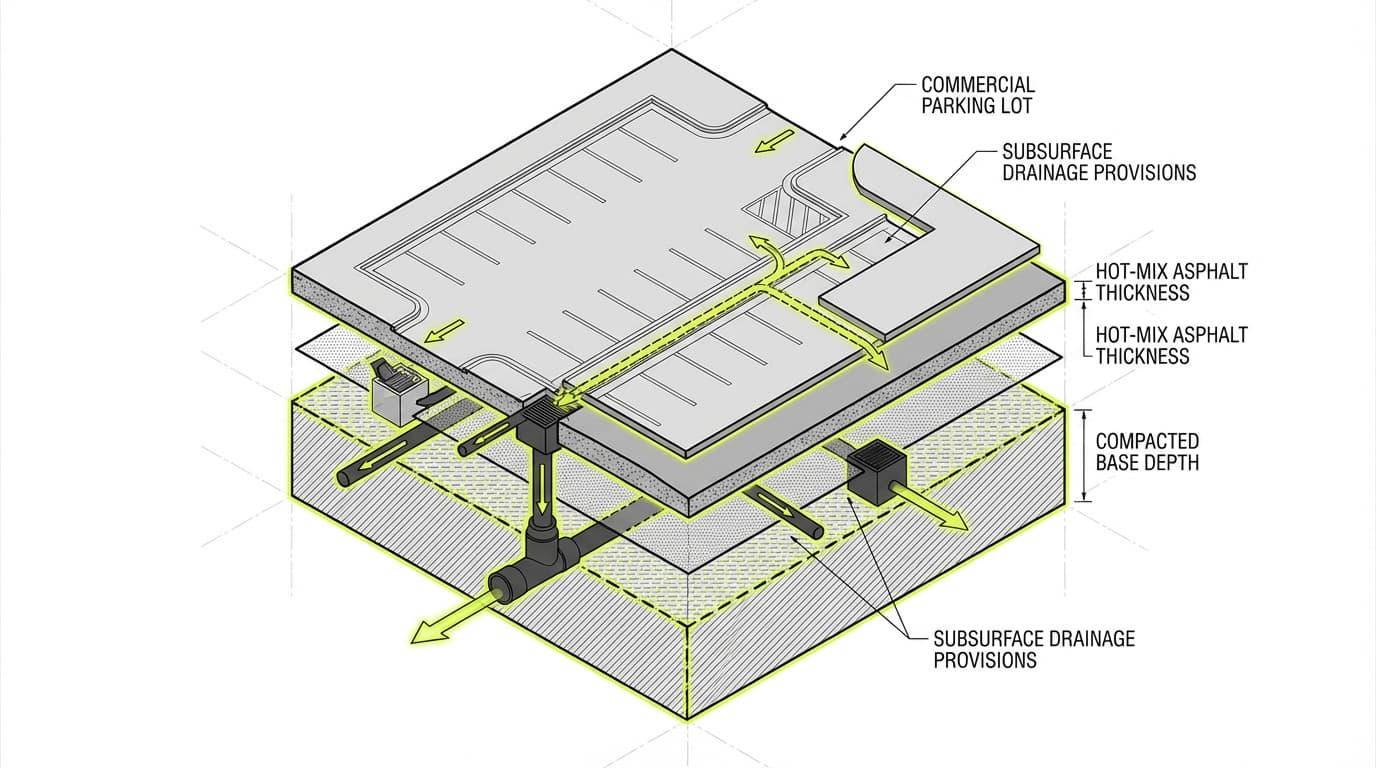
These massive discrepancies occur because contractors alter the underlying engineering line items—specifically the compacted base depth, the hot-mix asphalt thickness, and the subsurface drainage provisions.
Without comparing these specific structural elements line-by-line, a lower initial bid often results in a pavement failure within three Michigan winters, doubling the total cost of ownership.
The answer lives in the line items, not the bottom number. Base depth. Asphalt thickness. Drainage provisions. How much — or how little — each contractor has accounted for Michigan’s freeze-thaw season. Two bids can cover the same square footage and produce completely different lots, with completely different lifespans.
For commercial parking lots in the Jackson–Lansing–Ann Arbor–Kalamazoo corridor, straightforward paving with proper base preparation runs $2.50–$4.50 per square foot, with the statewide Michigan average around $3.11 per square foot based on 2024–2025 market data. Full-depth reconstruction on neglected surfaces reaches $6–$10 per square foot.
This guide walks through what moves that number — site conditions, base depth, Michigan climate requirements, project type — so you can evaluate bids accurately and avoid overpaying or underbuilding.
If you already know your lot size and you’re ready for a real number, Bart’s Asphalt turns around line-item commercial estimates within 24 hours of a site visit.
Get My Free Site-Specific Estimate Today!
What Are the Typical Commercial Asphalt Paving Costs in Michigan for 2026?
All figures below come from recent Michigan market data and third-party cost reports. They’re intended for budgeting purposes — not as quotes. Your actual project costs will depend on site conditions, scope, and when you break ground.
Example Total Project Costs:
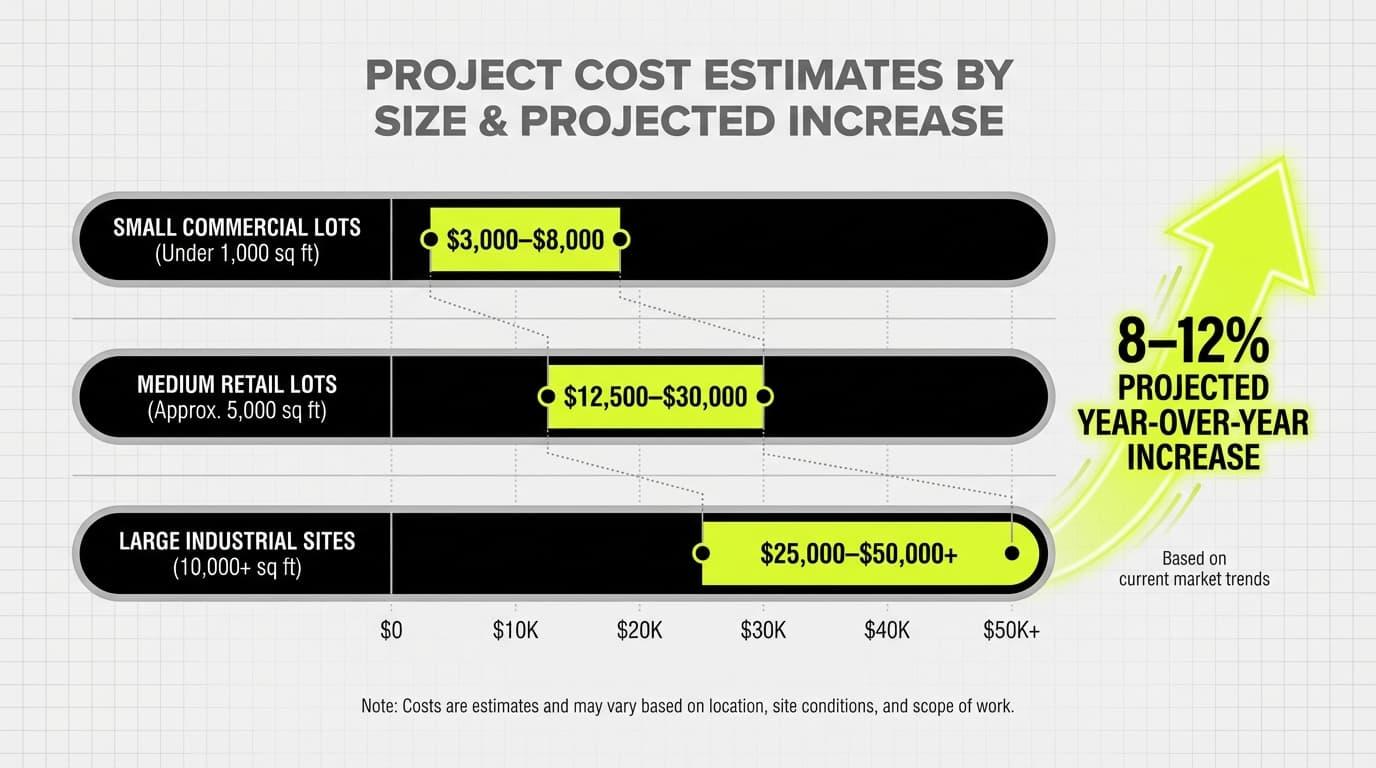
- Small Commercial Lots (Under 1,000 sq ft): Expected total cost of $3,000–$8,000. These projects, such as small office entrances, carry a higher per-square-foot cost due to minimum mobilization fees.”
- Medium Retail Lots (Approx. 5,000 sq ft): Expected total cost of $12,500–$30,000. Pricing varies between $2.50–$6.00/sq ft depending strictly on the required base preparation.”
- Large Industrial Sites (10,000+ sq ft): Expected total cost of $25,000–$50,000+. These layouts benefit from economies of scale, driving the baseline cost closer to $2.50–$5.00/sq ft.
When you’re looking at full-depth reconstruction with complete base replacement — the kind needed for lots with decades of neglect, alligator cracking, or major rutting — costs can reach $6–$10 per square foot. Michigan commercial projects fall into the same range when subbase failure, poor drainage, or 20–30 years of deferred maintenance are involved.
When finalizing 2026 capital budgets, facilities directors must account for rising petroleum indexes and regional labor shortages. According to 2025 construction materials tracking by the National Asphalt Pavement Association (NAPA), Midwest commercial paving costs are projected to experience an 8–12% year-over-year increase, requiring at least a 10% contingency line item.
See where your property falls in these ranges. Bart’s Asphalt provides detailed cost breakdowns for commercial lots across Southeast Michigan — no vague ballpark figures.
Get My Free Site-Specific Estimate Today!
New Asphalt vs. Overlay vs. Repair: What You’ll Actually Pay For?
When commercial property managers ask about asphalt paving costs, they’re usually asking about one of three distinct project types. Each has its own cost structure, and understanding which applies to your situation is the first step toward accurate budgeting.
New Construction as a Full-Depth Solution
Building a new facility or converting an existing gravel lot to a paved surface means starting from scratch. This typically requires excavation and soil preparation, 6–12 inches of compacted aggregate base (essential for Michigan’s frost depth), and 2–4+ inches of hot mix asphalt in one or more lifts.
Material and labor costs for new construction generally run in the upper half of the $2.50–$4.50/sq ft range. When soil correction, underdrains, and complex grading are required, you can reach $6–$10 per square foot — especially on sites with poor native soils or challenging drainage.
Milling and Overlay for Surface-Level Corrections
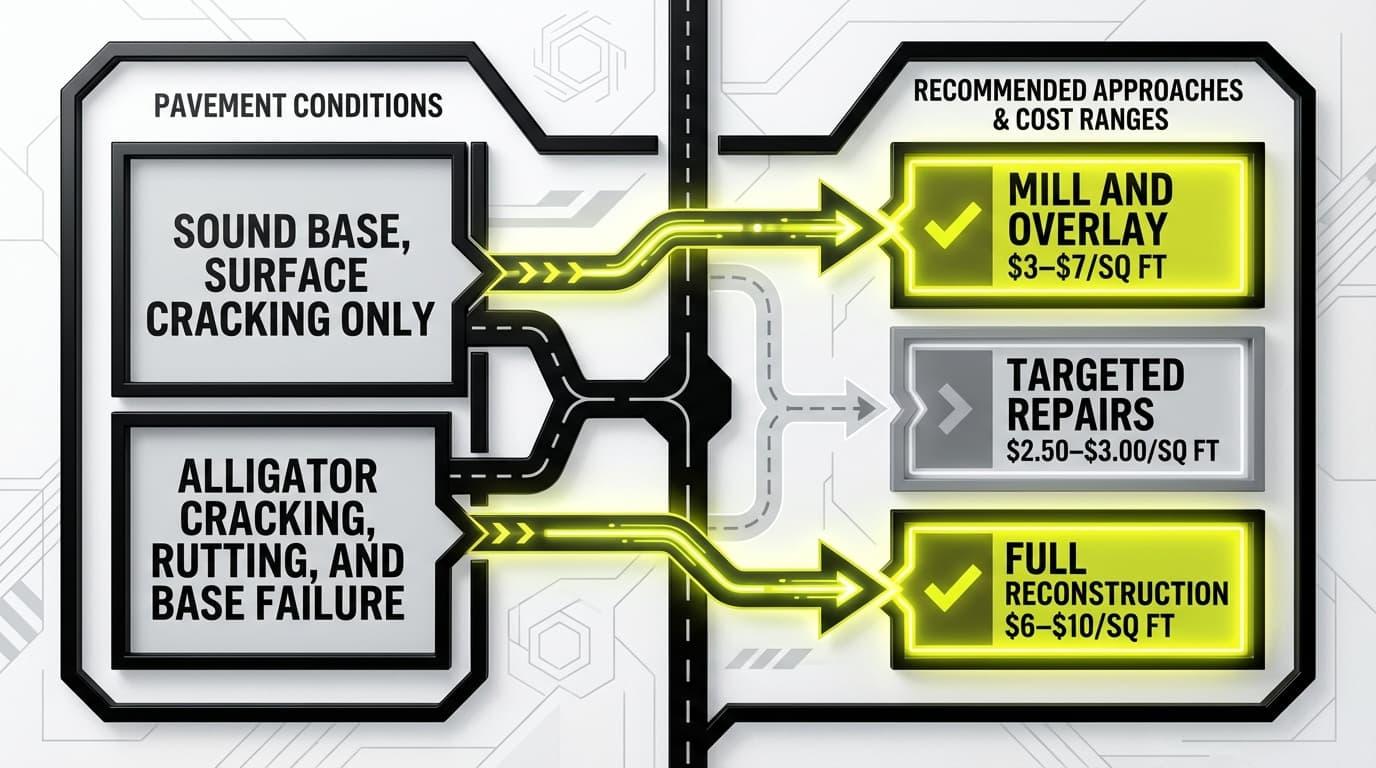
If your existing surface has surface-level cracking but the underlying base is structurally sound, an asphalt overlay after milling can extend the pavement’s life at significantly lower cost than full reconstruction.
- Milling the old asphalt layer typically runs around $1.43/sq ft
- New asphalt surface installation adds $1.50–$4.00/sq ft, depending on thickness
- Combined total: roughly $3–$7/sq ft
This approach works well when the base remains stable and drainage is adequate. It’s not appropriate for lots with widespread base failure.
Targeted Patching for Isolated Pavement Damage
For addressing isolated problem areas — potholes, small cracks, localized base failures — patching and repair work averages roughly $2.75 per square foot in Michigan (range $2.50–$3.00). Small patches often trigger minimum mobilization charges, which can make the effective cost per square foot higher on small jobs.
When Each Option Makes Sense
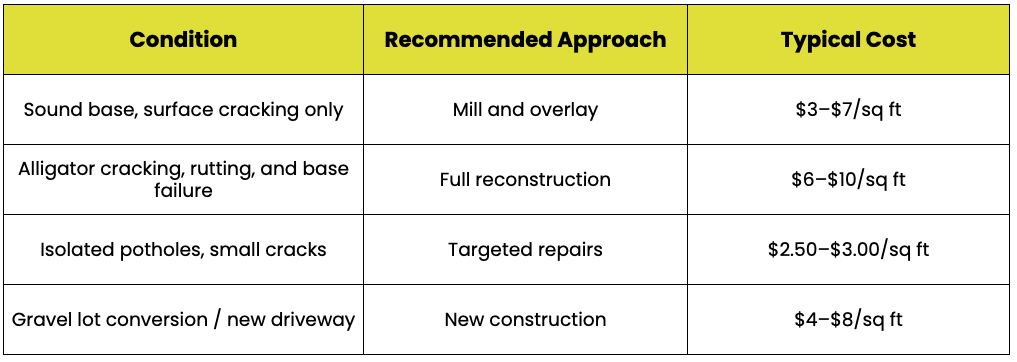
The key insight for Michigan property managers: spending more for proper base work and a thicker asphalt layer upfront often avoids paying twice after 2–3 winters of freeze-thaw cycles. A cheap overlay over a failing base is money wasted.
Not sure whether your lot needs an overlay or a full rebuild? At Bart’s Asphalt, we perform structural and drainage assessments before recommending any approach.
Get My Free Site-Specific Estimate Today!
Which Michigan-Specific Climate Factors Affect Your Asphalt Paving Cost?
Generic national cost calculators assume you’re paving in a temperate climate with stable soils and minimal freeze exposure. Michigan’s reality is different, and local commercial expertise exists specifically because of these differences.
Here’s what moves asphalt costs in Southeast Michigan that national guides routinely ignore:
The Impact of Michigan Freeze-Thaw Cycles on Pavement
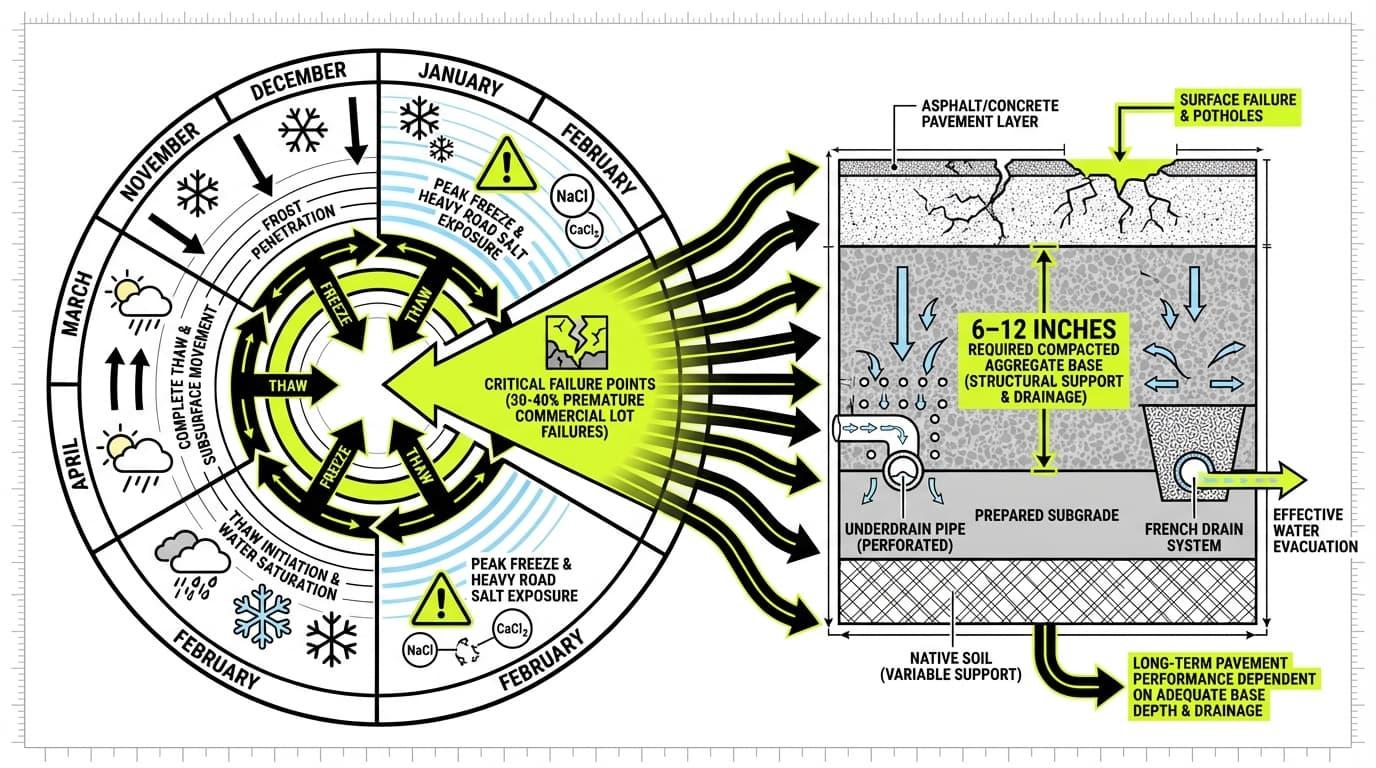
From roughly November through April, Southeast Michigan experiences relentless freeze–thaw swings. Water seeps into small cracks, freezes, expands, and upheaves pavement. This cycle repeats dozens of times per winter, and asphalt surfaces take the full brunt of it.
The practical implication: Michigan commercial lots require thicker, well-compacted bases to prevent frost heave and cracking. Skimping on site preparation — which some low-bid asphalt contractors do — results in premature failure within 2–3 winters. The repair costs to fix those failures far exceed any savings from cutting corners.
Compacted Aggregate Base Depth Requirements
Typical Michigan commercial specifications call for 6–12 inches of compacted aggregate base, depending on soil conditions and expected vehicle traffic. This is substantially more than what’s required in states without freezing temperatures, and it adds 20–50% to site preparation costs compared to warmer climates.
Chemical Degradation from Heavy Road Salt Exposure
Heavy salting accelerates asphalt surface degradation by chemically attacking binders. Asphalt pavement holds up well when properly sealed, but high-traffic salted entries and drive lanes may require a thicker layer of 3–4 inches instead of 2, higher-performance hot mix asphalt, and more frequent sealcoating to maintain a good surface.
Cross-Slope Drainage Engineering Necessities
Poor drainage is responsible for 30–40% of premature commercial lot failures in the Midwest. Water pooling on the paved surface or infiltrating the base causes erosion and accelerates freeze-thaw damage.
Proper cross-slope (1–2% minimum), catch basins, and underdrains are critical in Michigan. These add to project costs but prevent rework that runs 2–3x the original installation cost.
Local Plant And Contractor Access
Southeast Michigan’s network of asphalt plants and commercial paving crews can actually work in your favor. Local sourcing means hot-mix asphalt arrives at optimal compaction temperatures, and reduced trucking distances translate into lower material costs compared to out-of-area providers.
2026 Price Pressures
Oil price volatility, increased construction demand, and labor shortages are pushing Midwest asphalt costs upward. Regional asphalt contractors report 5–15% increases. Treat older online ranges as baseline numbers, not guarantees, and factor in a contingency when setting your capital budget.
Michigan’s freeze-thaw cycles and road salt change everything about how a lot should be designed and priced. Bart’s Asphalt builds commercial specs for Southeast Michigan — not generic one-size-fits-all sections.
Get My Free Site-Specific Estimate Today
Commercial vs. Residential Asphalt Costs (And Why Guides Disagree)
If you’ve spent any time researching asphalt paving online, you’ve noticed the estimates vary wildly. One source says $3 per square foot; another says $15. Understanding why helps you filter out irrelevant data fast.
Variances in Material and Labor Scope
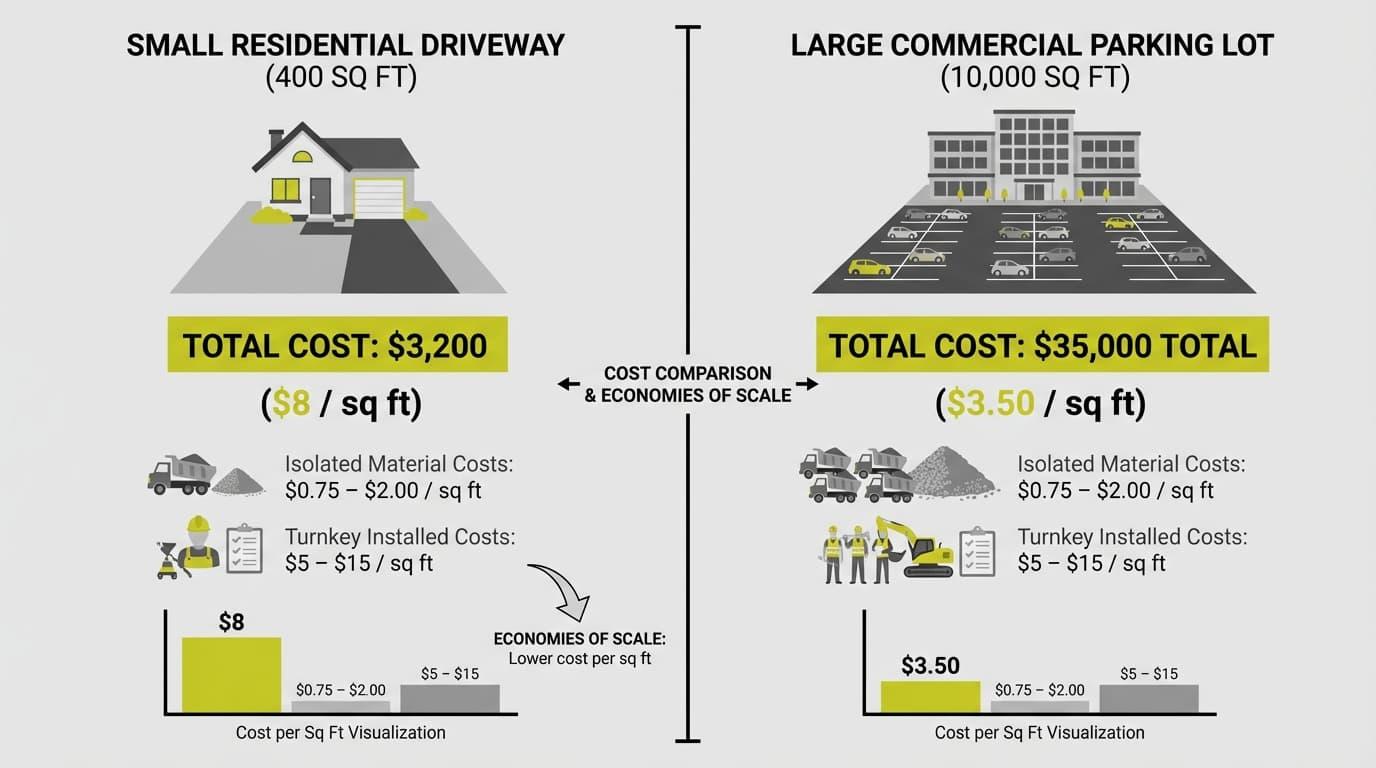
Online cost discrepancies occur because residential estimators often quote isolated material costs ($0.75–$2.00/sq ft for hot mix asphalt), whereas commercial contractors quote turnkey installed costs ($5–$15/sq ft).
A commercial turnkey quote comprehensively bundles labor, heavy equipment mobilization, full-depth demolition, aggregate base engineering, and ADA-compliant striping
Material costs alone tell you very little about total cost. The material and labor costs for a commercial lot include specialized equipment, skilled crews, proper compaction, and engineering — none of which show up in a materials-only quote.
The Impact of Mobilization Costs on Project Scale
Small residential driveways have disproportionately high costs per square foot because mobilization and setup costs get spread across fewer square feet, smaller equipment is less efficient, and contractor overhead is fixed regardless of driveway size.
Large commercial lots benefit from economies of scale. A 10,000 square foot lot might cost $35,000 total ($3.50/sq ft), while a 400 square foot asphalt driveway installation might cost $3,200 ($8/sq ft). The total cost is much higher for the commercial lot, but the cost per square foot is considerably lower.
Heavy-Duty Structural Requirements for Commercial Traffic
Commercial lots in Michigan must handle delivery trucks, garbage trucks, snow plows, and high-turn movements. This demands a thicker asphalt layer — often 3–4 inches versus 2 inches for residential driveways — heavier-duty base preparation, and more robust drainage systems. These requirements add to project costs, but they’re non-negotiable for parking lots that need to last.
A Baseline Framework for Property Managers
Residential guides work fine for homeowners planning a new asphalt driveway. Commercial property managers in Southeast Michigan should focus on local parking-lot-specific ranges: $2.50–$4.50/sq ft as a baseline, scaling upward for complex work, poor soils, or heavy vehicle traffic.
Conflicting numbers online are normal. The only real way to resolve them is a site-specific evaluation by a local asphalt paving company that understands commercial work.
How Does Commercial Asphalt Compare to Other Paving Materials in Michigan?
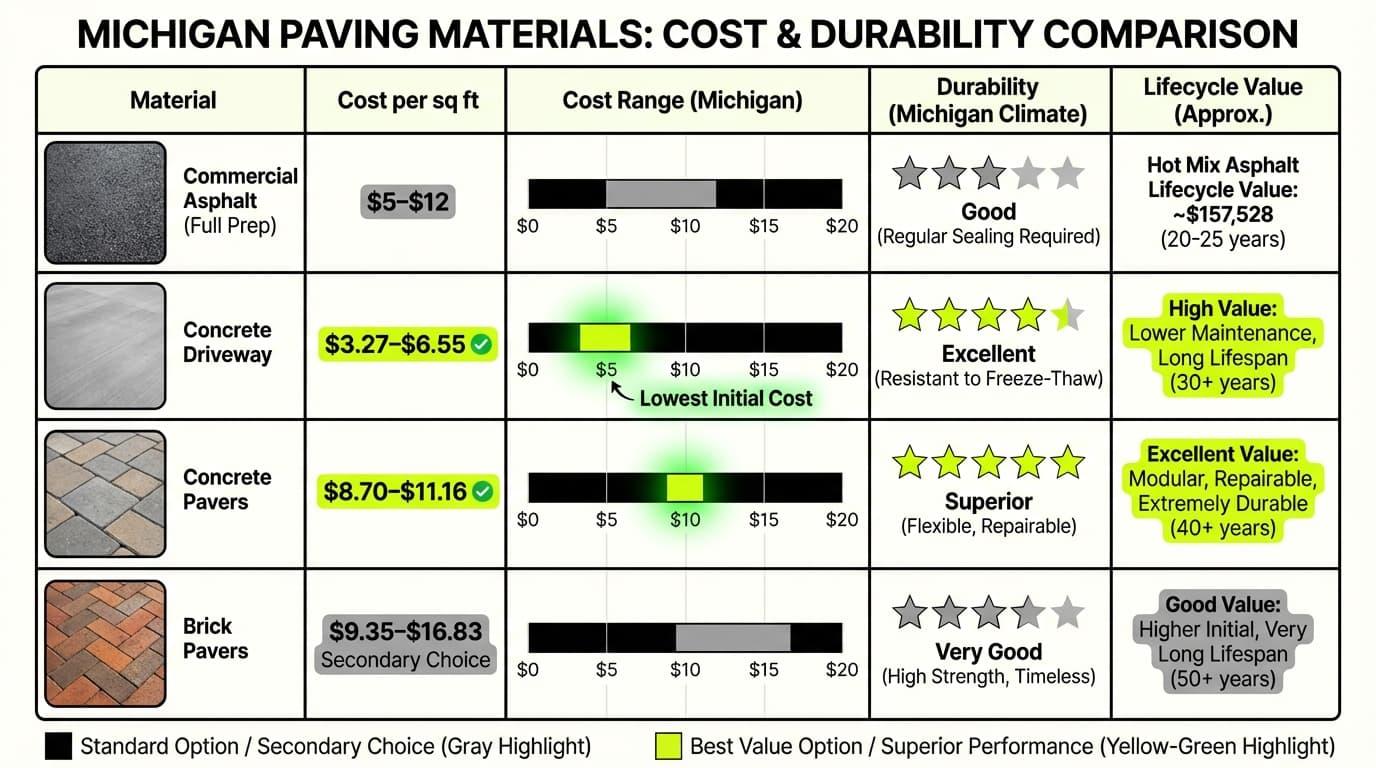
Comparing driveway materials helps justify budget decisions and informs lifecycle planning for Michigan properties. Here’s how asphalt pavement stacks up against the alternatives using Michigan-specific pricing.
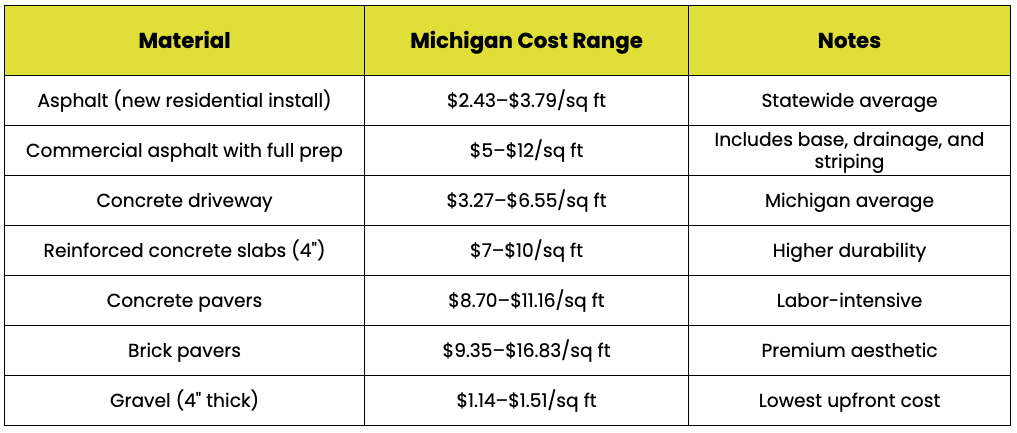
Why Gravel Isn’t The Bargain It Seems
Gravel’s low upfront cost is appealing, but for commercial properties, it creates ongoing headaches: dust, debris tracking into buildings, erosion, and constant regrading. The promise of minimal maintenance doesn’t hold up under real vehicle traffic.
Asphalt Vs. Concrete In Michigan
Concrete surfaces can last 25–30 years in temperate climates, but Michigan’s freeze-thaw cycles and road salt create serious problems. Concrete cracks and spalls under frost heave, repairs (slab jacking at $4–$5/sq ft, or complete replacement) are expensive, and salt accelerates concrete deterioration more aggressively than it does asphalt surfaces.
Asphalt pavement offers flexibility that concrete lacks. It handles freeze-thaw movement better, is far easier to repair, and sealcoating addresses salt and UV damage at low cost.
Lifecycle Value
Based on 2023 life cycle cost analyses highlighted by the Asphalt Pavement Association of Michigan (APA-MI), hot mix asphalt costs approximately $157,528, while that data applies to roadways, the same principles apply to commercial parking lots: asphalt delivers better value over time with proper maintenance.
For most Southeast Michigan commercial parking lots, asphalt remains the best balance of upfront cost, durability, and long-term value compared to concrete driveways, concrete surfaces, or brick pavers. See what a properly designed asphalt project looks like for your property.
Get My Free Site-Specific Estimate Today
Which Specific Line Items Drive Your Final Commercial Paving Price?
Two lots of the same square footage can have dramatically different final costs depending on what’s underneath and how the site functions. Here’s what a commercial estimator evaluates:
Square Footage And Layout
Complex parking lot layouts require highly manual, time-intensive labor that increases the total per-square-foot cost.
Specific layout constraints that drive up contractor pricing include:
- Landscaping cutouts and curbed islands.
- Tight turning radii and multiple entry points.
- Heavy-duty concrete loading docks and dumpster pads.
Existing Pavement Condition
The condition of the existing surface determines whether you’re looking at a simple overlay or full-depth reclamation:
- Surface cracking with a stable base: overlay candidate
- Alligator cracking, rutting and ponding: reconstruction likely needed
- Old asphalt over 20–30 years: often requires complete replacement
Base And Subgrade Work
This is where project costs can escalate significantly. Factors include soil corrections for poor native material, undercuts to remove unsuitable soil, geotextile fabric to stabilize soft areas, upgraded aggregate base using crushed stone or recycled materials, and excavation depth for Michigan’s frost requirements.
Asphalt Thickness And Mix Type
Commercial specifications typically call for 2–4 inches of asphalt, sometimes more for heavy truck traffic. Hot mix asphalt is the standard for durability; cold mix asphalt is only appropriate for temporary repairs. Porous asphalt is used in select stormwater management applications. A thicker layer and higher-performance mixes add to installation cost but extend service life significantly.
Drainage And Grading
Reworking slopes, installing underdrains, or adding catch basins can add thousands of dollars to a paving project. In Michigan, this isn’t optional — it’s how you avoid paying for costly repairs within a few winters.
Ada Compliance And Striping
Line striping, accessible stalls, crosshatching, signage, bumpers, and driveway aprons are additional costs but are legally required for commercial properties. Budget accordingly as part of your total project costs.
Minimum Job Charges
Many Michigan asphalt contractors require a minimum of $2,000 or more. Small patches or tiny lots may appear expensive on a per-square-foot basis precisely because of these fixed costs.
What Is the Long-Term ROI and Lifespan of Michigan Commercial Asphalt?
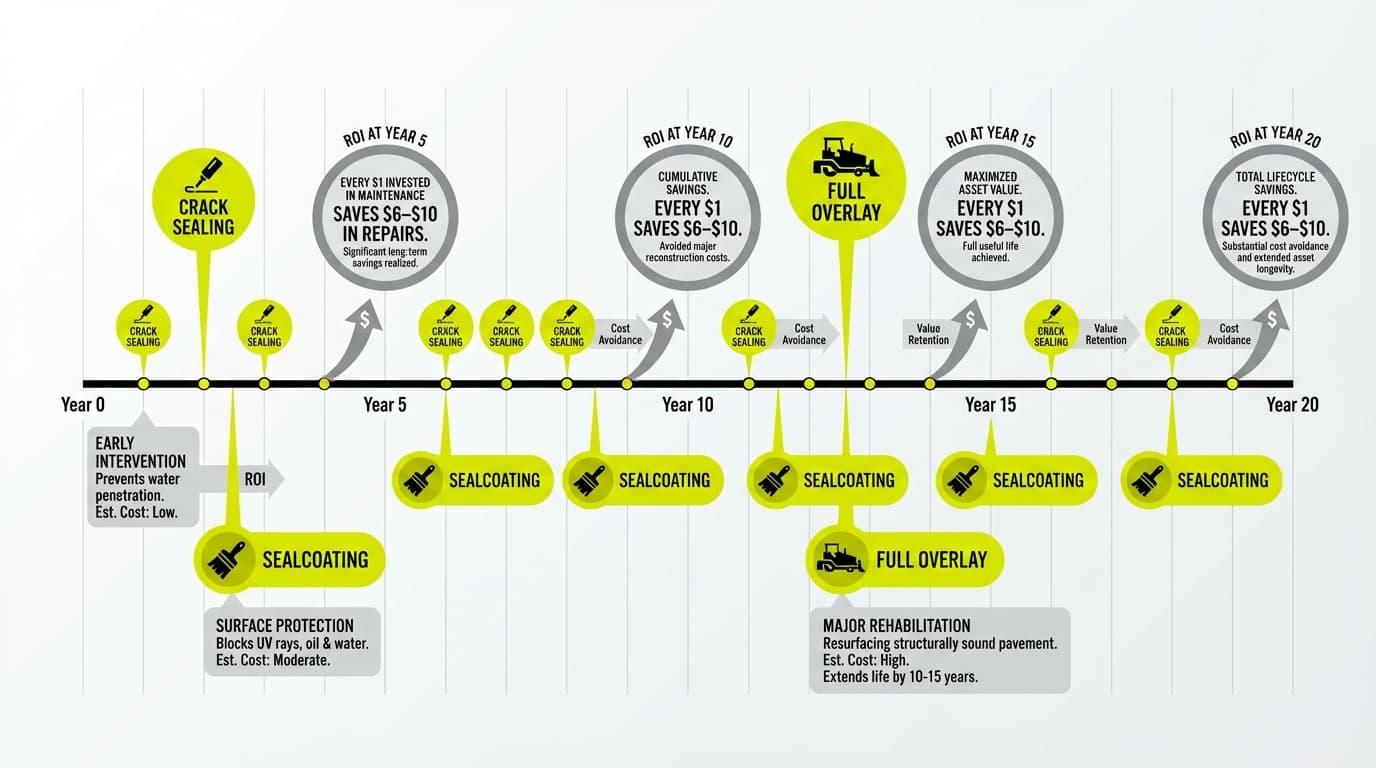
Asphalt isn’t just a construction expense — it’s a long-term infrastructure asset. Michigan lifecycle studies consistently show that asphalt, when properly maintained, delivers better cost effectiveness than any alternative over time.
Typical Asphalt Lifespan In Michigan
A properly constructed and maintained commercial asphalt pavement lasts 15–20 years in Michigan, assuming adequate base depth and compaction, proper drainage, and regular preventive maintenance. Neglected lots — those with deferred crack sealing and sealcoating — often fail in 8–12 years, requiring expensive reconstruction.
Preventive Maintenance Roi
Here’s the number that should drive your maintenance decisions: every $1 invested in timely crack sealing, sealcoating, and patching saves $6–$10 in future reconstruction costs, according to 2024 pavement preservation data from the Federal Highway Administration (FHWA) That’s documented infrastructure economics, not marketing spin.
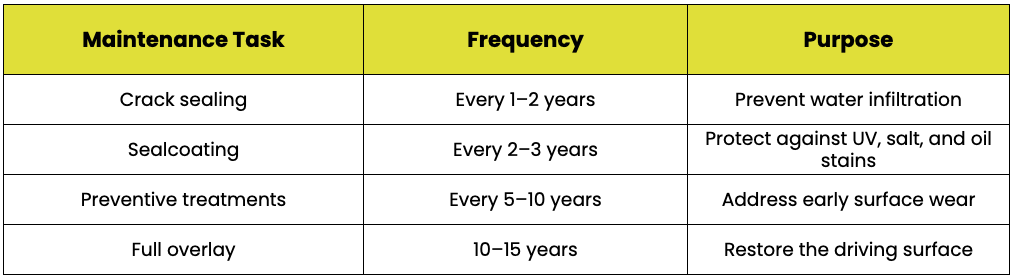
Recommended Maintenance Schedule
The Math In Practice
Consider a large lot that would cost approximately $75,000 to repave. With disciplined proper maintenance costing $300–$1,000 per year, that lot can remain in good condition for 15–20+ years.
Without proper maintenance, the same lot might need complete replacement in 10 years — essentially doubling your cost per year of service. That’s the real cost of deferred maintenance on an asphalt driveway or commercial lot in Michigan.
Concrete Comparison
While a commercial concrete lot boasts a theoretical 30-year lifespan, its rigid structure renders it highly susceptible to Michigan frost heaves, making subsequent slab replacement 300% more expensive than standard asphalt patching.
Every $1 in timely maintenance saves $6–$10 in future reconstruction costs. Bart’s Asphalt offers commercial sealcoating, crack sealing, and patching programs designed to protect that return.
How Should You Choose a Commercial Asphalt Contractor in Southeast Michigan?
The lowest bid is rarely the best value in a freeze-thaw climate. Mistakes in base preparation or material selection often don’t show up until 2–3 winters later — long after the contractor has cashed your check.
What To Look For:
Proven commercial portfolio: Look for examples of local parking lots, industrial yards, and retail centers. Residential driveways are a different business entirely.
Local Michigan experience: Crews should understand frost depth requirements, regional materials, and cold climate construction practices specific to this region.
Transparent scopes and specs: Insist on written proposals specifying base thickness, asphalt depth, asphalt mix type, and drainage details. Vague “blacktop” line items are red flags.
References from similar projects: Ask for contacts from projects of a similar size completed 2–3 winters ago. Check how those asphalt surfaces are actually holding up.
Beyond The Low Bid
When quotes from different asphalt contractors vary significantly, the differences usually lie in how thoroughly they address base repairs, drainage provisions, asphalt thickness and quality, and Michigan-specific climate considerations.
A low bid may simply be skipping items that will show up later as failures and costly repairs. Compare scopes line-by-line rather than just looking at the bottom number.
The Value Of A Consultative Partner
The best commercial asphalt paving companies function as consultative partners focused on long-term performance — not just quick installation. They’ll explain why proper base depth matters, recommend a maintenance schedule to minimize costs over time, and help you avoid paying twice.
If you manage property in the Jackson–Lansing–Ann Arbor–Kalamazoo corridor and want to save money while getting work that survives Michigan winters, start with a free, no-pressure estimate. Most local specialists can turn one around the same day or within 24 hours after a site visit. Bart’s Asphalt offers free, no-pressure on-site evaluations across the Jackson–Lansing–Ann Arbor–Kalamazoo corridor. Same-day estimates available.
Get My Free Site-Specific Estimate Today
FAQs
Below are answers to the most common questions Michigan property managers ask about commercial asphalt paving costs, maintenance, and how to get the best long-term value from their parking lots.
How Much Should I Budget Per Square Foot For A Michigan Commercial Parking Lot In 2026?
For planning purposes, most Southeast Michigan commercial parking lots can be budgeted at roughly $2.50–$4.50 per square foot for straightforward milling-and-paving or new installs with decent soils. Complex reconstruction, sites with poor drainage, or heavy-duty truck areas can reach $6–$10 per square foot.
These figures reflect recent Michigan market data and may shift with oil and labor prices throughout 2026. An on-site evaluation is still essential before setting a firm capital budget.
Is It Cheaper To Overlay My Existing Lot Or Start Over From Scratch?
Milling and overlay typically costs less per square foot — often in the $3–$7 range — than full reconstruction, but it’s only a sound investment if the underlying base is stable and drainage is acceptable.
If your lot shows widespread alligator cracking, major rutting, or standing water, those indicate base failure. A full rebuild with a new base may cost more upfront, but it prevents paying twice within a few winters when the overlay fails prematurely.
How Often Will I Need To Sealcoat A Commercial Parking Lot In Michigan, And What Does It Cost?
Sealcoating is typically recommended every 2–3 years in Michigan’s climate, with crack sealing as needed every 1–2 years. This protects against water infiltration, salt damage, and UV degradation.
Based on Michigan market data, sealcoating runs approximately $0.21–$0.41 per square foot (average around $0.31). Total project cost varies by lot size and layout, with larger lots benefiting from economies of scale.
Can I Save Money By Doing Part Of The Paving Work Myself?
Commercial asphalt paving is rarely a good DIY candidate. The specialized equipment, compaction requirements (achieving 92–95% density), and liability issues make professional installation essential.
However, property managers can sometimes reduce additional costs by handling non-technical tasks: planning traffic control, scheduling around low-traffic periods, or coordinating tenant communications. The highest ROI comes from professional base preparation and paving — those steps determine whether the lot survives Michigan winters.
Why Do Quotes From Different Michigan Asphalt Contractors Vary So Much?
Quotes differ based on how thoroughly asphalt contractors address base repairs and preparation, drainage provisions, asphalt thickness and mix quality, and Michigan freeze-thaw considerations.
A low bid may simply be skipping elements that will show up as failures and costly repairs later. Compare scopes line-by-line — base depth, asphalt mix types, warranties, maintenance provisions — instead of just looking at the final price. Favor detailed, transparent proposals from established local commercial specialists over vague, low bids.