

Choosing the right surface for your commercial property in Michigan is more than just a material preference; it’s a long-term financial and operational decision.
Before diving in, it’s important to clarify a common point of confusion: both asphalt and concrete are types of pavement. “Pavement” simply refers to any durable, finished surface used for roads, parking lots, or loading areas. What many people call “cement” is actually concrete, and cement itself is just one ingredient within it.
So the real question isn’t “pavement vs cement,” it’s asphalt pavement vs concrete pavement.
At Bart’s Asphalt, we help Michigan property owners answer that question every day. In this guide, we’ll break down the differences so you can make a confident, informed decision.
In this article, you’ll discover answers to key questions like:
- How do asphalt and concrete compare in upfront costs and long-term ownership?
- What impact does Michigan’s freeze-thaw cycle have on pavement performance?
- Which material minimizes compliance risks related to ADA and safety?
- How do maintenance needs and repair downtime differ between the two?
- When is concrete the smarter investment despite its higher initial price?
Ready to make an informed decision tailored to your Michigan commercial property? Keep reading to get expert insights and practical guidance.
Should You Choose Asphalt Pavement or Cement (Concrete) in Michigan?
If you manage a commercial property such as a parking lot, loading dock, or industrial yard in Southeast Michigan, you know the asphalt vs cement debate isn’t just a theory on paper. It’s a capital decision with a 20‑ to 30‑year tail, affecting everything from repair costs and downtime to tenant satisfaction and accessibility compliance.
The quick answer is that, in a Michigan freeze-thaw climate with an average of 42 cycles, asphalt pavement is usually the better total-ownership choice for most commercial parking lots. Cement-based concrete, on the other hand, may be the right choice for specific heavy industrial or loading dock applications where constant semi-truck traffic demands rigid, high-load-capacity surfaces.
Technically, cement is just an ingredient that does the binding job in concrete. The real comparison is asphalt pavement vs concrete pavement, but we’ll use both terms interchangeably in this article.
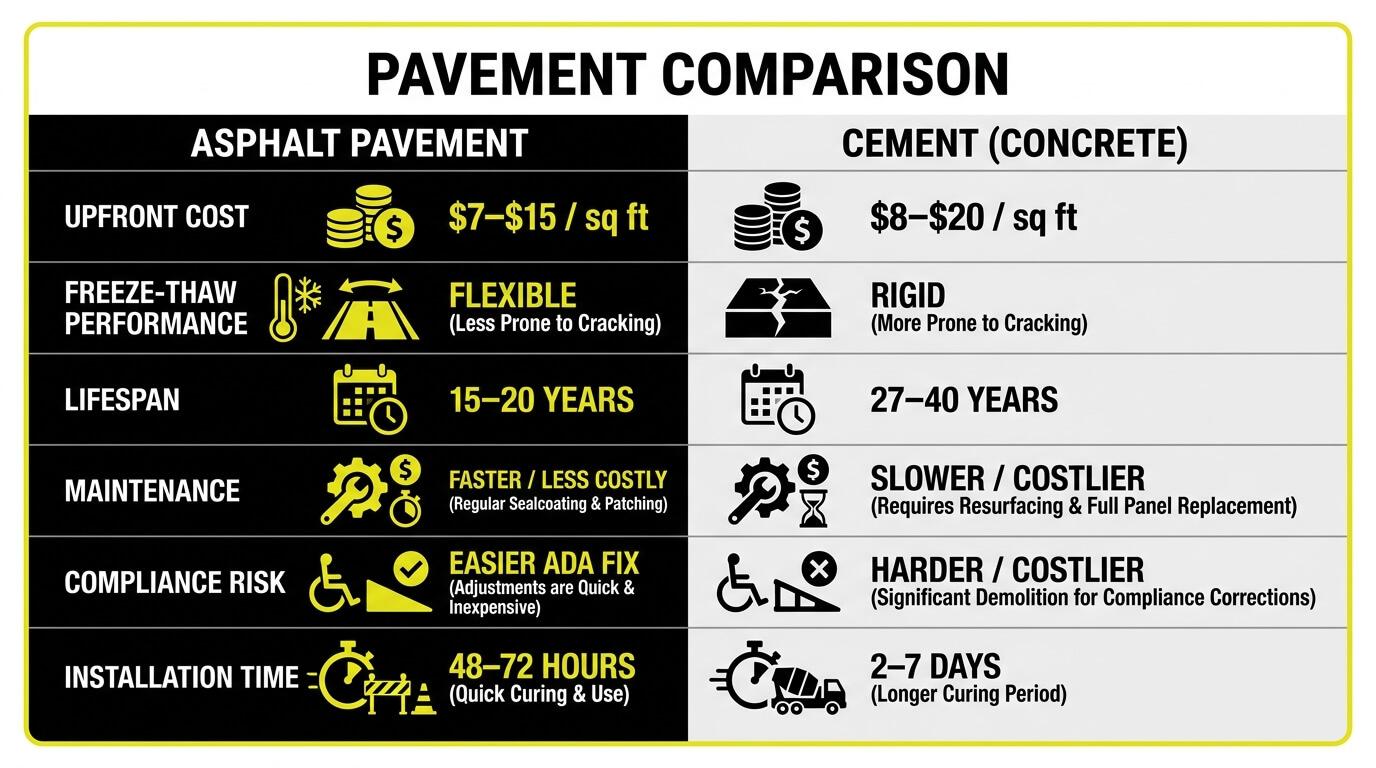
Key Commercial Decision Factors at a Glance
- Upfront Cost: Asphalt is cheaper per square foot ($7–$15 vs. $8–$20 for concrete), lowering the initial capital outlay.
- Freeze-Thaw Performance: Asphalt’s flexible layers better handle Michigan’s shifting, frost‑heaved subgrades.
- Lifespan: Concrete usually lasts longer (27–40 years vs. 15–20 for asphalt), but harsh winters can shorten its effective life.
- Maintenance: Asphalt needs more frequent maintenance, but repairs are usually faster and less costly.
- Compliance Risk: Concrete cracking creates ADA‑level trip hazards that are harder and costlier to fix.
- Installation Time: Asphalt returns to traffic in days (48–72 hours), while concrete needs a longer time (2–7 days) to cure fully.
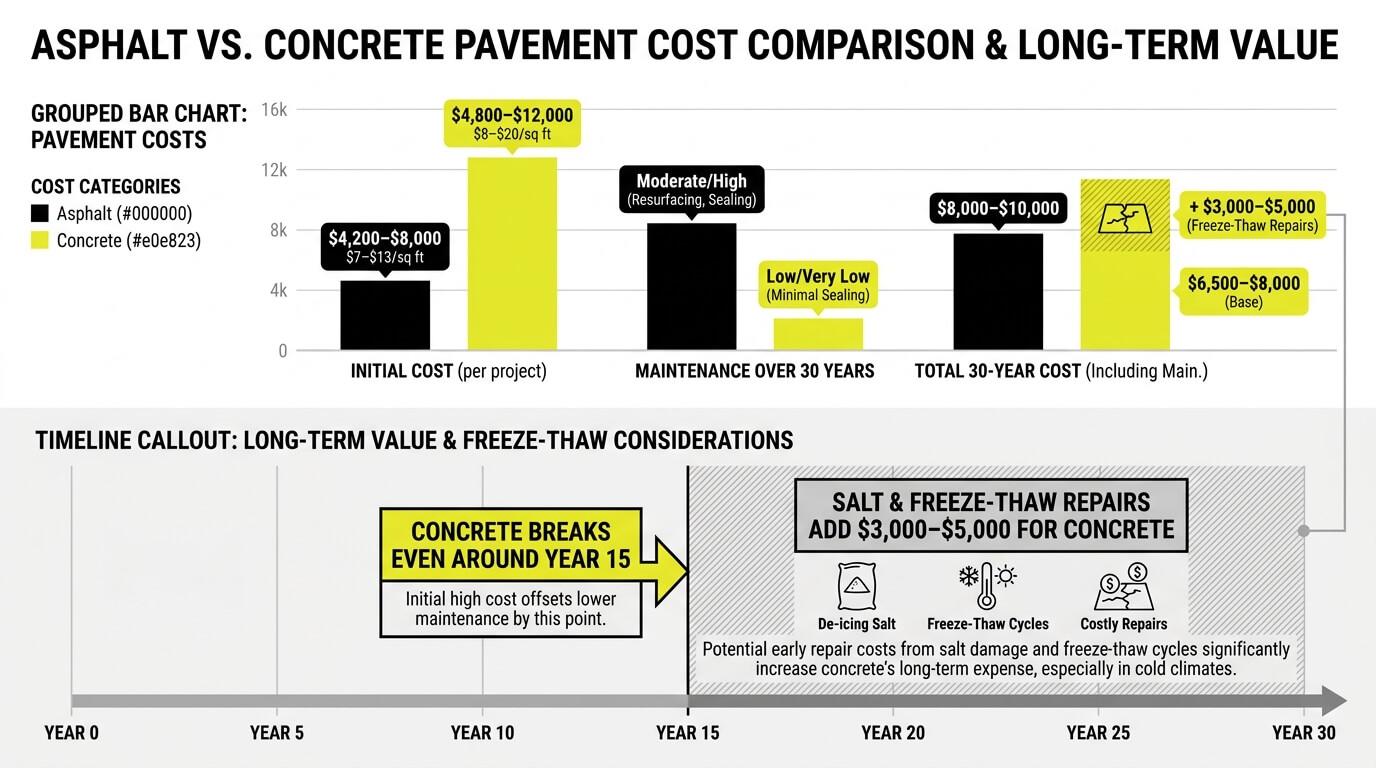
For a typical 600 sq ft section (2025–2026 benchmarks): Asphalt runs roughly $4,200–$8,000 installed, concrete $4,800–$12,000, in line with current U.S. market data (according to Home Advisor’s per‑square‑foot ranges).
Over 30 years, Michigan’s de‑icing salts and freeze‑thaw cycles often erase concrete’s paper‑cost advantage, particularly where long‑term value and minimal maintenance are priorities.
Key Terminology: Pavement vs Cement vs Concrete
Many commercial property owners use terms like “cement,” “concrete,” and “pavement” interchangeably, but they don’t mean the same thing. Getting this right matters when reviewing bids, specifications, and long-term maintenance plans.
Here’s the clear breakdown:
Pavement (General Term)
Pavement refers to any durable, finished surface used for roads, parking lots, or loading areas. Both asphalt and concrete are types of pavement. In commercial construction and engineering, “pavement” is the umbrella term, not a material itself.
Asphalt Pavement (Flexible Pavement)
Asphalt pavement is made from stone aggregate and sand bound together with bitumen, a petroleum-based binder. It’s installed in layers (surface, base, and subbase) that flex under load and adapt to movement in the underlying soil. You may also hear it called “blacktop” in everyday conversation.
Concrete Pavement (Rigid Pavement)
Concrete pavement is made by mixing aggregate, water, and Portland cement, which binds the materials into a rigid slab. Unlike asphalt, concrete does not flex. Instead, it distributes loads across a wider area, which makes it strong under heavy weight but more sensitive to subgrade movement.
Cement (Not a Pavement Surface)
Cement (specifically Portland cement) is a powdered binding ingredient, not a finished surface. It’s one component used to make concrete. When people say “cement parking lot,” they’re almost always referring to concrete pavement.
Why This Distinction Matters
The real comparison for commercial properties isn’t “pavement vs cement;” it’s asphalt pavement vs concrete pavement. Understanding the difference helps you interpret contractor proposals accurately, compare costs correctly, and choose the right material for your site conditions.
In commercial specifications, you’ll see “AC” (asphalt concrete) and “PCC” (Portland cement concrete) on design drawings and bids. The correct engineering comparison is asphalt pavement vs concrete pavement, but we’ll keep using “pavement vs cement” in this article for clarity.
Asphalt vs Cement (Concrete) Pavement Cost Comparison for Commercial Lots
Most comparison guides focus on per‑square‑foot prices without climate context, which is misleading for a Michigan commercial property decision.

Higher costs come from deeper excavation, soft or unstable soil, small lot size under 10,000 sq ft (which often carry a higher per‑unit price), heavy-truck areas that require thicker pavement sections, and any added drainage work.
30‑Year Total Ownership (600 Sq Ft Example)
- Asphalt: $8,000–$10,000 (initial cost + sealing every 3–5 years as maintenance required + two overlays).
- Concrete: $6,500–$8,000 (initial cost + joint sealing + occasional repairs).
Concrete’s initial cost typically breaks even around year 15. Still, in Southeast Michigan, salt‑induced scaling and freeze‑thaw damage often add $3,000–$5,000 in early repairs, effectively canceling out its long-term cost advantage over asphalt.
Lifespan and Structural Performance in a Freeze–Thaw Climate
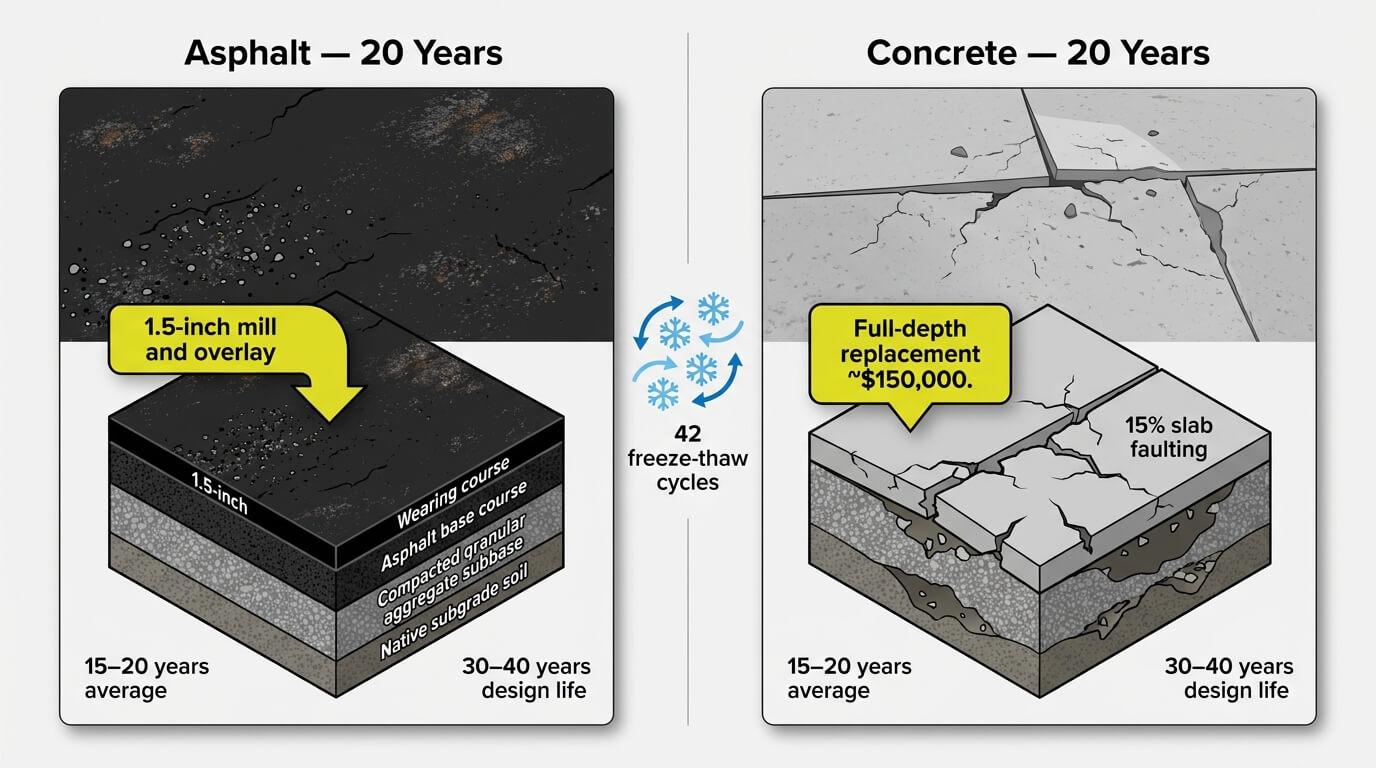
The core difference, as mentioned earlier, is that asphalt is a flexible material that bends with subbase movement. At the same time, concrete is a rigid pavement that cracks when loads or soil movement exceed its capacity. Asphalt absorbs movement better. Concrete is stronger at the surface, but less tolerant of subgrade movement below it.
Current Lifespan Benchmarks
- Asphalt: About 15 to 20 years on average (per Michigan Department of Transportation data) with regular maintenance.
- Concrete: 30 to 40 years is the typical design life for modern concrete pavements, with many agencies now targeting 40+ years under ideal conditions.
A May 2025 REJOST study found that PCC delivered a higher average strength score than AC, with stronger load-bearing performance and a clear statistical advantage. That makes concrete the better fit for high-load highways. However, strength alone doesn’t decide the best surface for commercial parking lots.
Michigan’s annual freeze-thaw cycles create joint and slab cracking in rigid concrete pavements. When subgrade settles or drainage fails, concrete doesn’t forgive. Asphalt’s layered structure helps it better withstand frost heave. It may rut or develop small cracks, but those issues are usually cheaper to mill, overlay, or patch than to replace the full depth of the slab.
Here’s a real‑world scenario: At a Metro Detroit corporate campus, a 20‑year‑old asphalt parking lot shows surface raveling. The damage is corrected with a 1.5‑inch mill and overlay. Nearby, a similarly aged concrete apron shows about 15 percent slab faulting, which requires full‑depth replacement at a cost of roughly $150,000.
This contrast shows how asphalt’s flexible, layered structure can extend service life. Asphalt repairs are often low‑disruption and more affordable. Rigid concrete failures, on the other hand, usually require major reconstruction.
Maintenance, Repairs, and Downtime for Businesses
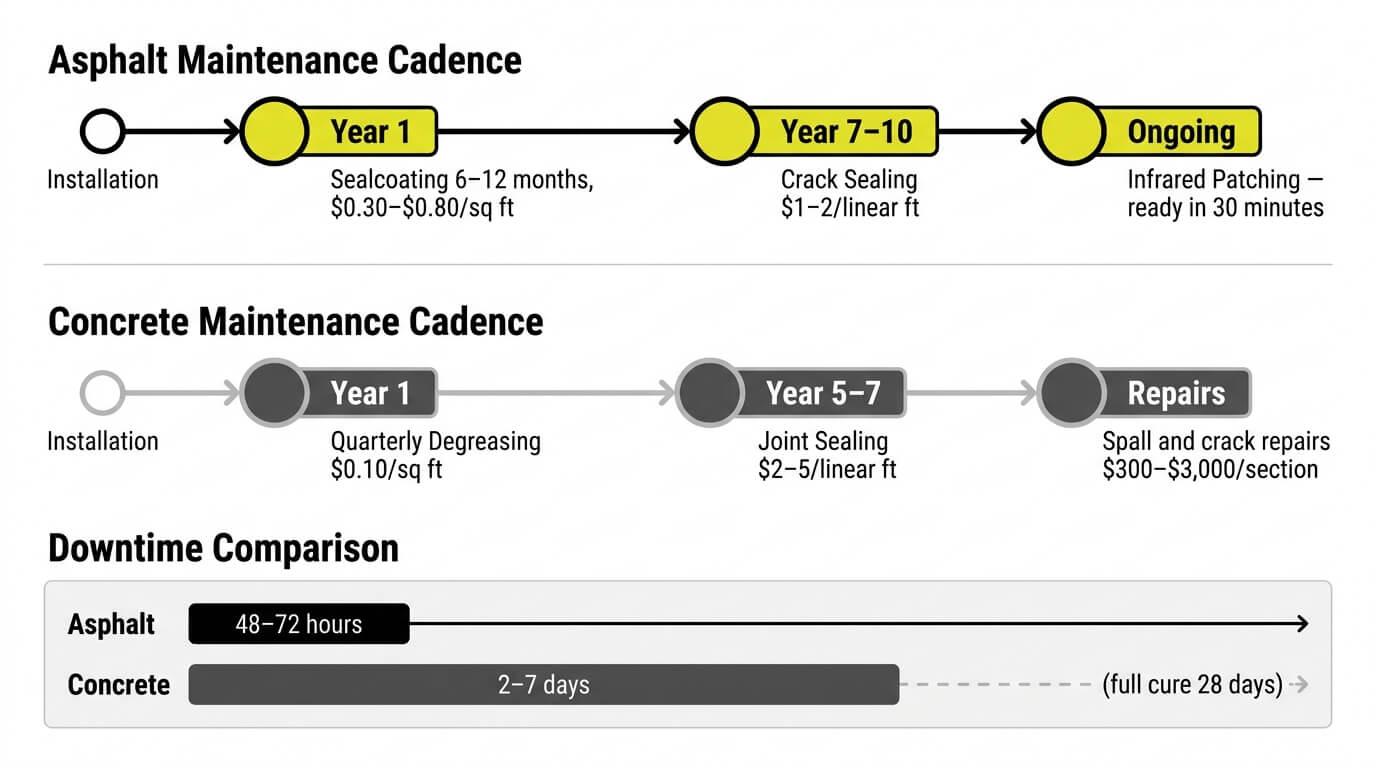
For commercial property managers, pavement maintenance is more than a budget line item; it directly shapes how smoothly your business operates every day. Closed lanes, rerouted traffic, and safety hazards all add up to lost time, lost revenue, and frustrated tenants or customers.
Asphalt Maintenance
Asphalt lots follow a simple, predictable maintenance schedule that extends their life and keeps disruption to a minimum.
- Sealcoating 6–12 months after installation, then every 3–5 years ($0.30–$0.80/sq ft) helps protect the surface from weather, UV damage, and minor cracks.
- Crack sealing around year 7–10 ($1–2/linear ft) slows water infiltration and prevents small cracks from turning into larger failures.
- Periodic patching via infrared repair (which can be completed in 30 minutes with minimal disruption) lets you address localized damage without shutting down large sections of a lot.
Concrete Maintenance
Concrete needs regular care, but repairs are often more visible and take longer to complete.
- Joint sealing every 5–7 years ($2–5/linear ft) helps control water and salt intrusion that can accelerate cracking and spalling.
- Surface degreasing quarterly ($0.10/sq ft) keeps the surface cleaner and easier to inspect for developing damage.
- Spall and crack repairs usually run $300–$3,000 per section, are harder to disguise visually, and often require more labor and longer curing times compared with asphalt fixes.
Business Downtime Comparison
Every hour of closure matters for parking, deliveries, and customer access.
- Asphalt: Traffic‑ready in 48–72 hours; resurfacing can be staged with partial lot access, so many spaces remain usable during work.
- Concrete: Needs 2–7 days before heavy traffic (full cure at 28 days), which usually means longer closures and more significant schedule impacts.
For example, at a Michigan retail center, staging an asphalt overlay can keep a large portion of the parking area open during the work. In contrast, a concrete resurfacing project would typically require a longer closure, resulting in significant revenue loss and inconvenience.
Modern infrared asphalt repairs can restore ADA‑compliant ramps in just a few hours, whereas a concrete pour typically keeps the area out of service for several days. That level of downtime is often difficult to justify for busy commercial properties.
The Impact of Michigan Climate, Weather, and Salt
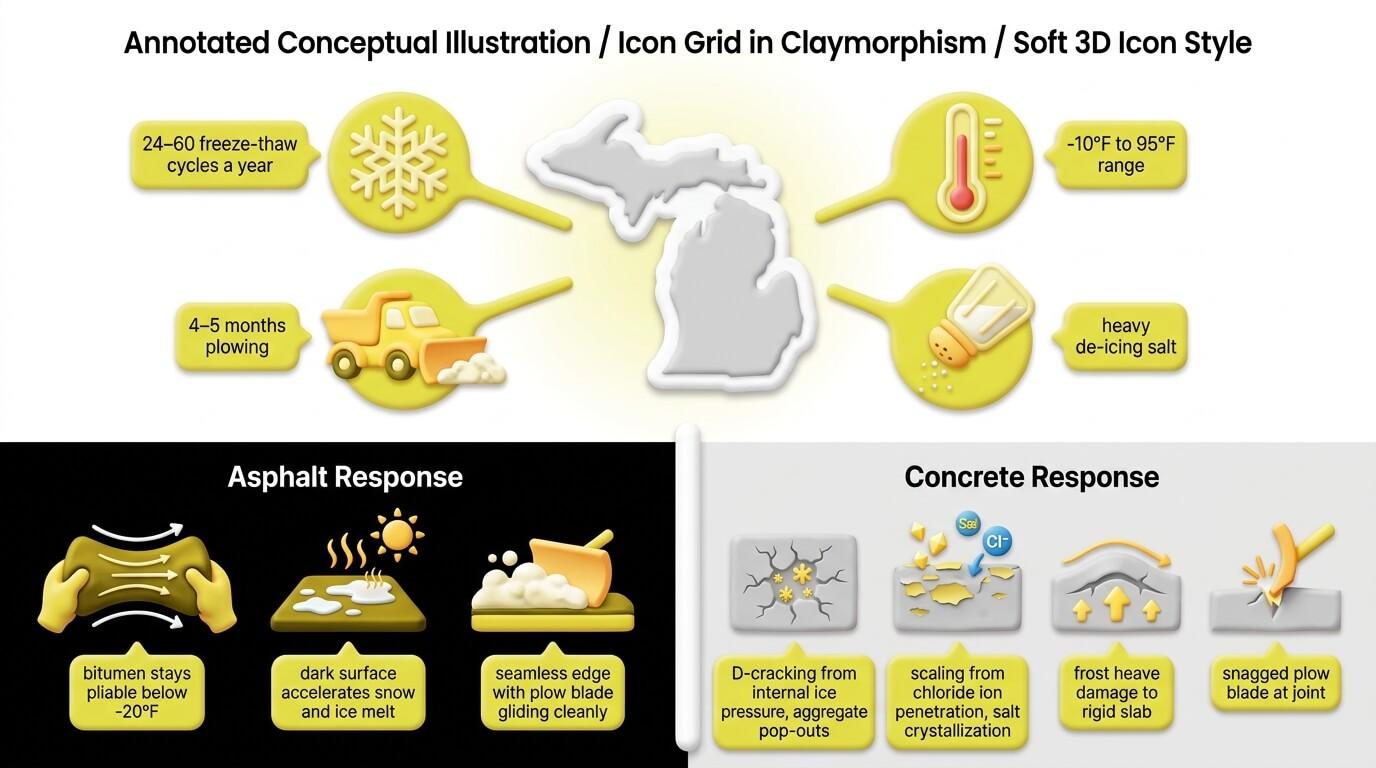
Michigan’s climate puts special stress on commercial pavements. The state can see 24–60 freeze‑thaw cycles a year, freezing temperatures from around -10°F to 95°F, plowing for 4–5 months, and heavy use of de‑icing salt. Material choice must account for all of that, especially on parking lots, loading docks, and industrial yards.
Asphalt Behavior in Michigan Conditions
Asphalt performs well in cold climates, which is a big advantage for Michigan‑area commercial properties.
- Excellent in cold climates because bitumen stays pliable below -20°F, allowing the surface to adjust to frost heave and temperature swings.
- Tolerates thermal movement without catastrophic failure, so small cracks and surface wear are more forgiving and easier to repair.
- Dark surface accelerates snow and ice melt, which can reduce ice buildup and help plows clear the surface more efficiently.
- May soften in extreme heat, but Michigan sees only a handful of hot‑weather days above 95°F, so this is usually a minor concern for most commercial lots.
Concrete Behavior in Michigan Conditions
Concrete can handle cold‑climate loads, but its rigid structure is more sensitive to Michigan’s frequent freeze‑thaw cycles and salty conditions. How it is designed and sealed has a big impact on long‑term performance.
- Vulnerable to frost heave and repeated freeze‑thaw cycles, especially when joints, subgrade, and drainage are not well designed.
- D‑cracking and aggregate pop‑outs can develop from internal ice pressure, which weakens the surface over time.
- Scaling from salt crystallization, where chloride ions penetrate pores and cause surface flaking, is a common issue if the mix is not air‑entrained or the surface is not well protected.
- Cooler surface (up to about 10°F cooler in hot climates), but this advantage is less relevant in Michigan’s shorter, milder summer months.
In Michigan, you also have to consider plowing. Asphalt’s seamless dark surface is less likely to catch plow blades, while concrete joints can snag edges and accelerate deterioration. For cold temperatures and heavy de‑icing salt use, many experts prefer asphalt for most commercial lots, with concrete reserved for specific high‑load, low‑flex applications.
Environmental Considerations for CO₂, Recycling, and Emerging Technologies
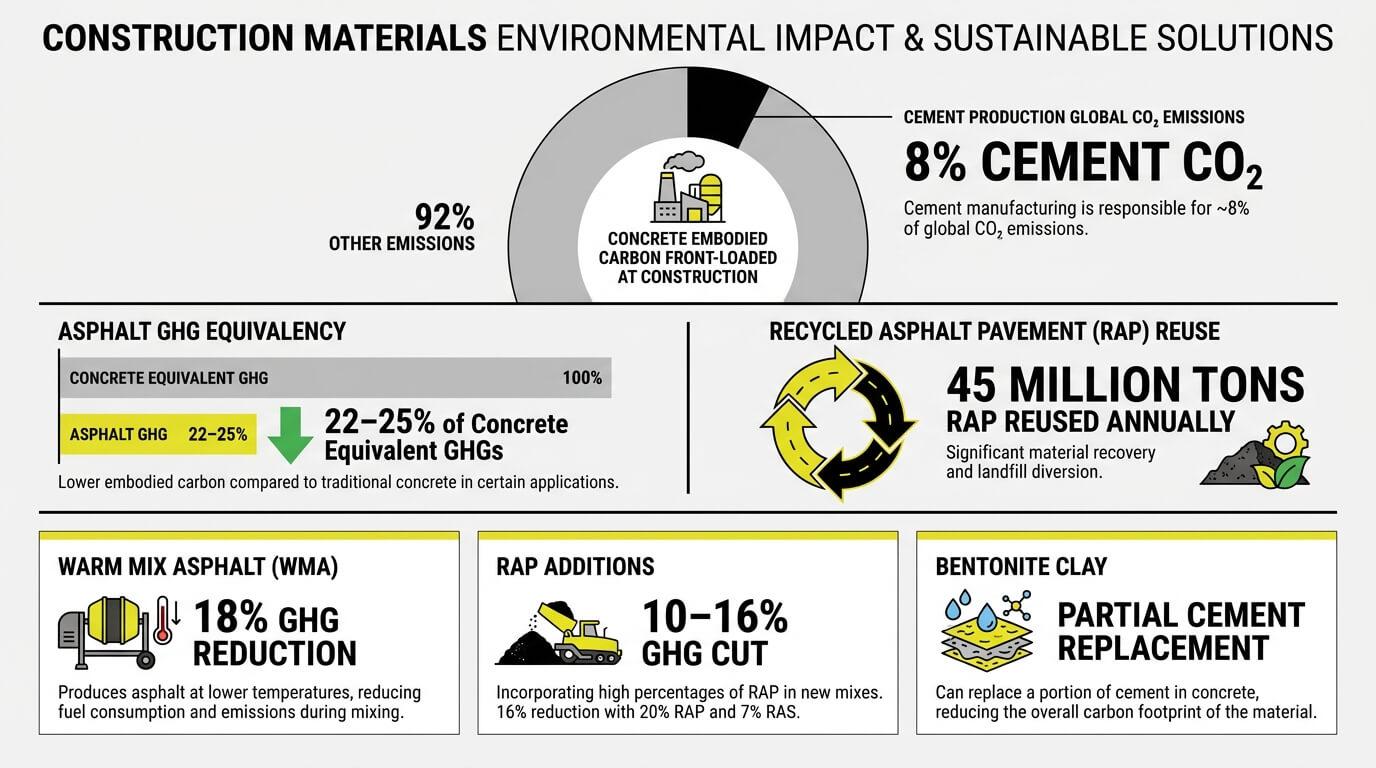
Commercial property portfolios increasingly weigh carbon footprint alongside cost, long‑term durability, and labor costs. For Michigan owners, this means looking beyond first‑year emissions at how materials perform over 25–30 years, including maintenance and repairs.
Cement’s Carbon Profile
Cement’s carbon footprint is a major factor in any sustainability conversation.
- Cement production accounts for roughly 8% of global CO₂ emissions, driven by high‑temperature kilns and the chemical reactions in limestone and clay.
- Concrete’s embodied carbon is front‑loaded at construction, so the heaviest climate impact arrives in the early years of the pavement’s life.
Asphalt’s Environmental Profile
Asphalt entails different environmental trade-offs, but it offers advantages in recycling and energy use.
- Initial construction greenhouse gases (GHGs) are only about 22–25% of those for an equivalent concrete pavement, according to an Ontario‑based lifecycle analysis.
- Asphalt is the most recycled material in the U.S., with about 45 million tons of reclaimed asphalt pavement (RAP) reused annually.
Emerging Technologies
Several new technologies are helping both asphalt and concrete reduce their environmental impact. Warm mix asphalt (WMA) lowers mixing and compaction temperatures, delivering an 18% reduction in greenhouse‑gas emissions compared with conventional hot‑mix asphalt.
Adding recycled asphalt pavement can cut GHG emissions by roughly 10–16%, with one U.S. EPA study finding a 16% reduction when 20% RAP and 7% RAS (Reclaimed Asphalt Shingles) were used in the mix. This reduces the need for fresh aggregate and lowers long‑term material and labor costs.
On the concrete side, recent research on bentonite clay as a supplementary cementitious material shows it can partially replace cement. The results suggest it can also improve concrete strength and durability, which may reduce cement‑related CO₂ and lower long‑term maintenance‑related labor costs.
Here’s the balanced view: Asphalt has lower upfront carbon and higher recyclability, while concrete’s longer lifespan can offset its impact in warmer climates. However, Michigan’s freeze‑thaw cycles often shorten concrete’s effective life, reducing that advantage and making asphalt’s lower emissions and easier maintenance more attractive for many commercial properties.
Risk, Safety, and ADA/Compliance Implications
For property owners, material choice is a liability decision rooted in safety, accessibility, and long‑term maintenance. Trip hazards, stagnant water, and failed markings create ADA violations and legal exposure. Even small changes in elevation or drainage can turn into claims or regulatory fines if not addressed early.
Short‑Term Risks of Asphalt
New asphalt poses some temporary but manageable hazards that fade as the surface cures and stabilizes. These include:
- Volatile Organic Compounds (VOC) off‑gassing for 24–72 hours post‑installation
- Fresh surfaces that are sensitive to heavy point loads in extreme heat
Long‑Term Risks of Asphalt
Over time, poorly maintained asphalt can create safety and compliance issues, increasing maintenance and repair costs. For example:
- Without sealing after year 7–10, oxidative cracking accelerates
- Rutting under heavy loads if the base or thickness is underdesigned
Short‑Term Risks of Concrete
Concrete faces different early‑stage concerns, especially when construction or curing schedules are not followed.
- Opening to traffic before the curing time (2–7 days) is complete causes early cracking.
- Poor mix design leads to surface scaling in freezing conditions.
Long‑Term Concrete Risks and Compliance
Concrete’s long‑term performance can create persistent ADA‑sensitive and liability‑prone problems if not monitored and maintained.
- Slab cracking creates differential heights at joints (ADA max 1/4‑inch lips).
- Cracks disrupt striping and stenciled ADA symbols.
- Frequent repairs are required to maintain compliance.
Example: A cracked concrete ramp at a Detroit apartment complex creates a 3/8‑inch trip hazard, resulting in OSHA/ADA fines of about $14,000. In contrast, an asphalt overlay can level the surface seamlessly for a fraction of the cost of reconstruction.
Bart’s Asphalt provides fast, ADA‑compliant asphalt repairs with minimal downtime for commercial properties. We handle everything from small patches to full‑lot overlays as a one‑stop pavement partner.
Use-Case Breakdown: Which Material Fits Which Michigan Commercial Property?
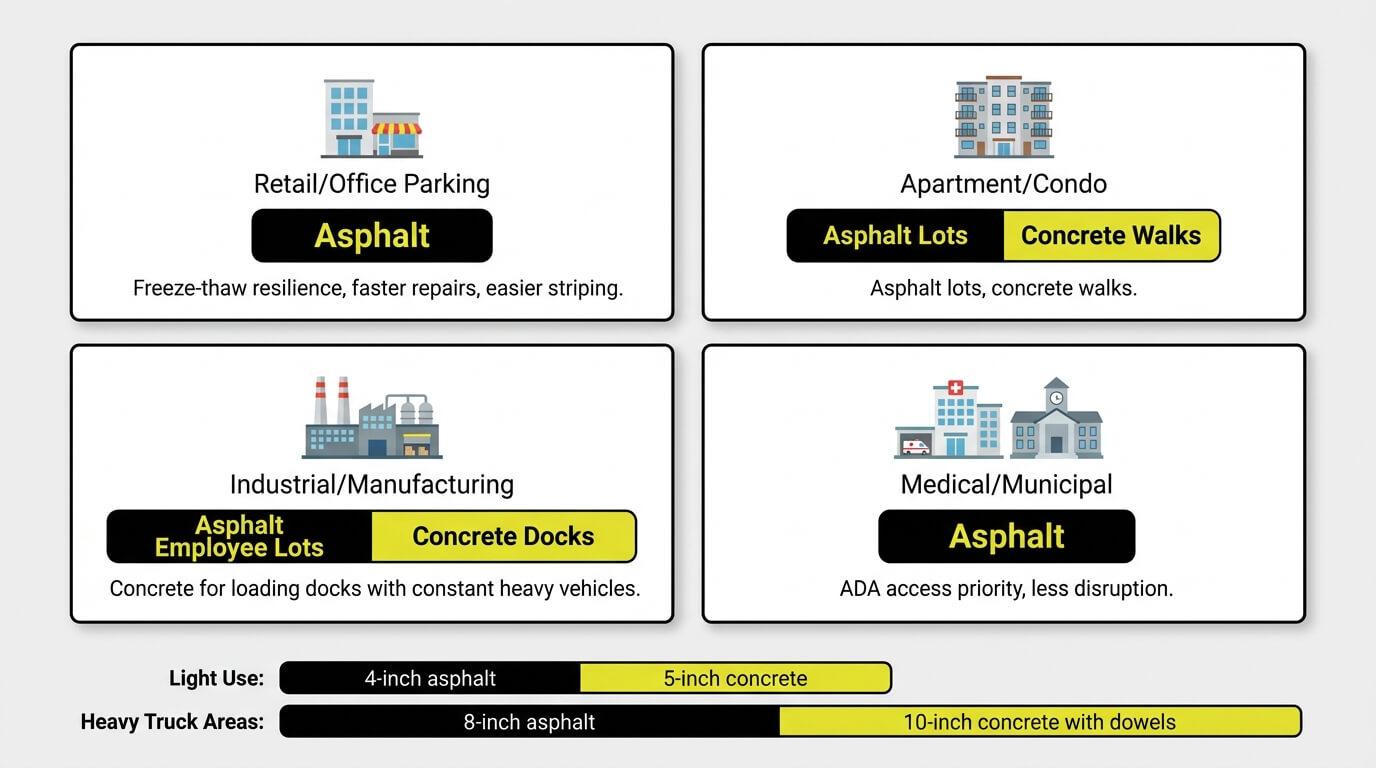
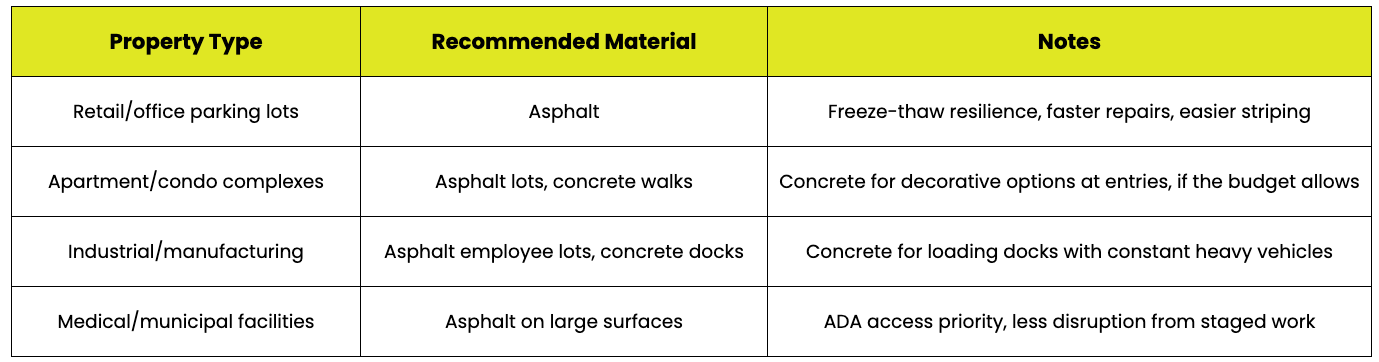
In practice, many Southeast Michigan commercial properties use both asphalt and concrete strategically, letting each material play to its strengths. Below is a recommended use‑case overview for common property types.
Thickness Guidelines
- Light Use: 4‑inch asphalt or 5‑inch concrete provides adequate support for typical car‑traffic zones while balancing cost and performance.
- Heavy Truck Areas: 8‑inch asphalt or 10‑inch concrete with dowels delivers the structural capacity needed for constant heavy‑vehicle loads, especially at loading docks and industrial pads.
Bart’s Asphalt tailors these thickness and material choices to your exact traffic and site conditions. Our team engineers each pavement design to match your long‑term budget, durability goals, and Michigan freeze‑thaw exposure.
Schedule a site assessment today
Total Cost of Ownership Over 25–30 Years
Commercial capital planning typically uses a 25–30-year horizon that aligns with depreciation schedules and long‑term lease agreements. This time frame also reflects how often parking lots and loading surfaces are fully reconceived or replaced.
Key Cost Components Over Time
- Initial Construction: About 60% of the total cost is spent upfront.
- Routine Maintenance: Around 20% for sealing and crack filling over time.
- Major Repairs: Roughly 15% for overlays or slab replacements.
- Indirect Costs: About 5% for downtime and lost revenue impacts.
600 Sq Ft Reference Over 30 Years
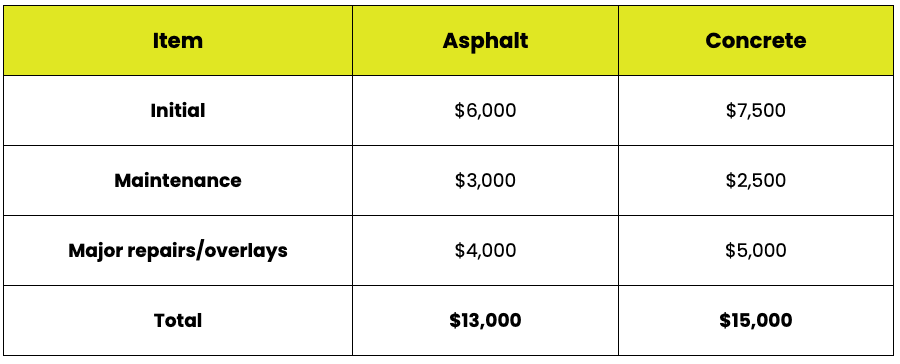 That’s roughly $0.72/sq ft/year for asphalt vs. $0.83/sq ft/year for concrete in Michigan conditions. National residential driveways may favor concrete, but commercial Michigan lots with heavy plowing and salting flip the calculus.
Bart’s Asphalt designs asphalt parking lots specifically to maximize these savings under Michigan conditions.
Call Bart’s Asphalt for a quote
Common Myths and Data Gaps in the Asphalt vs Cement Pavement Debate
Many commercial owners hear oversimplified claims about asphalt and concrete that don’t account for Michigan’s freeze‑thaw climate or real‑world maintenance. In this section, we’ll clarify those myths.
Myth: “Cement is always more durable and therefore better.”
Concrete scores higher in lab strength tests, but rigidity becomes a liability on Michigan’s moving, freezing subgrades. Catastrophic failure requires expensive slab replacement, whereas asphalt’s patchable distress is less costly.
Myth: “Asphalt is always cheaper over the life of the lot.”
Upfront, yes. But neglected asphalt, without regular maintenance, can cost more than well-engineered concrete. Both materials reward proper maintenance discipline.
Myth: “Concrete is automatically greener than asphalt.”
Depends on the metric. Concrete’s lighter color reduces the heat island effect, but cement manufacturing produces far higher CO₂ emissions. Asphalt has lower initial GHGs and superior recyclability.
Final Thoughts: Making the Right Pavement Choice for Michigan Commercial Properties
Choosing between asphalt and concrete paving materials for your Michigan commercial property involves several factors, including traffic load, budget, and compliance.
Asphalt’s flexibility helps it withstand extreme temperature swings and frost heave, giving it a longer effective lifespan than concrete in most Michigan lots. Its lower maintenance and easier repairs often lead to lower maintenance costs over time.
Concrete lasts longer in lab conditions, but its labor‑intensive installation and rigid concrete finish can crack under freeze‑thaw cycles, leading to a short lifespan in practice.
The key differences lie in how each material handles weather, traffic, and routine upkeep. Gravel underlayment, drainage, and site use also influence long‑term performance.
For most commercial properties, asphalt offers the best balance of durability and cost, especially with a structured maintenance program.
For asphalt paving that stands up to Michigan’s harsh climate and heavy traffic, Bart’s Asphalt combines proven techniques with responsive maintenance support. Trust Bart’s Asphalt to protect your investment with durable, cost‑effective paving solutions.
Get a free paving estimate now
FAQs About Asphalt vs Cement Pavement for Michigan Commercial Properties
Is asphalt or concrete better with Michigan road salt?
Asphalt tolerates salt, requires minimal maintenance, and is easier to patch. Concrete and asphalt driveways both suffer over time, but concrete can scale without proper sealers, affecting long‑term value and creating minor issues.
Can I pour concrete over an existing asphalt lot?
Pouring concrete over asphalt is rarely the right material choice for commercial use. Most projects mill and overlay asphalt driveways instead, preserving long‑term value and avoiding first‑glance cost surprises.
How soon can traffic use concrete and asphalt driveways?
Asphalt driveways can typically handle light traffic in 48–72 hours with minimal maintenance. Concrete and asphalt driveways need more caution; concrete requires 2–7 days before use and 28 days for full cure.
Which surface is easier to keep ADA‑compliant over time?
Asphalt driveways are easier to regrade, patch, and restripe, reducing long‑term value erosion from compliance failures and minor issues. Concrete and asphalt driveways can both meet ADA standards, but asphalt offers faster, lower‑cost fixes.
Which material handles heavy truck traffic better?
Concrete driveways excel under constant heavy truck loading at docks with their rigid finish. Concrete and asphalt driveways both work well, but asphalt driveways offer more forgiving surfaces and custom finishes for mixed traffic.
What’s the right material for my Michigan commercial lot?
For most Southeast Michigan lots, asphalt driveways are the right material, balancing first‑glance cost with durability. An on‑site consultation will help weigh concrete and asphalt driveways, long‑term value, and which is the best investment for your property.