


Infrared repair is a fast, cost-effective method ideal for surface-level damage, while cut-and-replace is a complete structural solution for deep pavement failures. Choosing the right one depends on balancing cost, speed, and the severity of the pavement damage.
This guide compares the durability, cost, and ideal applications for both methods to help you decide
Key Takeaways
- Infrared asphalt repair is a quick, cost-effective method that creates seamless patches by reusing existing materials, making it ideal for minor surface repairs.
- The cut-and-replace method is more suitable for severe damage, as it completely removes and replaces damaged sections, ensuring long-lasting structural integrity.
- Choosing between infrared and cut-and-replace methods depends on the specific damage and pavement conditions, balancing speed, cost, durability, and environmental impact.
What Is Infrared Asphalt Repair?
Infrared asphalt repair is a technique that uses high-intensity infrared heaters to heat and soften existing pavement. The infrared process heats the damaged area to approximately 325°F.
This softening allows technicians to add hot mix asphalt and create a seamless, thermally bonded patch that matches the existing surface.
Developed in the 1980s, infrared restoration has transformed asphalt maintenance. According to the Asphalt Institute, infrared technology now accounts for approximately 20% of the types of pavement used in commercial applications repair applications.
Traditional methods required saw cutting damaged sections and removing material entirely, creating joints that allowed water infiltration and future cracking. The infrared process eliminates these seams.
The method works by positioning an infrared heater over the repair area. The equipment radiates intense heat that penetrates 1.5 to 2.5 inches into the existing asphalt without burning the surface — making it well-suited for isolated surface damage worth repairing when the base layer remains structurally sound.
Once softened, crews rake out damaged material, apply rejuvenating agents to restore flexibility, and blend new hot mix asphalt with the heated existing pavement. The result is a thermally bonded patch that performs like the original surface.
Infrared asphalt is faster than conventional methods. A typical infrared repair takes 20 to 30 minutes from start to finish. This speed means less time blocking traffic and fewer disruptions for businesses.
The process is also more environmentally friendly because it recycles existing materials rather than hauling waste to landfills.
Property managers appreciate that infrared repairs require less manpower and equipment compared to traditional methods, making them cost-effective for pothole repair and surface corrections.
The Infrared Heating and Bonding Process
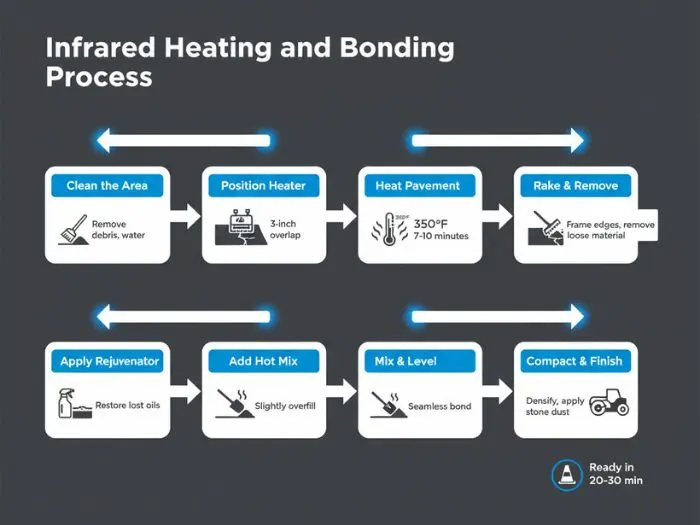
The infrared repair process follows a precise sequence to ensure a seamless, thermally bonded patch. Each step builds on the previous one to create a long-lasting repair that resists water damage and traffic stress.
Clean the Area
Remove all dirt, debris, loose asphalt, and water from the damaged surface. A clean workspace is crucial for a strong bond and uniform heating. Any contamination can prevent proper adhesion between new and existing asphalt.
Position the Infrared Heater
Place the infrared heating unit over the repair area, extending about 3 inches beyond its perimeter. The heater radiates intense infrared energy evenly across the surface.
According to KM International, proper positioning ensures consistent heat penetration without creating hot spots that could burn the material.
Heat for 7 to 10 Minutes
The infrared heater raises the asphalt temperature to 325°F-350°F. This heat penetrates to a depth of 1.5 to 2.5 inches. The softening occurs without damaging the aggregate or burning the binder.
With over 20 years of asphalt repair work, we find that this heating time achieves ideal workability for most existing pavement conditions.
Rake and Remove Damaged Material
Once heated, rake the softened asphalt to break up and remove any failed or contaminated material. Frame the edges first for an attractive finish. This way, there’s a smooth base for the new mix and removes any debris that survived the initial cleaning.
Apply a Rejuvenating Agent
Spray a maltenes rejuvenator to replenish lost oils in the existing asphalt binder. The Asphalt Institute defines these agents as restoring the original properties of aged pavement, keeping asphalt flexible and durable after repair.
Add New Hot Mix Asphalt
Place new hot asphalt mix as needed to fill the repair area. Slightly overfill by about ¼ inch to allow for compaction. The new material must be at the proper temperature to blend effectively with the heated existing surface.
Mix and Level the Asphalt
Thoroughly blend the new asphalt with the existing softened material. This mixing creates a seamless, thermally bonded patch in which old and new materials become a single homogeneous surface.
Level the surface to match the surrounding pavement elevation, avoiding bird baths or low spots that collect water.
Compact the Repair
Use appropriate compaction equipment to densify the blended material. Proper compaction ensures stability, eliminates air voids, and creates a smooth finish that resists traffic loads. The density achieved during this step determines the patch’s long-lasting quality.
Apply Final Surface Treatment
Optionally apply more rejuvenator to the repair area. Then use stone dust or sand to enhance texture and prevent sticking. This finish ensures the new patch matches the existing pavement appearance.
Clean Up and Reopen
Clear the site and allow it to cool briefly before reopening to traffic. A typical infrared repair is ready for traffic within 20 to 30 minutes total from start to finish. This quick turnaround means minimal disruption to businesses and less time spent managing traffic control.
Important Note: Infrared repair is most effective on asphalt less than 10 years old. Older, heavily oxidized pavements may require pre-testing or alternative methods to ensure proper bonding and durability.
Speed and Cost Effectiveness
Infrared asphalt repair completes most patches in under 30 minutes, minimizing downtime for traffic and business operations.
The pavement is ready for traffic immediately after compaction, unlike conventional methods that require hours of curing time. This speed translates directly into cost savings.
According to our project data from 2024, a typical infrared repair costs between $2 and $6 per square foot. This rate covers the operation of the infrared heater, new hot-mix asphalt, labor, and equipment mobilization.
Compare this to cut-and-replace methods that average $8 to $15 per square foot, and the cost advantage becomes clear.
The method reuses existing asphalt rather than hauling away waste and importing entirely new material. This recycling approach lowers material costs by approximately 30% compared to complete replacement.
Fewer trucks mean less fuel consumption and reduced transportation expenses. Property managers also save money on traffic control because the repair requires less time blocking lanes or closing parking areas.
Labor costs remain lower because infrared repairs require less manpower than traditional methods. A two-person crew with an infrared heater can perform repairs that would otherwise demand a four-person team with saws, jackhammers, and heavy equipment.
The reduced crew size results in lower hourly labor costs and faster project completion.
For businesses, time is money. A parking lot repair that takes 4 hours with conventional methods can be completed in 30 minutes with infrared technology. This means stores stay open, customers keep shopping, and revenue continues flowing.
The cost-effective nature of infrared repair extends beyond the invoice to include avoided business losses.
Environmental and Material Benefits
Infrared asphalt repair is a more environmentally friendly process because it reuses existing materials. By heating and rejuvenating the on-site asphalt, it eliminates the need to haul away old material and transport new asphalt to the job site.
This recycling-in-place approach reduces waste sent to landfills and conserves natural resources.
The method cuts emissions by approximately 50% compared to conventional asphalt repair methods. EPA research on recycled asphalt confirms that reusing existing pavement significantly lowers the carbon footprint of repair operations. Less trucking means less diesel fuel burned.
Lower new hot-mix asphalt production means less energy is consumed at the asphalt plant.
Traditional methods generate substantial waste. Saw cutting and removing damaged sections creates tons of material that must be transported off-site. Infrared restoration avoids this entirely by transforming the existing surface into a usable repair material.
The only waste generated comes from the small amount of contaminated asphalt that cannot be reused.
The process also reduces the demand for virgin aggregate and asphalt binder. Mining new stone and refining petroleum products consumes energy and disturbs natural habitats. By recycling the existing asphalt, infrared repairs preserve these resources for future use.
This sustainability aligns with growing pressure on businesses and municipalities to reduce environmental impact.
For property managers tracking environmental metrics, infrared repair offers measurable benefits. Projects can document reduced truck trips, lower fuel consumption, and decreased landfill waste.
These quantifiable improvements support corporate sustainability goals and demonstrate environmental responsibility to stakeholders.
What Is the Cut and Replace Asphalt Method?
Cut-and-replace asphalt repair involves removing and replacing damaged pavement sections. The method involves saw-cutting the perimeter of the failed area, excavating the damaged asphalt and underlying base material, and installing new hot-mix asphalt to restore structural integrity. This approach addresses problems that extend below the surface.
The National Asphalt Pavement Association (NAPA) reports that cut-and-replace methods account for approximately 60% of structural repairs nationwide.
The technique is often called “full depth reclamation” in the industry because it addresses pavement failure from the surface down through the sub-base layers.
Unlike surface treatments that only fix the top layer, cut-and-replace repairs remove all damaged material. Crews cut clean edges with concrete saws to precisely define the repair area.
Excavation equipment then removes the failed asphalt and any compromised base material underneath, which ensures no weak spots remain that could cause future failure.
Once excavation is complete, crews inspect and repair the sub-base as needed. A stable foundation is critical for long-lasting results.
After base preparation, a tack coat is applied to bond the new asphalt to the existing pavement edges. New hot mix asphalt is then placed and compacted to match the surrounding surface elevation.
The method requires more equipment than infrared repairs. Concrete saws, excavators, dump trucks, rollers, and paving equipment must all mobilize to the job site. This means higher costs for asphalt contractors and longer project timelines.
However, the complete replacement addresses damage that infrared restoration cannot fix, making it ideal for structural failures.
Property managers choose to cut and replace when the sub-base has failed or when damage extends deeper than 3 inches. The method is also necessary when the existing pavement is too old or oxidized for infrared bonding.
While costs are higher, the durability justifies the investment for high-traffic applications.
Steps in the Complete Removal Process
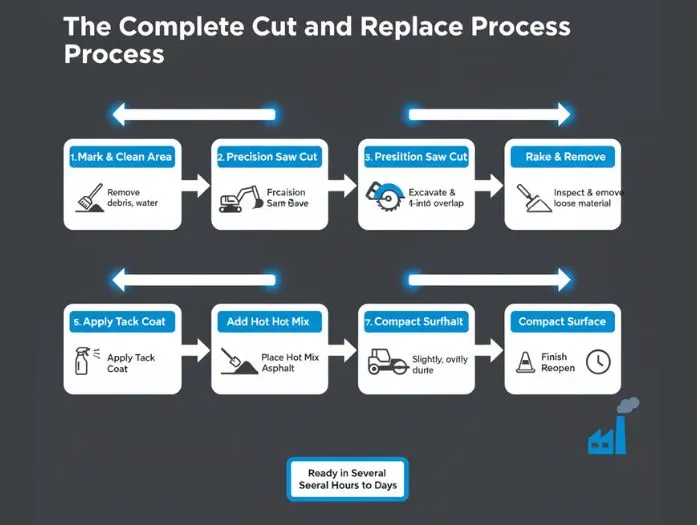
The cut-and-replace method follows a systematic approach to ensure quality and long-lasting results. Each step must be performed correctly to avoid future pavement problems.
Clean and Mark the Damaged Area
Remove debris and clearly mark the repair perimeter. Accurate marking ensures crews cut only the damaged section, minimizing waste and unnecessary work.
Perform Precision Saw Cutting
Use concrete saws to cut clean, straight edges around the damaged area. Proper cutting technique prevents damage to the existing pavement that will remain. The cuts should penetrate the full depth of the asphalt to facilitate clean removal.
Excavate and Remove Material
Use excavation equipment to remove the damaged asphalt and compromised sub-base materials. Load the waste into dump trucks for disposal. Complete removal ensures no weak material remains that could cause future failure.
Inspect and Repair the Base Layer
Examine the exposed sub-base for moisture, weakness, or contamination. Add new aggregate base material if needed and compact thoroughly.
According to our experience performing structural repairs since 2003, base failure is the primary cause of recurring pavement damage. A solid foundation is essential.
Apply Tack Coat
Spray tack coat adhesive on the vertical edges of the existing pavement and the prepared base surface. This bonding agent ensures the new hot mix asphalt adheres properly to the surrounding surface.
Place New Hot Mix Asphalt
Fill the excavated section with new hot asphalt material. The temperature must meet specifications to ensure proper compaction and density. Depending on depth requirements, crews may place material in multiple lifts.
Compact the New Surface
Use heavy rollers to compact the new asphalt tightly. Proper compaction eliminates air voids, increases density, and creates a smooth finish that matches the existing pavement. The edges require special attention to ensure a seamless transition.
Finish and Open to Traffic
Ensure the new surface is level and smooth. Allow adequate cooling time before reopening to traffic. Depending on weather conditions and material thickness, this may require several hours to a full day.
The process demands more time and equipment than infrared repair, but it provides the most durable solution for severe damage. While demanding, this method is essential for major pavement problems in high-traffic areas.
Durability and Structural Integrity
The cut-and-replace method provides a highly durable repair solution with a typical lifespan of 15 to 20 years in high-traffic applications.
This longevity makes it the ideal choice for highways, airports, and commercial parking lots where structural integrity cannot be compromised.
According to NAPA engineering data, full-depth replacement effectively addresses sub-base failures. By removing all damaged material and rebuilding from the foundation up, the repair eliminates the root cause of pavement failure.
This complete restoration ensures the surface withstands severe traffic loads and environmental stress over many years.
Many asphalt contractors back these repairs with warranties ranging from 1 to 5 years, depending on project specifications and local standards. This confidence reflects the long-lasting quality of properly executed cut-and-replace work.
The warranty coverage provides property managers with peace of mind and protection against defects.
The method prevents recurring problems that plague surface-only repairs. When the sub-base has failed, no surface treatment can provide lasting results.
Water penetration, freeze-thaw cycles, and traffic loads will quickly destroy any patch applied over a weak foundation. Cut-and-replace removes this weak foundation and replaces it with stable material.
The trade-off is higher upfront costs and longer downtime. The process typically requires 2 to 3 times the downtime of infrared repairs. For a typical repair area, crews may need several hours to a full day to complete the work.
This extended timeline impacts traffic flow and business operations more significantly than quick infrared repairs.
However, this investment prevents costly future failures. A properly executed cut-and-replace repair can save thousands or even millions in avoided maintenance costs over its lifespan, depending on the scale of the pavement network.
The initial expense is offset by decades of trouble-free performance.
For critical infrastructure where failure could create safety hazards or major disruptions, cut-and-replace is the gold standard.
Property managers and municipalities choose this method when durability and performance outweigh concerns about speed and upfront costs. The complete structural repair ensures long-lasting results that justify the investment.
Which Repair Method Is More Durable?
Cut-and-replace is the most durable solution for structural failures, while infrared repair provides excellent durability for surface-level issues.
Durability depends on matching the repair method to the type and depth of damage rather than assuming one approach is universally superior.
Cut-and-replace provides a long-lasting fix because it removes the entire failed section, including damaged sub-base material.
According to the Transportation Research Board (TRB) pavement studies, full-depth replacement typically lasts 15 to 20 years in heavy traffic applications.
Infrared repair creates a seamless, thermally bonded patch that prevents water infiltration, making it highly durable against alligator cracking, bird baths, or potholes, while the sub-base remains intact.
The bonded connection eliminates joints that typically allow water to penetrate and cause freeze-thaw damage.
For surface-level repairs, infrared patches can last 5 to 7 years or longer, depending on traffic loads and maintenance.
The key difference lies in failure prevention. Infrared asphalt repair addresses surface damage and prevents water from reaching the sub-base. If the foundation is sound, this protection ensures long-lasting results.
Cut-and-replace rebuilds the entire pavement structure, making it ideal when the foundation has already failed.
Here is a comparison of durability factors:
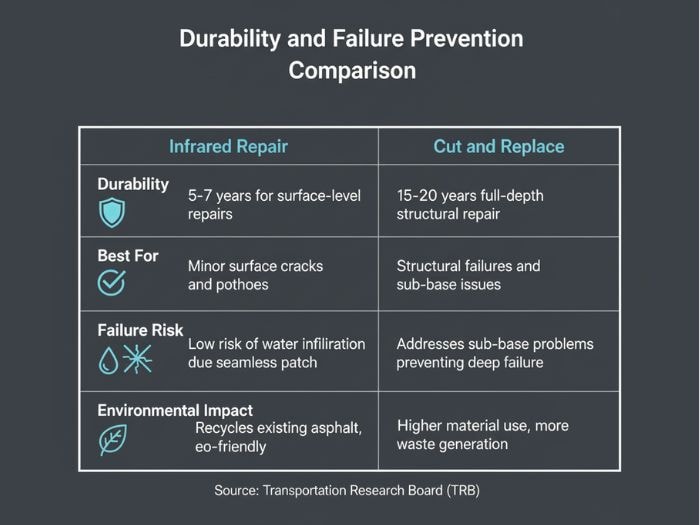
This data shows that durability is not absolute because both methods deliver long-lasting results when properly matched to the damage type.
So, the question property managers and asphalt contractors should ask is not “which method is more durable” but rather “which method provides the durability I need for this specific damage.”
Surface Level Repairs vs Full Depth Repairs
Surface-level repairs, such as infrared asphalt, are ideal for minor damage when the sub-base remains structurally sound.
These repairs address problems in the top 2 to 3 inches of pavement, making them quick and cost-effective for maintaining appearance and functionality.
Infrared repair excels at fixing potholes, alligator cracking, bird baths, and surface deterioration. The thermally bonded patch blends seamlessly with the existing pavement, preventing water penetration that causes further damage.
For property managers dealing with parking lot wear or driveway damage, infrared provides an effective solution that minimizes disruption.
The method is particularly effective for pothole repair in areas with moderate traffic. A typical infrared repair restores the surface to like-new condition in under 30 minutes.
The patch performs well under normal traffic loads because the existing sub-base provides adequate support. As long as the foundation remains stable, surface-level repairs deliver excellent results.
Full-depth repairs are necessary for addressing extensive damage and structural failures. Cut-and-replace is the best choice when the sub-base has failed or when damage extends deeper than 3 inches.
This thorough approach ensures that underlying problems are fully resolved, providing a durable repair that prevents recurring failure.
Signs that require full-depth repair include large areas of alligator cracking, significant settlement or depression, base material visible through cracks in the asphalt, and water rising through cracks when traffic passes.
These symptoms indicate that surface-level repairs will fail quickly because the foundation cannot support the patch.
For quick decision-making, if you are dealing with a driveway or parking area with primarily surface damage, infrared is your best option. The method is faster, cheaper, and delivers high-quality results.
But in roads and high-traffic areas where structural integrity matters, full-depth cut-and-replace ensures durability and safety for many years.
The choice depends on accurately assessing pavement conditions. Property managers should inspect the repair area for signs of base failure before selecting a method.
Asphalt contractors can perform probing or coring to determine the depth of damage and base stability.
This assessment ensures the repair method matches the problem, avoiding wasted money on inadequate fixes or unnecessary over-engineering.
Prevention of Water Penetration and Pavement Cracking
Infrared asphalt repair creates seamless patches that significantly reduce water infiltration, cutting the risk of cracking by approximately 40% according to industry research.
This seamless integration prevents water from seeping into joints, a significant cause of freeze-thaw damage and pavement deterioration in winter conditions.
Traditional methods create cold joints where new material meets existing pavement. These joints act as pathways for water to penetrate below the surface.
Once water reaches the sub-base, freeze-thaw cycles cause expansion that breaks up the asphalt from underneath. The thermally bonded connection in infrared repairs eliminates these vulnerable joints.
The infrared process blends new and existing asphalt into one continuous material. There is no seam or edge where water can enter. This protection is critical for preventing the most common cause of pavement failure.
Water infiltration leads to base softening, loss of support, and eventual surface cracking, requiring expensive repairs.
To further enhance protection after infrared repair, applying a fog seal or light seal coating is highly recommended. This additional layer shields the surface from moisture and UV damage, extending the pavement’s lifespan.
The seal coating fills minor surface voids and creates a waterproof barrier that prevents oxidation.
These prevention benefits align perfectly with the ideal applications of infrared repair for minor to moderate surface damage.
For areas where water penetration typically initiates deterioration, combining the infrared process with post-repair sealing ensures a durable, long-lasting fix.
The sealed, seamless patch outperforms conventional patching methods that remain vulnerable to water damage and cracking.
Property managers should budget for seal coating 6 to 12 months after infrared repairs to maximize protection. This follow-up treatment costs significantly less than allowing water damage to develop and requiring significant repairs.
The combined approach of infrared repair plus sealing provides the most cost-effective long-term solution for maintaining asphalt quality.
How Do the Methods Compare in Cost and Efficiency?
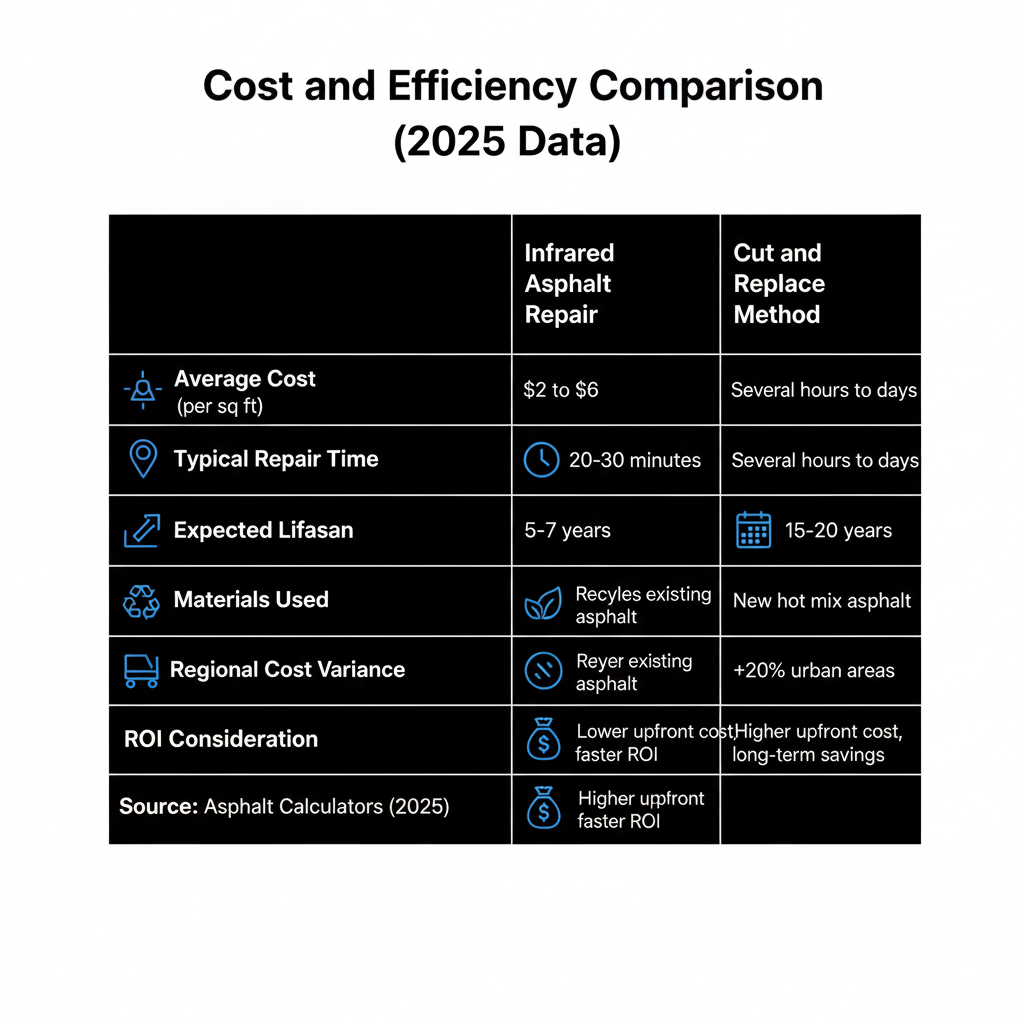
Infrared repair costs between $2 and $6 per square foot and completes repairs in 20 to 30 minutes, while cut-and-replace costs $8 to $15 per square foot and requires several hours to complete.
This cost and time difference makes infrared repair the more efficient choice for surface-level damage, while cut-and-replace delivers better value for structural problems despite higher initial costs.
According to a 2025 project data by Asphalt Calculators, the average infrared repair cost of $4 per square foot covers infrared heater operation, new hot-mix asphalt, labor, and equipment.
A typical 100-square-foot repair area costs approximately $400 and takes less than 1 hour to complete.
Cut-and-replace repairs averaging $11 per square foot include saw cutting, excavation, sub-base repair, new material placement, and compaction. The same 100-square-foot area costs approximately $1,100 and takes 4 to 6 hours, depending on depth and base conditions.
Traffic must be diverted during the entire process, adding indirect costs for businesses and traffic management. The efficiency advantage of infrared repair becomes especially clear for businesses.
A retail parking lot repair that takes 30 minutes with infrared technology would require half a day with cut-and-replace methods.
The difference means stores avoid closing and customers continue shopping without disruption. For every hour saved, businesses preserve revenue that would otherwise be lost.
Regional and inflation factors influence these costs. Urban areas typically see prices 20% higher than rural locations due to logistics, labor rates, and permit requirements. Material price fluctuations also affect costs, making early planning and budgeting essential.
Asphalt contractors recommend getting quotes based on current market conditions rather than relying on outdated estimates.
Below is a detailed cost and efficiency comparison for 2025:
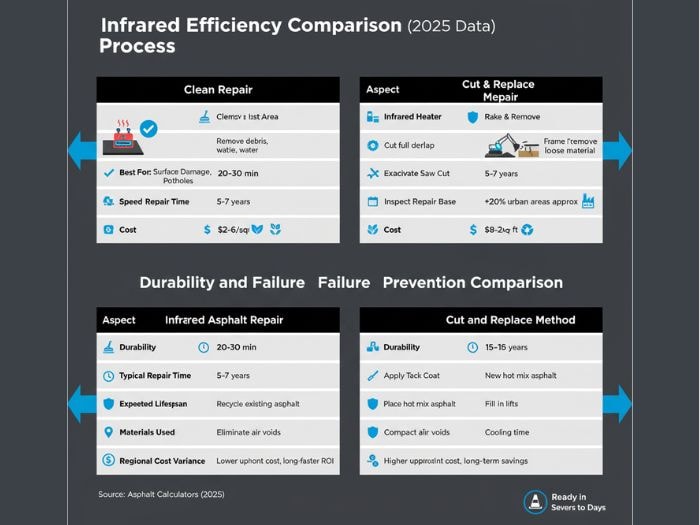
Return-on-investment calculations show different strengths. Infrared repair offers excellent short-term ROI due to low costs and fast turnaround, making it ideal for property managers with budget constraints.
Cut-and-replace, while expensive upfront, yields long-term savings by preventing recurring repairs and reducing liability from pavement failures.
A $1,100 investment that lasts 20 years costs less annually than a $400 repair that must be repeated every 5 years.
The key to making cost-effective decisions is matching the repair method to the damage severity. Spending $15 per square foot on cut-and-replace for minor surface damage is wasteful when infrared repair could save money.
Conversely, trying to fix structural failure with a $ 4-per-square-foot infrared patch wastes money when the repair fails within a year and requires complete replacement anyway.
When Is the Best Time to Use Each Method?
Infrared repair is best for surface-level damage less than 3 inches deep, including potholes, alligator cracking, bird baths, and minor surface deterioration where the sub-base remains structurally sound.
Cut-and-replace is ideal for structural failures, deep damage exceeding 3 inches, areas with sub-base failure, and severely oxidized pavement where thermal bonding cannot be achieved. The decision depends on accurate assessment of pavement conditions.
Property managers should look for specific indicators to determine which method will deliver the most cost-effective, long-lasting results.
Choose Infrared Repair When:
The damage is primarily surface-level. Potholes, shallow cracks, bird baths, and surface wear respond excellently to infrared restoration. If you can see that the existing pavement structure underneath appears sound, infrared repair provides a quick, cost-effective fix.
The sub-base is stable. Press on the edges of the damaged area with your foot. If the pavement feels firm and does not move or flex significantly, the foundation likely remains intact. Infrared repair will perform well in these conditions.
Speed is critical. When businesses cannot afford extended downtime or traffic disruptions, infrared repair completes work in under 30 minutes. This makes it ideal for retail parking lots, drive-through lanes, and high-traffic areas where every hour of closure impacts revenue.
The budget is limited. At $2 to $6 per square foot, infrared repair costs significantly less than complete replacement. For routine maintenance and minor repairs, infrared provides excellent value without requiring significant capital investment.
The pavement is less than 10 years old. Newer asphalt bonds more effectively during the infrared process because the binder has not oxidized extensively. The existing material remains flexible enough to blend with new hot mix asphalt.
Choose Cut and Replace When:
The sub-base has failed. Signs include large areas of alligator cracking that flex when driven over, significant depressions or settlement, and water pumping up through cracks.
These symptoms indicate the foundation cannot support the surface, making full-depth repair necessary.
Damage exceeds 3 inches deep. Infrared heaters typically penetrate 2 to 2.5 inches effectively. Deeper damage requires complete removal and replacement to ensure structural integrity.
The pavement is heavily oxidized or older than 15 years. Very old asphalt becomes too brittle to bond thermally with new material.
The existing surface will not soften adequately during infrared heating, preventing proper integration. Cut-and-replace ensures a quality repair in these conditions.
Long-term durability is the priority. When the repair area experiences heavy traffic loads or critical structural requirements, cut-and-replace provides a service life of 15 to 20 years. The higher initial cost is justified by decades of trouble-free performance.
Recurring repairs have failed. If infrared or other surface treatments have repeatedly failed at the exact location, the problem likely extends to the sub-base.
Continuing to apply surface repairs wastes money. Cut-and-replace addresses the root cause and prevents future failures.
Year-Round Considerations:
Both methods can be performed year-round, but winter conditions affect the process differently. Infrared repair requires slightly longer heating times in cold weather but remains effective.
The infrared heater compensates for cold ambient temperatures by running longer. Quality is not compromised when the process is performed correctly.
Cut-and-replace faces greater challenges in winter. Frozen ground complicates sub-base repair and compaction. Hot-mix asphalt cools faster in cold conditions, making it harder to achieve proper density.
Many asphalt contractors prefer to schedule major cut-and-replace projects in warmer months to ensure optimal results.
For property managers planning maintenance, spring and fall offer ideal conditions for both methods. These seasons provide moderate temperatures that optimize material performance and worker efficiency.
However, infrared repair’s flexibility makes it viable for emergency pothole repair, even during winter months when waiting for better weather could pose safety hazards.
The variety of factors influencing method selection requires careful assessment. Property managers should consult experienced asphalt contractors who can inspect the damage, assess sub-base conditions, and recommend an approach that balances cost, durability, and timeline requirements.
What Are the Environmental Impacts of Each Method?
Infrared repair is significantly more environmentally friendly than cut-and-replace because it recycles existing asphalt in place, reducing waste generation by approximately 90% and cutting emissions by about 50% compared to conventional methods.
Cut-and-replace generates substantial waste material and requires more energy-intensive operations, making it less sustainable despite its structural advantages.
The environmental comparison breaks down into several key factors. Infrared restoration reuses the existing pavement rather than hauling it away as waste.
A typical 100-square-foot infrared repair generates less than 50 pounds of material waste from contaminated sections that cannot be reused. The same area repaired with cut-and-replace generates approximately 500 to 700 pounds of asphalt waste that must be transported to recycling facilities or landfills.
EPA research on recycled asphalt materials confirms that reusing existing pavement significantly lowers the carbon footprint of repair operations. The in-place recycling approach eliminates multiple truck trips.
Cut-and-replace requires dump trucks to haul away old material and additional lorries to bring in new hot mix asphalt and base material. Each truck trip consumes diesel fuel and generates emissions.
Hot mix asphalt production is energy-intensive. Aggregate must be heated to approximately 300°F and mixed with asphalt binder at the plant. Infrared repair reduces demand for new material by 60% to 70% by incorporating existing asphalt into the patch.
This conservation means less energy is consumed at asphalt plants and reduced demand for virgin petroleum products. The differences in equipment also affect the environmental impact.
An infrared heater runs on propane or natural gas with relatively clean-burning combustion.
Cut-and-replace operations require diesel-powered saws, excavators, dump trucks, and rollers. The cumulative emissions from this equipment fleet significantly exceed the infrared heater’s output for equivalent repair areas.
For property managers tracking sustainability metrics, infrared repair offers quantifiable environmental benefits. Projects can document reduced truck trips, lower fuel consumption, decreased landfill waste, and conservation of virgin materials.
These improvements support the corporation’s ecological goals and demonstrate its responsibility to stakeholders.
Cut-and-replace offers some environmental advantages despite its higher overall impact. Recycled asphalt pavement (RAP) can be incorporated into new hot mix asphalt, recovering some material value from removed sections.
Modern asphalt plants routinely include 10% to 30% RAP in new mixes, reducing demand for virgin materials.
However, this partial recycling still requires energy for crushing, screening, and reheating the reclaimed material. The durability factor also influences long-term environmental impact.
A cut-and-replace repair lasting 20 years avoids multiple surface repair cycles during that period. While the initial ecological cost is higher, the extended service life results in fewer total repairs and a lower cumulative impact.
For structural failures requiring complete replacement anyway, choosing cut-and-replace avoids the waste of performing inadequate surface repairs that fail prematurely.
The most environmentally responsible approach is to match the repair method to the damage type. Using infrared repair where appropriate maximizes recycling and minimizes waste.
Performing cut-and-replace when necessary prevents premature failure and repeat repairs that waste resources.
Property managers committed to sustainability should avoid over-engineering repairs with full-depth replacement when surface methods would suffice, but also avoid under-engineering with inadequate surface repairs that fail quickly.
Real World Applications and Project Examples
Our company completed an infrared asphalt repair project in 2024 for a major retail client in Denver, Colorado.
The property’s main entrance lane had developed severe alligator cracking across 12 sections, totaling approximately 600 square feet. Our assessment revealed the sub-base remained intact and stable.
Initial analysis showed that cut-and-replace would require a 4 to 6-hour full closure of the entrance lane. This closure would force customers to use a distant alternate entrance, significantly impacting business during peak shopping hours.
The client needed a solution that minimized disruption while delivering quality results.
Our crew mobilized with infrared equipment and completed all twelve repairs in just under 3 hours, for a total project time. Each patch required approximately 15 minutes, including setup, heating, material blending, and compaction.
The entrance lane remained partially accessible during most of the work, with only brief 10 to 15-minute full closures as each section was completed.
The project cost the client $2,400, or $4 per square foot, compared to an estimated $6,600 for cut-and-replace at $11 per square foot. This represented a 64% cost savings.
More importantly, the abbreviated timeline prevented an estimated $3,000 in lost revenue from reduced customer access during the busy weekend when work was performed.
One year after completion, we inspected the repairs during routine maintenance. All twelve patches remained in excellent condition with no cracking, settlement, or edge deterioration.
The thermally bonded patches continue performing as well as the original pavement, validating the method for this application.
A contrasting structural repair project demonstrates when cut-and-replace proves necessary. A suburban commercial building’s delivery area had developed a significant depression measuring approximately 400 square feet.
Inspection revealed that the sub-base had failed due to poor drainage, allowing water to accumulate beneath the pavement.
Surface repair methods, including infrared, would have failed quickly because the underlying problem would cause immediate renewed settlement. The property manager authorized complete reconstruction to address the drainage issue and replace the failed base material.
Our crew excavated to a depth of 18 inches, installed proper drainage piping, replaced the sub-base with compacted aggregate, and placed 4 inches of new hot mix asphalt in two lifts.
The project required two full days, with the delivery area completely closed. The cost totaled $4,400 at $11 per square foot.
While significantly more expensive and disruptive than infrared repair would have been, this investment addressed the root cause of failure. Three years later, the repaired area remains stable with no settlement or cracking.
The client avoided what would have been recurring repair costs if inadequate surface methods had been attempted. The long-term value justified the higher initial investment.
These real-world examples illustrate the importance of matching the repair method to damage type.
Property managers achieve the best results by accurately assessing pavement conditions and selecting the method that balances cost, timeline, and durability for their specific situation.
Summary
Infrared asphalt repair is a fast, cost-effective, and environmentally friendly method that recycles existing asphalt to create seamless, permanent patches.
It uses infrared heaters to soften the pavement, allowing new hot mix asphalt to blend and bond with the existing surface, preventing water infiltration and extending pavement life.
This method typically costs $2 to $6 per square foot and completes repairs in about 20 to 30 minutes, making it ideal for potholes, cracks, and minor surface damage.
Cut-and-replace offers a more durable solution for deeper structural problems, removing damaged asphalt and base layers and rebuilding the pavement for 15 to 20 years of service life, at a cost of $8 to $15 per square foot.
With infrared repair growing about 15% annually due to its efficiency and sustainability, property managers should assess their pavement needs carefully and consult professionals to determine the best repair method.
Ready to extend the life of your pavement with minimal disruption? Contact us today for a free site assessment and personalized repair plan.
Frequently Asked Questions
Can infrared repair be used on all types of asphalt damage?
Infrared repair is most effective for surface-level damage less than 3 inches deep, including potholes, alligator cracking, and bird baths, where the sub-base remains stable. The method cannot address structural failures or severe foundation damage.
Pavement older than 15 years or heavily oxidized may not bond properly during the infrared process, requiring alternative methods.
Does infrared repair work in cold or wet weather?
Infrared repair can be performed year-round, including winter conditions. Cold weather requires longer heating times to achieve the target 325°F temperature, but does not affect final quality when the process is performed correctly. Wet conditions require the surface to be dried before heating begins.
The infrared heater can help evaporate surface moisture, though standing water should be removed first to ensure proper bonding.
What is the life expectancy of a cut-and-replace patch versus an infrared patch?
Cut-and-replace repairs typically last 15 to 20 years in high-traffic applications because they address structural issues and replace the entire pavement depth. Infrared repairs last 5 to 7 years for surface-level damage, with longevity depending on traffic loads, sub-base stability, and maintenance.
Both methods can exceed these averages when matched to the damage type and performed with high-quality materials and techniques.
Is the color and texture of an infrared patch a perfect match?
Infrared patches blend seamlessly with existing pavement because they incorporate the original asphalt into the repair. The thermally bonded surface typically matches color and texture very closely, especially on pavement less than 10 years old.
Some slight color variation may occur initially due to the rejuvenating agents used, but this difference fades as the patch weathers. The finish quality depends on proper heating, mixing, and compaction techniques.
What causes sub-base failure that requires cut-and-replace repair?
Sub-base failure typically results from water infiltration that softens or washes away foundation material. Poor drainage, inadequate base compaction during original construction, overloading beyond design capacity, and freeze-thaw cycles in areas with moisture problems are common causes.
Signs include large regions of alligator cracking that flex under traffic, significant depressions or settlement, and water pumping through cracks. Once the sub-base fails, surface repairs cannot provide long-lasting results.
How long does an infrared asphalt repair take?
A typical infrared repair takes 20 to 30 minutes from start to finish, including setup, heating for 7 to 10 minutes, material preparation, blending, and compaction. The pavement is ready for traffic immediately after completion.
Larger repair areas or multiple patches require proportionally more time, but each patch follows the same quick process that minimizes traffic disruption and downtime.
Is infrared repair more cost-effective than traditional methods?
Infrared repair costs $2 to $6 per square foot compared to $8 to $15 for cut-and-replace, making it significantly more cost-effective for surface-level damage. The method also saves money by reducing traffic control costs, requiring less manpower and equipment, and recycling existing material rather than hauling and purchasing new asphalt.
Can infrared repair fix deep potholes or structural damage?
Infrared repair is effective for potholes and damage up to approximately 2.5 inches deep, which is the maximum heat-penetration depth. Deeper potholes or structural damage extending into the sub-base require cut-and-replace methods to ensure proper repair.
Attempting to use infrared on damage that exceeds its capabilities results in premature failure and wasted resources. Adequate assessment of damage depth determines which method will deliver long-lasting results.
Is infrared asphalt repair environmentally friendly?
Infrared repair is highly environmentally friendly because it recycles existing asphalt in place, reducing waste by approximately 90% compared to cut-and-replace methods. The process cuts emissions by about 50% according to EPA data by eliminating multiple truck trips and reducing demand for energy-intensive new hot mix asphalt production.
The method conserves natural resources and lowers the carbon footprint of pavement maintenance operations, making it an excellent choice for property managers focused on sustainability.