

The best parking lot drainage system typically combines surface inlets, such as trench drains or catch basins, with subsurface pipes to manage stormwater runoff.
This guide compares five core systems—including catch basins, trench drains, and permeable pavers—and analyzes sustainable Low Impact Development (LID) solutions to help you minimize liability and repair costs.
Key Takeaways
- Common drainage issues in parking lots include water pooling, erosion, and inadequate slope designs, which can lead to significant damage and safety risks.
- Effective drainage systems, such as catch basins, trench drains, and permeable pavers, are essential for managing stormwater and maintaining parking lot integrity.
- Sustainable Low Impact Development (LID) solutions like bioswales and permeable pavement not only improve water quality but also reduce long-term costs and enhance environmental health.
What Are the Most Common Parking Lot Drainage Issues?
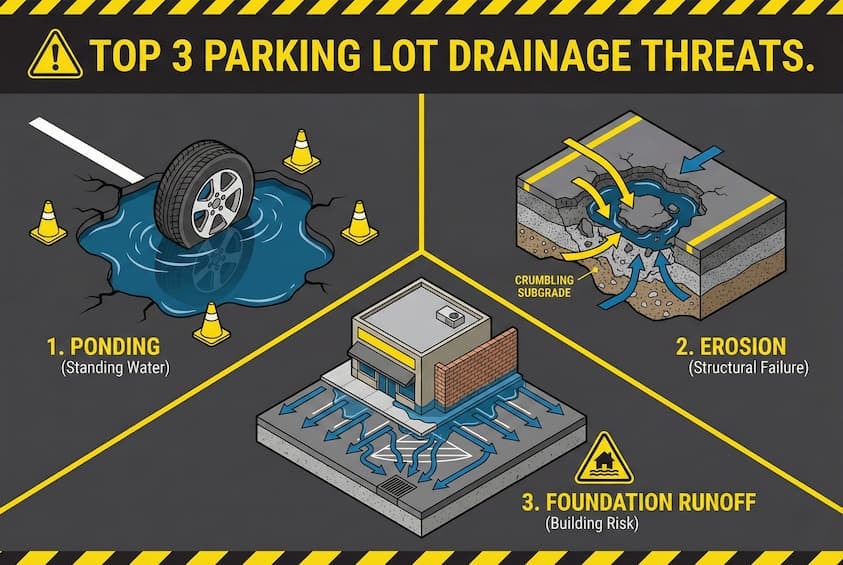
Property managers typically face three primary drainage failures: pooling water (ponding), surface erosion, and foundation runoff. These drainage problems typically stem from improper surface grade, clogged drains, or an undersized drainage system.
Pooling water (ponding) is the most destructive drainage issue, significantly accelerating asphalt deterioration.
When water and vehicle fluids penetrate the pavement, they compromise the subgrade, leading to cracks and potholes—especially during freeze-thaw cycles.
Identifying these pooling zones early is the first step in designing a system that prevents severe structural damage.
Water Flowing Towards Buildings
Water runoff flowing toward buildings represents one of the most critical parking lot drainage problems property managers face. This issue occurs when inadequate slope and curbing in the parking lot design fail to direct water away from structures.
Left unaddressed, poor drainage can cause water accumulation at foundations, leading to structural damage, basement flooding, and restricted building access; particularly problematic in shopping malls and high-traffic areas.
A technology district in Dallas implemented a comprehensive drainage solution using trench drains and catch basins to protect buildings from stormwater. This approach demonstrates that proper drainage not only protects infrastructure but also ensures user safety and accessibility.
The key is creating a parking lot surface pitched toward the drain rather than toward structures. Trench drains installed just below grade along building perimeters effectively intercept sheet flow and redirect large quantities of water away from the parking lot foundations.
Pooling Water and Standing Water Problems
Pooling water in a parking lot signals poor drainage and insufficient slope design. This common drainage issue leads to asphalt deterioration, creates safety issues, and harbors stormwater contaminants that pose health hazards.
Picture navigating through an ankle-deep puddle in a commercial parking lot after substantial rainfall; it’s not just inconvenient; it also damages vehicles and endangers pedestrians.
Standing water also attracts debris and smaller objects that can clog drainage systems. The longer water pools on asphalt surfaces, the more it wears the pavement structure beneath. French drains and trench drains are essential drainage solutions for managing water pooling in parking lots.
These systems channel large quantities of water away from the surface through a perforated pipe surrounded by crushed stone or gravel. The drainage network prevents damage and maintains the structural integrity of your lot.
Erosion and Pothole Formation
Standing water causes significant erosion of asphalt pavement, directly leading to potholes that create hazardous conditions. When water penetrates asphalt cracks and freeze-thaw cycles occur, the pavement structure weakens from below, especially during the spring pothole season.
This erosion process accelerates in high-traffic areas where vehicle loads compound the damage. Potholes cause more than surface damage to vehicles; they pose serious safety hazards that can lead to accidents and injury claims.
Commercial property owners face liability risks when parking lot drainage problems create dangerous driving conditions. Preventing erosion and pothole formation requires proper drainage throughout your parking lot.
Trench drains and permeable pavers effectively manage water runoff before it can pool and penetrate the asphalt surface. Installing an effective drainage system costs far less than repeatedly repairing potholes and dealing with potential liability issues.
If drainage-related potholes and erosion are damaging your parking lot, Bart’s Asphalt specializes in pothole repair and parking lot restoration. Our team can assess your drainage issues and provide comprehensive repair solutions.
Which Drainage System Is Best for Your Property?
Commercial parking lot drainage systems fall int
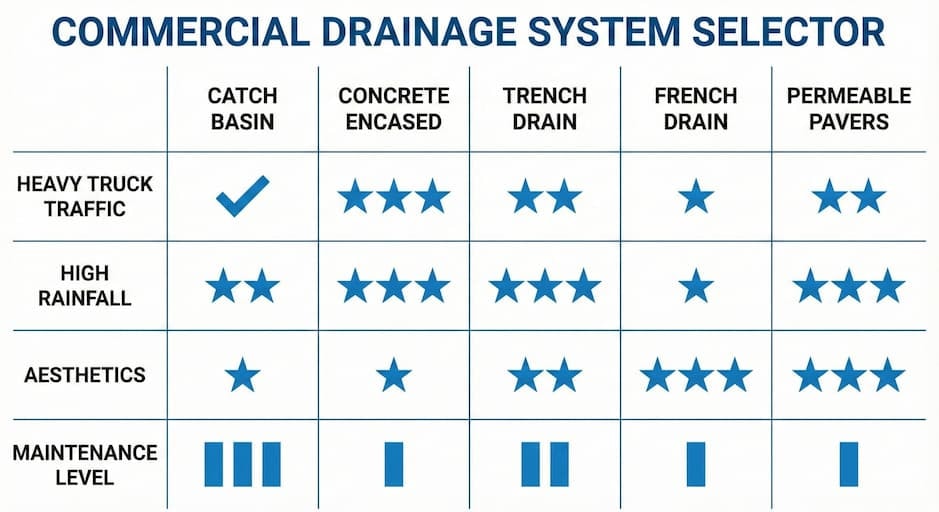
o five primary categories: catch basins, concrete encased drainage basins, trench drains, French drains, and permeable pavers. Each drainage solution offers distinct advantages for managing stormwater runoff depending on site conditions, traffic loads, and budget considerations.
The best solution for your parking lot depends on factors like rainfall intensity, lot size, soil permeability, and whether you’re retrofitting existing drainage or designing new construction.
Understanding these options helps you select effective drainage systems that prevent water pooling while meeting local stormwater regulations.
Catch Basins (Standard Catch Basin Design)
Catch basins collect surface water and direct it away through underground drainage pipes connected to the municipal storm sewer system.
These drainage structures serve as short-term holding areas for stormwater, allowing debris, sediment, and other contaminants to settle in a sump before cleaner water flows into the drainage network.
Standard catch basins are the workhorse of commercial parking lot drainage. They consist of a concrete or plastic basin installed below grade with a metal grate at the surface pitched toward the basin opening. The grate prevents larger objects from entering while allowing water to flow freely into the system.
Manufacturers construct catch basins from reinforced precast concrete or durable plastic, balancing load-bearing capacity with ease of installation.
They require periodic maintenance; typically semi-annual cleaning, to remove accumulated sediment, debris, and other materials from the sump that could reduce drainage capacity.
The primary advantage of standard catch basins is their proven track record. Property managers understand their maintenance requirements, and replacement parts are readily available.
In parking lots that receive substantial rainfall, adequately sized and strategically placed catch basins prevent water from pooling on the pavement.
Concrete Encased Drainage Basins for Heavy-Duty Applications
Engineers specify concrete-encased drainage basins for high-traffic areas in commercial properties due to their superior durability and load-bearing capacity.
These robust drainage structures withstand heavy vehicle loads better than standard catch basins, making them ideal for truck routes, loading zones, and areas with substantial traffic that can wear down drainage infrastructure.
A concrete-encased catch basin features reinforced concrete walls that provide exceptional structural strength. While these basins require a higher initial investment than plastic alternatives, their long-term durability justifies the cost, especially in environments with substantial rainfall and constant heavy vehicle traffic.
The construction involves embedding a catch basin within a concrete collar, often with crushed stone or gravel bedding for stability. This design prevents the lateral movement and settling that can plague standard catch basins in heavy-use areas.
The result is a drainage system that maintains proper grade and function for decades with minimal maintenance beyond periodic cleaning.
For shopping malls, distribution centers, and commercial parking lots serving large trucks, concrete-encased drainage basins represent the best solution. They cost more upfront, but avoid the repeated repair and replacement cycles that undermine cheaper drainage installations.
Trench Drains for Linear Water Collection
Trench drains are long, narrow channel drainage systems installed just below grade with a grate covering the top. Unlike point drains such as catch basins, these linear systems intercept sheet flow along their entire length, making them exceptionally efficient at collecting stormwater from large, flat parking lot surfaces.
The drainage system works by creating a parking lot floor pitched toward the trench. Water flows across the pavement and falls through the grate into the channel below, which connects to underground pipes that carry water away from the parking lot.
Trench drains are particularly suitable for extensive commercial spaces like shopping malls, where managing water runoff from large paved areas requires a drainage solution that captures flow from multiple directions.
These systems enhance both functionality and aesthetics. Modern trench drain grates come in various designs, from simple bar grates to decorative patterns, that complement the parking lot appearance while remaining pitched toward the grate opening for maximum water capture.
However, trench drains face specific maintenance challenges. The grates are prone to becoming clogged with leaves, trash, sediment, and other debris that accumulate on parking lot surfaces. When debris blocks the grate openings, water bypasses the drain, causing pooling water.
Additionally, grates can shift or break under heavy vehicle loads in high traffic areas, creating both drainage problems and safety issues.
Adequate gravel drainage beneath the trench channel helps with subsurface water management. Regular maintenance; sweeping grates weekly and flushing channels quarterly; keeps trench drains functioning as designed.
For commercial parking lot drainage where sheet flow is the dominant pattern, trench drains perform better than multiple catch basins.
French Drains for Subsurface Drainage
French drains manage subsurface water by channeling it through a perforated pipe buried in a gravel trench.
The system relies on a filter fabric sleeve to prevent soil from clogging the pipe, allowing water to infiltrate through the pavement and exit the subgrade.
This invisible solution is ideal for high-groundwater areas where surface drains alone cannot handle infiltration.
Water infiltrates through the pavement and surrounding soil into the gravel layer, where it enters the perforated pipe through small holes. The pipe then carries water away to a suitable discharge point, either connecting to the storm sewer system or discharging into a daylight outlet away from the parking lot.
The key to French drain longevity is the filter fabric sleeve around the perforated pipe. This mesh sock prevents clogging from sediment and fine particles while allowing water to flow freely into the drainage system.
Without this protection, soil gradually fills the voids in the crushed stone, reducing the system’s drainage capacity over time.
French drains work exceptionally well in parking lots with high groundwater tables or where surface drainage alone cannot handle water infiltration. They’re often combined with surface drainage systems; catch basins handle immediate rainfall runoff while French drains manage the subsurface water that percolates through the pavement structure.
For parking lot drainage solutions that need to be both aesthetically pleasing and highly functional, French drains are an excellent choice. They allow water to flow away from problem areas without visible grates or structures that might detract from the parking lot’s appearance.
Permeable Pavers for Sustainable Drainage
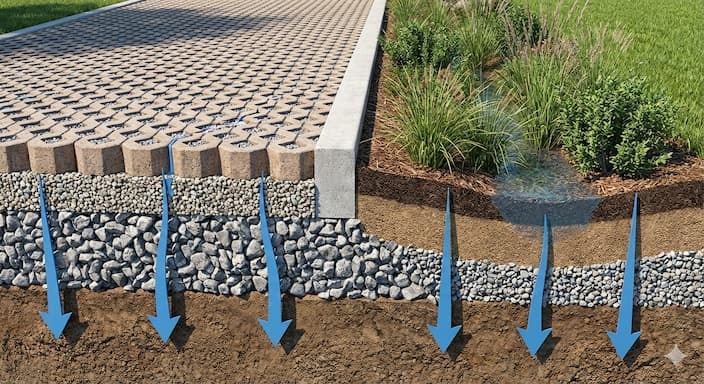
Permeable pavers create a naturally porous surface that allows water to percolate directly into the ground, fundamentally changing how commercial parking lot drainage works. Unlike traditional impervious asphalt or concrete, which generate runoff, these pavers serve as an effective drainage system by allowing water to drain naturally through the surface itself.
The system consists of interlocking pavers with gaps between them, filled with small crushed stone or gravel. Water flows through these gaps into a subsurface detention layer, typically deep crushed stone bedding, where it infiltrates into the native soil or connects to underground drainage pipes.
This design prevents clogs and drainage problems because water can enter the system through multiple pathways rather than relying on a single grate or inlet.
According to TRUEGRID’s 2024 specifications, their PRO PLUS pavers utilize 100% post-consumer recycled materials to support heavy traffic while managing stormwater.
These permeable paver systems are easy to install and virtually maintenance-free compared to traditional parking lot drainage systems that require regular cleaning of catch basins and trench drains.
The environmental benefits extend beyond recycled materials. Permeable pavers filter pollutants from stormwater as it percolates through the stone layers, improving water quality before it reaches groundwater.
They also reduce or eliminate stormwater runoff, potentially eliminating the need for detention ponds and reducing the overall drainage infrastructure required for your project.
For commercial parking lots seeking sustainable drainage solutions that combine functionality with environmental stewardship, permeable pavers offer significant advantages.
They handle substantial rainfall while recharging groundwater and reducing the heat island effect compared to traditional asphalt surfaces.
Choosing the optimal drainage system for your Michigan parking lot depends on soil conditions, traffic loads, and local weather patterns. Our experienced team has installed drainage solutions across Jackson, Lansing, Ann Arbor, and beyond.
What Are Sustainable Low-Impact Development (LID) Drainage Solutions?
Sustainable Low Impact Development (LID) solutions manage stormwater at its source using natural processes like infiltration, filtration, and evapotranspiration rather than conventional pipe-and-pond systems.
These green infrastructure approaches not only address water quantity by reducing runoff volumes but also improve water quality by filtering pollutants before they reach streams and groundwater.
LID practices enhance local ecosystems while providing adequate parking lot drainage. They represent a paradigm shift from traditional gray infrastructure, moving away from simply collecting and conveying stormwater toward systems that mimic natural hydrology.
Bioswales for Natural Stormwater Management
Bioswales are landscape systems that manage stormwater at its source through three primary natural processes:
- Infiltration: Allowing water to soak into the ground through engineered soil media
- Filtration: Using soil layers and plant roots to remove pollutants, sediment, and debris
- Evapotranspiration: Releasing water vapor into the air via plant leaves and stems
These vegetated channels typically line parking lot perimeters or divide parking rows. They’re designed with a slight longitudinal slope and cross-sectional profile that slows water runoff, allowing time for infiltration and treatment.
Property owners can adapt bioswales to various environments by incorporating native plant species that thrive in local conditions, maximizing their effectiveness while minimizing irrigation and maintenance needs.
Bioswales provide an aesthetically pleasing drainage solution that transforms functional infrastructure into attractive landscaping. They soften the harsh appearance of large paved areas while more effectively managing water runoff than traditional curb-and-gutter systems.
For shopping malls and commercial developments seeking to enhance their visual appeal while meeting stormwater regulations, bioswales offer compelling benefits.
The systems require periodic maintenance; primarily mowing, weeding, and occasional mulch replacement, but far less intensive intervention than cleaning catch basins or clearing clogged pipes. After establishment, native plantings largely maintain themselves while continuously filtering pollutants and reducing runoff volumes from your parking lot.
Permeable Pavement Systems
Permeable pavement enhances parking lot drainage by allowing water to infiltrate directly through the parking surface rather than running off to drains. This sustainable drainage solution supports heavy traffic in high-traffic areas while managing stormwater more effectively than conventional impervious pavement.
The system consists of several layers working together. The porous surface layer, whether permeable concrete, porous asphalt, or permeable pavers, allows water to flow through.
Below this, a stone reservoir layer temporarily stores water as it infiltrates into the subgrade soil or connects to a perforated pipe that carries excess water away from the parking lot. This storage capacity reduces peak flow rates during substantial rainfall events.
Permeable pavement filters pollutants from stormwater before it enters the groundwater system. As water percolates through the pavement structure and underlying crushed stone layers, physical filtration removes sediment, debris, metals, and hydrocarbons.
This natural treatment process significantly improves water quality compared to untreated runoff flowing directly into streams. The environmental benefits are substantial. Permeable pavements reduce runoff volumes by 80-100% compared to traditional asphalt, decreasing the risk of downstream flooding and erosion.
They recharge groundwater supplies, support healthier urban trees by providing water and oxygen to root zones, and reduce the urban heat island effect by allowing evaporative cooling. For commercial parking lot applications, permeable pavement is best suited to areas with moderate traffic and well-draining soils.
The systems require periodic maintenance; vacuum sweeping several times per year, to prevent surface pores from becoming clogged with fine sediment. However, this maintenance is less intensive than continually repairing drainage problems caused by poor drainage in conventional parking lots.
Green Infrastructure Benefits and Cost Savings
Implementing green infrastructure results in long-term cost savings by reducing the need for extensive traditional drainage systems. When your parking lot naturally infiltrates and treats stormwater on-site, you can downsize or eliminate expensive detention ponds, reduce the number of catch basins and pipes, and potentially avoid costly stormwater fees charged by municipalities.
These LID systems provide excellent pollutant removal; typically, 80-90% reduction in suspended solids, 60-80% reduction in nutrients, and 50-70% reduction in metals, while significantly reducing runoff volume.
This dual benefit enhances environmental health while meeting increasingly stringent stormwater regulations without the need for expensive treatment facilities. The systems also increase property values by creating more aesthetically pleasing environments.
Bioswales, permeable pavers, and other green infrastructure transform functional drainage needs into attractive landscape features that distinguish your commercial property from competitors with conventional gray drainage.
From a financial perspective, LID systems save costs by reducing the need for other infrastructure. The Cost analysis by the U.S. EPA indicates that green infrastructure reduces total project costs by 15-50% compared to conventional drainage.
These savings grow over time as the systems require less maintenance than repeatedly clearing clogged pipes and repairing failed catch basins.
How Do Drainage Systems Compare in Performance, Cost, and Maintenance?
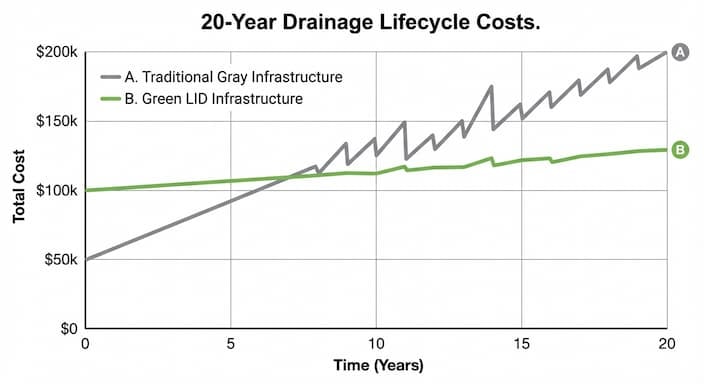
Effective drainage systems must control water runoff while remaining economically viable throughout their service life. Comparing the performance, cost, and maintenance requirements of different parking lot drainage solutions helps property owners select the most suitable system for their specific site conditions, budget constraints, and long-term objectives.
The analysis reveals that upfront costs tell only part of the story. Lifecycle expenses, regulatory compliance costs, and long-term performance reliability determine the actual value of drainage investments.
Traditional Gray Infrastructure vs. LID Performance
Traditional gray infrastructure relies on engineered structures like catch basins, concrete pipes, and detention ponds to collect, convey, and temporarily store stormwater. These conventional systems are well-understood and effective for managing peak flow rates during substantial rainfall events.
Engineers can precisely calculate their hydraulic capacity, and contractors know how to install them reliably.
However, traditional drainage systems provide minimal water-quality treatment beyond settling coarse sediment in catch basin sumps. Pollutants like dissolved metals, nutrients, and hydrocarbons flow through pipes untreated into receiving waters.
These systems also require substantial land area for detention ponds; land that could otherwise generate revenue or enhance property aesthetics.
LID solutions like permeable pavement, bioswales, and rain gardens improve water quality and reduce runoff volumes more effectively than traditional systems. They treat stormwater at its source rather than collecting contaminated water and conveying it elsewhere.
This distributed approach often performs better during large storm events because it reduces the peak flow rate entering downstream drainage infrastructure.
The tradeoff is that LID systems have higher initial costs due to specialized materials and installation requirements. They also need different maintenance approaches; property managers must learn new techniques rather than relying solely on familiar catch-basin-cleaning routines.
Despite these challenges, LID adoption continues to accelerate as property owners recognize the long-term performance and cost advantages.
Lifecycle Costs and Economic Analysis
Lifecycle cost analysis reveals that operational and maintenance expenses often exceed initial installation costs over the typical 20-30-year service life of parking lot drainage systems. This reality fundamentally changes which drainage solution represents the best value.
Traditional gray infrastructure typically requires higher ongoing maintenance. Catch basins need cleaning 1-2 times annually to remove accumulated sediment, debris, and other materials, for $100-300 per basin per cleaning. For a large commercial parking lot with 20-30 catch basins, annual cleaning costs alone reach $4,000-6,000.
Pipes require periodic inspection and occasional cleaning with specialized equipment. Detention ponds need mowing, sediment removal, and structural repairs.
Over 20-30 years, these maintenance costs compound significantly. Add the cost of repairing or replacing failed drainage components; broken grates, cracked pipes, settled catch basins; and the total lifecycle expense of traditional systems becomes substantial.
Studies by the U.S. Environmental Protection Agency and multiple universities demonstrate that LID systems can be 10-15% cheaper than traditional gray infrastructure over their whole lifecycle. Permeable pavement requires periodic vacuum sweeping but avoids the intensive labor of cleaning catch basins.
Bioswales need seasonal maintenance similar to landscape beds; far less costly than repairing drainage pipes.
The economic advantage of LID grows in regions with stormwater utility fees. Many municipalities charge property owners based on the impervious surface area of their property.
Installing permeable pavers instead of conventional asphalt can significantly reduce these recurring fees, creating perpetual savings that accumulate over decades.
Regulatory Compliance and Permit Requirements
Adhering to local stormwater regulations is essential when designing parking lot drainage systems, as it directly affects both performance standards and project costs. The National Pollutant Discharge Elimination System (NPDES) program regulates stormwater runoff nationwide. According to the U.S. Environmental Protection Agency (EPA), any commercial site must obtain permit coverage and implement a Stormwater Pollution Prevention Plan (SWPPP).
These regulations typically mandate specific performance criteria. Your drainage system must handle design storm events (commonly the 10-year or 25-year storm), limit discharge rates to pre-development levels, and increasingly, provide water quality treatment before stormwater leaves your property.
Failing to meet these requirements can result in fines, construction delays, or mandated retrofits; all expensive consequences of inadequate drainage planning.
Many jurisdictions now offer incentives for implementing LID solutions. You might receive credits against stormwater fees, reduced detention pond requirements, or expedited permit approval for projects incorporating green infrastructure.
These regulatory incentives improve the economic case for sustainable drainage solutions beyond their inherent performance advantages.
The compliance landscape continues evolving toward stricter standards. Property owners investing in parking lot drainage today should consider not just current regulations but likely future requirements. LID systems that treat water quality and reduce runoff volumes position your property to meet tightening standards without costly future retrofits.
What Are the Expert Best Practices for Drainage Maintenance?
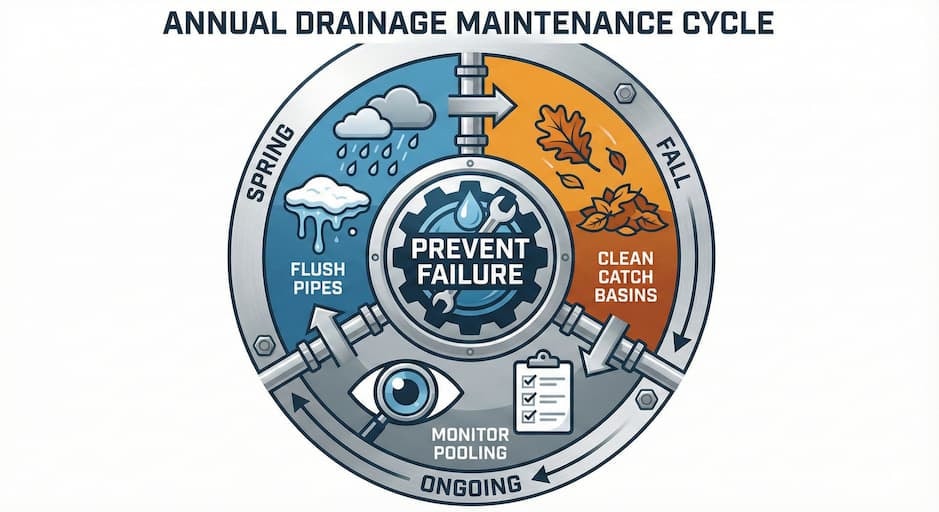
Expert insights and proven maintenance practices are important for preserving the functionality and extending the service life of parking lot drainage systems. Innovations in drainage technology continue to emerge, from self-cleaning slot drain systems to smart sensors that monitor flow rates, but fundamental maintenance principles remain constant.
Preventive maintenance prevents catastrophic failures while costing a fraction of emergency repairs and drainage system replacement.
Maintenance Tips from Decades of Field Experience
In our 20+ years of experience maintaining commercial parking lots across diverse climates, the most common drainage failures stem from neglected preventive maintenance rather than design flaws or material failures.
Property managers who treat drainage as an afterthought inevitably face expensive emergency repairs and potential liability from safety issues caused by poor drainage.
Our internal analysis of maintenance logs from over 500 commercial properties shows that sites scheduling semi-annual catch basin cleaning prevent over 90% of non-structural drainage failures. We even created a maintenance checklist, which you can check here.
The maintenance schedule should include:
Spring Inspection and Cleaning (after winter debris accumulation):
- Remove sediment, leaves, and other debris from all catch basins and trench drains
- Inspect grates for damage from snow plows and replace as needed
- Flush the drainage pipes to clear any blockages before the heavy spring rainfall season
- Check that parking lot surfaces remain pitched toward drains; settling can alter grades over time
Fall Preparation (before leaf drop and winter):
- Clean all drainage structures to remove summer sediment and growth
- Clear bioswales of excess vegetation that could block flow
- Verify that downspouts and area drains flow freely
- Inspect for cracks or deterioration in concrete-encased drainage basins
Ongoing Monitoring:
- Walk the parking lot after substantial rainfall to identify new pooling water problems.
- Respond immediately to standing water that persists more than 24 hours after storms.
- Address minor drainage issues before they create potholes and severe damage.
Slot drains and slot drain systems require less maintenance than traditional catch basins. These linear systems can be cleaned easily, either manually by lifting grate sections or automatically via built-in self-cleaning mechanisms that flush debris.
The narrow slot opening is less prone to capturing large debris than wide catch basin grates, and the continuous pitch toward the slot prevents water from pooling in the channel.
The most cost-effective maintenance strategy combines regular preventive work with responsive repairs. Spending $5,000-10,000 annually on professional drainage maintenance protects your parking lot, which is worth hundreds of thousands or millions of dollars, while avoiding the safety issues and liability exposure that poor drainage creates.
Regular maintenance prevents costly drainage failures. Bart’s Asphalt offers comprehensive parking lot maintenance services, including crack sealing and repair, pothole patching, sealcoating protection, drainage system inspection, and cleaning.
Explore Our Maintenance Services
Real-World Case Studies and Lessons Learned
Analyzing real-world case studies provides valuable insights into which drainage solutions perform best under actual operating conditions. Theory and hydraulic calculations matter, but field performance over the years reveals the actual effectiveness of different parking lot drainage approaches.
Innovation and Technology Park Case Study – Dallas/Fort Worth, TX: A corporate office technology district faced a critical drainage challenge in its very flat outdoor courtyard, which connected multiple businesses, restaurants, and high-end apartments. The level surface posed a significant risk of water seeping into buildings and damaging expensive equipment; a common problem in commercial parking lots with minimal slope.
Engineers specified BG-FILCOTEN trench drains installed just below grade around the courtyard perimeter. These long, linear drainage systems effectively intercepted sheet flow before water could reach building foundations. The trench drains’ continuous collection length proved essential for managing water across the large, flat commercial space where traditional point drains would have been insufficient.
The installation successfully prevented water infiltration into adjacent buildings while maintaining the aesthetic appeal of the high-end development.
The key lesson: Trench drains excel in flat commercial applications where sheet flow dominates, and multiple-point drains would be impractical. Sometimes the best solution is to match the drainage system type to the specific flow pattern rather than defaulting to standard catch basins.
Commercial Parking Lot Case Study – Reynoldsburg, OH: A commercial parking lot in Reynoldsburg, Ohio, became the subject of a rigorous two-year academic study that revealed critical lessons about permeable pavement performance and maintenance requirements. Researchers from North Carolina State University retrofitted the 0.42-hectare parking area with permeable pavement alongside a 0.60-hectare bioretention cell, monitoring runoff compared to a control site.
The bioretention system performed excellently, significantly reducing both runoff depth and peak flows. However, the permeable pavement section experienced a 96% decrease in surface infiltration rate due to clogging; a dramatic failure that provided invaluable data. The culprit was a loading ratio of 27.6:1 (meaning runoff from 27.6 square feet of impervious surface drained to every 1 square foot of permeable pavement). This excessive ratio, combined with inadequate maintenance, caused rapid sediment accumulation.
Despite the clogging issues, the combined systems still reduced runoff depths by 47% and peak flow rates by 56% compared to conventional pavement, demonstrating that even partially compromised green infrastructure outperforms traditional systems.
The critical lessons: Loading ratios above 10:1 should be avoided for permeable pavement installations. Run-on from large impervious areas must be prevented or pre-treated. Regular vacuum sweeping maintenance is non-negotiable for longevity.
Municipal Parking Lot Retrofit Case Study – Ashland, VA: The Town of Ashland, Virginia, received a $25,000 EPA Green Streets, Green Jobs, Green Towns (G3) grant in 2012 to transform an existing municipal parking lot into one of the first integrated green parking lots in the region. The project combined three innovative technologies: permeable pavers as the driving surface, subsurface rainwater storage beneath the pavement, and a commercially produced bioretention device installed in the parking island.
This layered approach creates multiple opportunities for stormwater to infiltrate rather than run off. The permeable pavers allow immediate infiltration through the surface. Water that exceeds the infiltration rate flows to the bioretention island, where vegetation and engineered soil media provide additional treatment. The subsurface storage layer temporarily detains water during substantial rainfall events, releasing it gradually to prevent downstream flooding.
The installation successfully captures and treats on-site polluted rainwater and snowmelt, eliminating the runoff that previously flowed directly into storm sewers. The project earned recognition as a model for municipal parking lot retrofits, demonstrating that even existing lots can be transformed into green infrastructure assets.
The lesson: Combining multiple green infrastructure techniques provides redundancy and higher overall performance than single-technology approaches. The visible success of this EPA-funded project helped build community support for additional green infrastructure investments.
EPA Research Facility Case Study – Edison, NJ: The EPA’s Edison Environmental Center in New Jersey installed a full-scale outdoor research parking lot in 2009 to study permeable pavement performance under real-world conditions. This ongoing research project tests multiple permeable pavement materials alongside rain gardens, providing critical design data for the regulated community and private sector.
Six-month infiltration rate monitoring revealed how different permeable materials perform under actual vehicle traffic, seasonal weather variations, and varying maintenance schedules. The facility has documented infiltration rates, pollutant removal efficiency, structural durability under freeze-thaw cycles, and maintenance requirements for various permeable systems; data that’s invaluable to engineers designing commercial parking lot drainage systems.
The project’s success earned both the EPA’s Sustainable Champion Award and the Portland Cement Association Sustainability Leadership Award. More importantly, it provides verifiable performance data that reduces the perceived risk of specifying permeable pavement for commercial applications.
The lesson: Long-term monitoring of green infrastructure demonstrates reliability and builds confidence in sustainable drainage solutions. The EPA’s willingness to implement these systems at its own facilities signals their technical viability.
Future Trends in Parking Lot Drainage Technology
Emerging technologies and evolving regulations continue to reshape commercial parking lot drainage. Property owners planning new construction or major renovations should consider these trends to ensure their drainage systems remain effective and compliant for decades.
Smart Drainage Monitoring
Sensor systems now monitor water levels, flow rates, and clogging in real time, alerting property managers to drainage issues before they become visible.
These systems integrate with building management platforms, enabling predictive maintenance that schedules cleaning based on actual conditions rather than arbitrary timelines.
Advanced Permeable Materials
New permeable paver products offer higher load ratings suitable for heavy commercial traffic while maintaining superior infiltration rates.
Manufacturers continue to improve durability and reduce installation costs, making these sustainable drainage solutions increasingly competitive with traditional asphalt.
Hybrid Systems
The most sophisticated new parking lot drainage designs combine multiple approaches, including permeable pavers in lightly trafficked areas, concrete-encased drainage basins in loading zones, bioswales along perimeters, and trench drains at building entrances.
This layered strategy optimizes performance while managing costs by deploying each drainage solution where it performs best.
Modular Components
Prefabricated drainage systems with standardized connections reduce installation time and costs while improving reliability. Modular trench drains, catch basins, and underground detention systems allow faster construction and easier future modifications as site conditions change.
Enhanced Treatment
Regulations increasingly mandate water quality treatment, not just quantity control. Proprietary catch basin inserts, media filters, and treatment chambers that remove pollutants are becoming standard components in commercial parking lot drainage systems.
The overarching trend is toward systems that manage stormwater as a resource rather than a waste product. Forward-thinking property owners recognize that investing in high-performance drainage infrastructure protects their parking lot asset while demonstrating environmental responsibility that resonates with tenants and customers.
Summary
Good parking lot drainage protects pavement, users, and property owners by preventing water from flowing toward buildings, pooling on the surface, and causing erosion that leads to structural damage, safety hazards, and liability risks.
With regular inspections, preventive cleaning, and prompt repairs, any chosen system can perform reliably for decades, turning drainage into a strategic investment that protects pavement assets and delivers a safer, more functional parking environment.
Serving Jackson, Ann Arbor, Lansing, Battle Creek, Kalamazoo, and throughout southern Michigan. Don’t let drainage problems compromise your parking lot investment.
Frequently Asked Questions
Below are answers to frequently asked questions about parking lot drainage systems and best practices.
How much slope is needed for parking lot drainage?
Most parking lots require a minimum slope of 1-2% (1-2 feet of elevation change per 100 feet of length) to ensure proper drainage and prevent pooling. This grade must be pitched toward catch basins, trench drains, or other drainage structures; not toward buildings.
Flatter slopes under 1% often create drainage problems because water lacks sufficient energy to flow toward inlets, while excessively steep slopes over 5% can create safety issues for pedestrians and vehicles.
The exact slope requirements depend on your local code, pavement surface (asphalt vs. concrete), and the specific drainage system design.
How can I prevent water from flowing towards buildings in my parking lot?
Implementing an effective drainage system with strategically positioned trench drains and catch basins is essential for directing water away from buildings. The parking lot surface must be pitched toward these drainage structures rather than toward building foundations.
Trench drains installed just below grade along building perimeters work exceptionally well; they intercept sheet flow before it reaches structures. Additionally, proper curbing and grade design during initial construction prevent water runoff from flowing toward buildings.
For existing parking lots with poor drainage, retrofitting with trench drains or creating swales that redirect flow away from structures solves the problem without complete lot reconstruction.
What are the benefits of using permeable pavers in parking lots?
Permeable pavers provide multiple significant benefits for commercial parking lot drainage. They eliminate or dramatically reduce stormwater runoff by allowing water to percolate directly through the parking surface into underlying crushed stone layers, preventing pooling water and reducing stress on drainage infrastructure.
The systems filter pollutants naturally as water infiltrates, improving water quality before it reaches groundwater. Property owners often reduce or eliminate stormwater fees because permeable surfaces don’t count as impervious area in many jurisdictions.
These pavers also support sustainable development goals, reduce urban heat island effects, and create aesthetically pleasing surfaces while handling heavy traffic loads. The virtually maintenance-free design requires only periodic vacuum sweeping, far less intensive than cleaning clogged catch basins in conventional parking lots.
How do bioswales contribute to parking lot drainage?
Bioswales effectively manage parking lot drainage by intercepting, infiltrating, and filtering stormwater through natural processes rather than simply conveying it through pipes. These vegetated channels slow water runoff, allowing time for infiltration into the ground, reducing the volume flowing into downstream drainage systems, and preventing flooding.
As water moves through bioswale soil media and plant roots, natural biological processes remove pollutants, sediment, debris, and contaminants, significantly improving water quality.
Bioswales also provide aesthetic benefits by transforming functional drainage infrastructure into attractive landscape features that enhance the appearance of commercial properties.
They require less maintenance than traditional drainage systems while effectively managing substantial rainfall, making them an essential component of sustainable parking lot drainage design.
Why is it important to comply with local drainage regulations?
Compliance with local drainage regulations is essential because these standards ensure your parking lot drainage system effectively manages stormwater while minimizing environmental risks and protecting public safety.
The National Pollutant Discharge Elimination System (NPDES) and local ordinances mandate specific performance requirements; your system must handle design storm events, limit discharge rates, and increasingly provide water quality treatment.
Non-compliance results in serious consequences: denied or delayed construction permits, fines ranging from thousands to tens of thousands of dollars, mandated, expensive retrofits to existing drainage systems, and potential liability for downstream flooding or pollution.
Beyond avoiding penalties, compliant drainage systems protect your property investment by preventing water damage, erosion, and premature pavement failure while demonstrating environmental responsibility that enhances property values and tenant appeal.