

Yes, asphalt is typically 20-30% cheaper to install than concrete for commercial properties. In Southeast Michigan, hot-mix asphalt costs $3–$7 per square foot, while commercial concrete ranges from $5–$10 per square foot. However, asphalt requires sealcoating every 3-5 years to maintain its long-term cost advantage.
The cost comparisons are wrong, the climate assumptions are wrong, and the maintenance math almost never accounts for what Michigan winters actually do to pavement.
So here’s what this guide focuses on instead. It’s built specifically for commercial properties in Southeast Michigan — with real 2026 pricing, a clear breakdown of where the long-term cost difference actually lives, and an honest answer to when concrete genuinely makes more sense than asphalt. For a closer look at long-term asphalt maintenance costs, including what you’ll pay to keep a commercial parking lot protected year after year, that’s covered in detail as well.
Bart’s Asphalt works with both materials, which means the goal here isn’t to sell you blacktop. It’s to help you make the decision that’s right for your property, your budget, and your operations.
Key Takeaways
- For commercial parking lots in Southeast Michigan, hot-mix asphalt typically costs $3–$7 per square foot installed, while concrete lots usually run $5–$10 per square foot in 2026 dollars.
- Asphalt is usually 20–30% cheaper to install initially and can be open to traffic in 24–48 hours, while concrete may need up to 7 days for light traffic and up to 28 days to fully cure.
- National data shows concrete can have 20–25% lower life-cycle costs in some climates, but Michigan’s freeze–thaw cycles and road salt often make asphalt the more practical and cost-controllable choice for commercial lots.
- For a typical mid-size parking lot or two-lane commercial drive, asphalt can save tens of thousands of dollars upfront — especially on large square footage like schools, apartment complexes, and industrial yards.
- Both asphalt and concrete have their place on commercial sites; the right material depends on traffic patterns, load requirements, and your long-term maintenance commitment.
Why “Is Asphalt Cheaper Than Concrete?” isn’t a Simple Yes/No
You’ve got two quotes sitting on your desk. One contractor recommends asphalt, the other recommends concrete. The numbers look different, the timelines look different, and now you’re trying to figure out which paving material actually makes more sense for your Southeast Michigan commercial property.
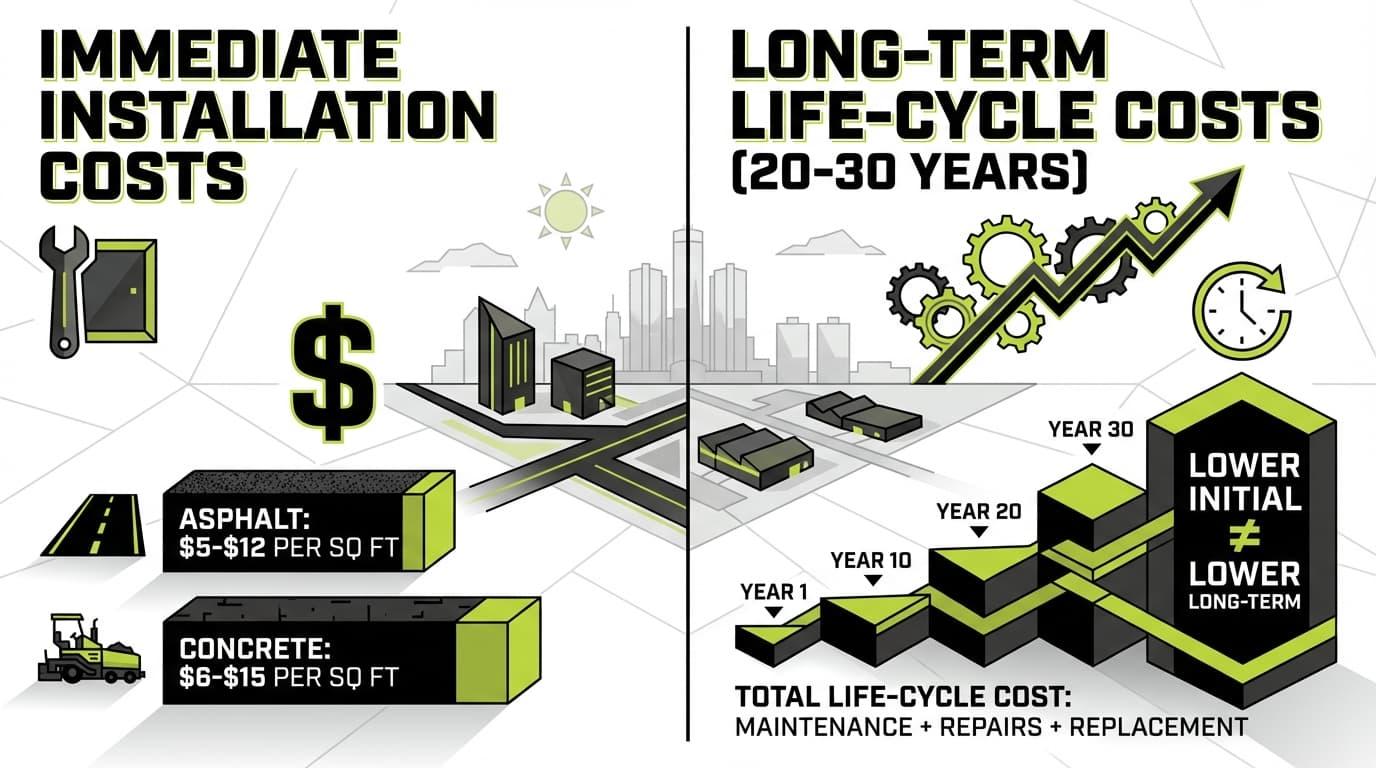
Truth is, “cheaper” has two dimensions that matter to property managers. There are the initial installation costs, which you pay this year to get the lot paved. Then there’s life-cycle cost over 20–30 years, which includes long-term maintenance costs, downtime during repairs, and eventual replacement.
National residential articles often quote $5–$12 per square foot for an asphalt driveway and $6–$15 per square foot for a concrete driveway, but commercial projects operate under different rules. Vehicle traffic loads are heavier, base prep is more intensive, and drainage requirements are stricter.
Bart’s Asphalt works as a commercial asphalt specialist who also understands concrete. Bart’s Asphalt’s position as a dual-material commercial specialist matters because the objective is to align pavement material selection with the property’s specific load requirements and capital budget, rather than fulfilling a single-product sales quota.
The rest of this guide walks through upfront cost comparisons, long-term maintenance costs, Michigan climate realities, operational downtime, and when concrete genuinely makes sense on a commercial site.
Managing a commercial lot in Southeast Michigan, and not sure which material fits your budget? Bart’s Asphalt provides honest side-by-side cost projections, no sales pitch.
Request A Free Site Evaluation
What Is the Initial Cost Difference Between Commercial Asphalt and Concrete?
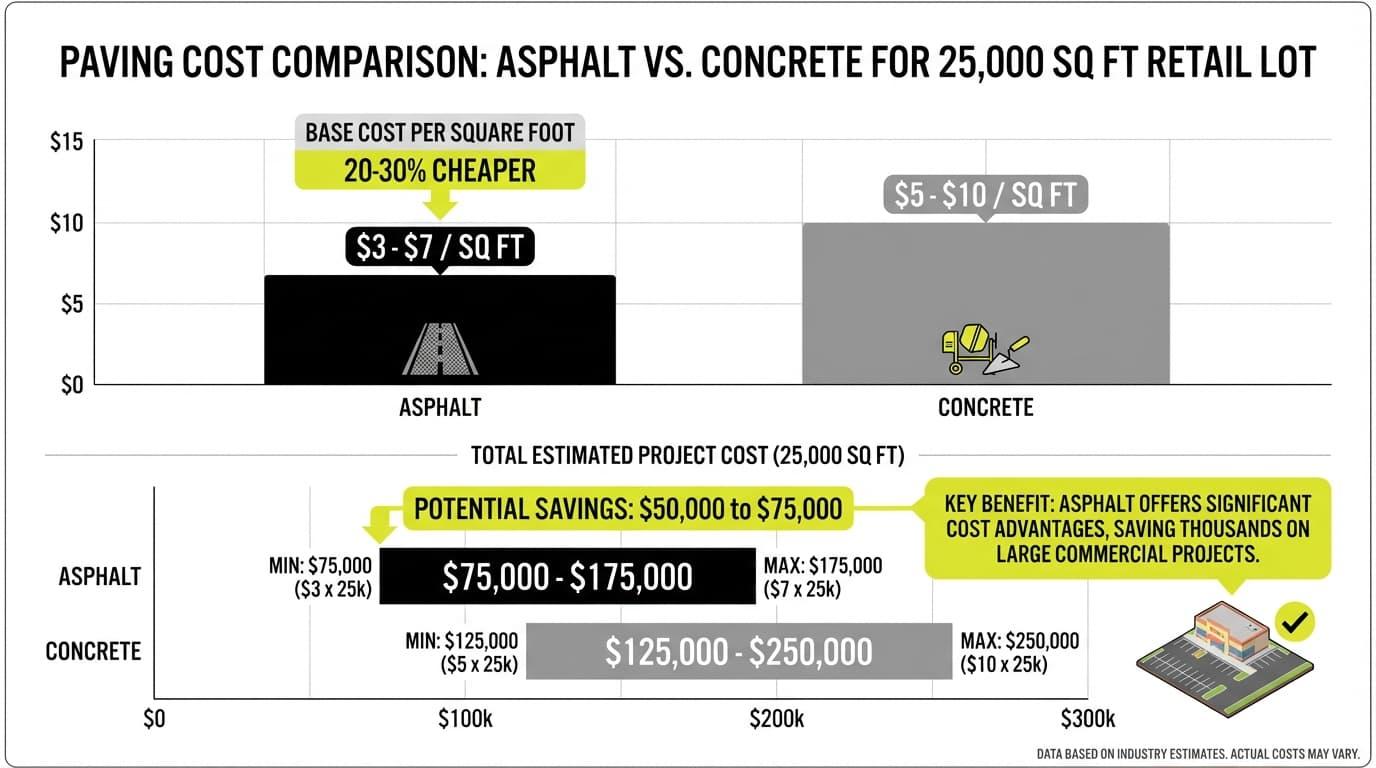
The initial installation cost for commercial hot-mix asphalt in 2026 is $3–$7 per square foot, whereas concrete installations range from $5–$10 per square foot.
These commercial rates are slightly lower than national residential averages due to scale efficiencies, despite requiring thicker base layers and stricter drainage parameters.
For a standard 25,000-square-foot retail lot, this results in an immediate capital savings of $50,000 to $75,000 when choosing asphalt over concrete.
Typical 2026 commercial install ranges in Michigan show asphalt hot-mix lots at roughly $3–$7 per square foot, while concrete lots run approximately $5–$10 per square foot. Heavier-duty sections — truck lanes, loading docks — push both toward the high end of each range.
For context, national residential benchmarks show asphalt at $5–$12 per square foot and concrete at $6–$15 per square foot. Commercial jobs often come in slightly lower per square foot because of scale efficiencies, but the total project cost rises due to thicker sections, more robust base work, and stricter drainage requirements.
Here’s a concrete example: a 25,000-square-foot retail center lot in Michigan might cost approximately $100,000–$150,000 for asphalt versus $150,000–$225,000 for concrete, depending on thickness, sub-base conditions, and drainage corrections needed. That cost difference can represent a significant portion of your capital budget.
For roads, global data from a 2025 Kaushik Engineering Works analysis shows asphalt’s initial road construction cost per kilometer can be 30–40% lower than concrete. That percentage savings pattern tends to hold for larger commercial parking projects as well.
Why is asphalt generally cheaper upfront? – The binder (bitumen) costs less than Portland cement.
The installation process requires fewer labor hours. Equipment staging for large areas is simpler and faster. In most Michigan commercial bid comparisons, asphalt comes in 20–30% cheaper to install initially than an equivalent-strength concrete design.
How Does Commercial Lot Size Impact Paving Installation Costs?
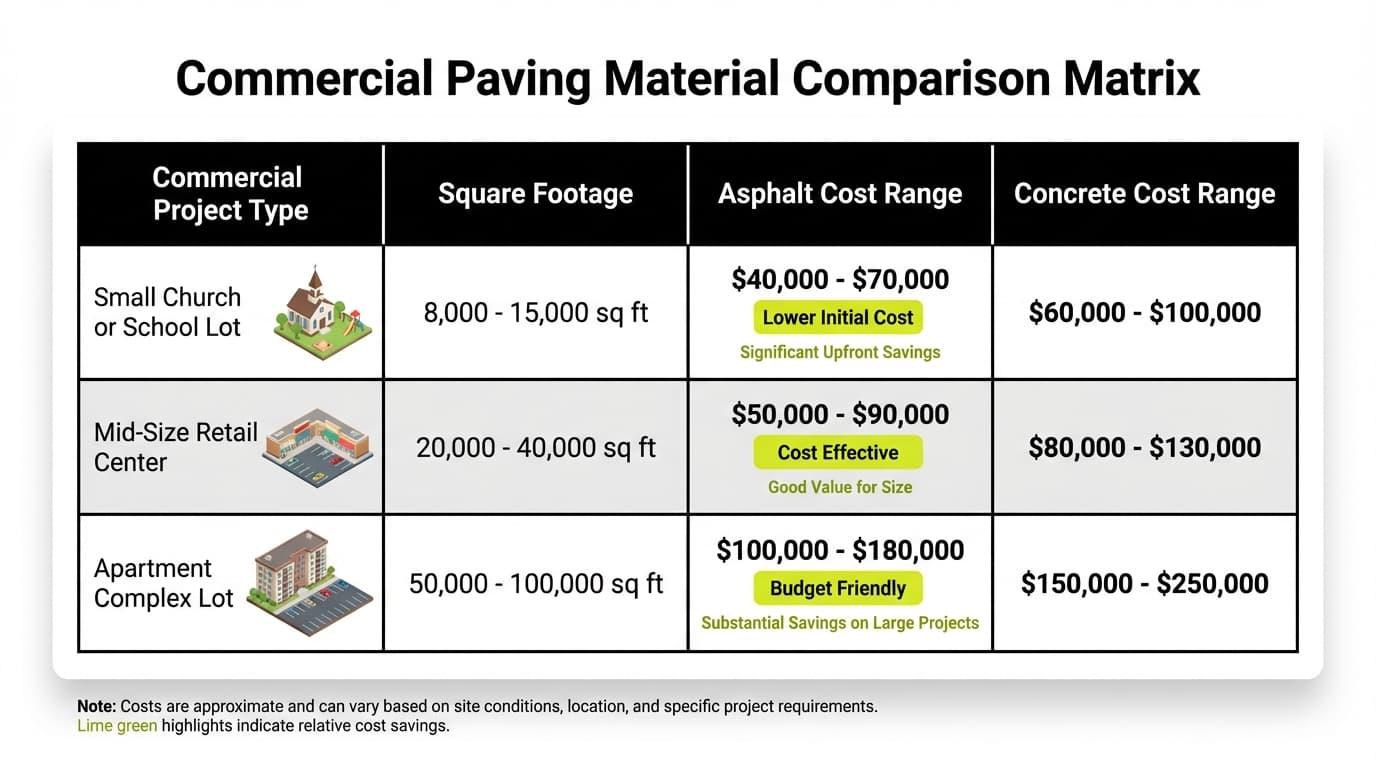
Cost per square foot only tells the full story when tied to actual project sizes and traffic categories — light, medium, or heavy-duty commercial use. Consider these realistic Michigan commercial examples:
See where your lot falls in these ranges. Bart’s Asphalt can turn around a line-item estimate within 24 hours of a site visit.
Get Your Custom Estimate Today!
Mobilization, base repair, and drainage upgrades have a fixed component regardless of lot size. This makes smaller projects feel more expensive per square foot than large ones for both paving materials. Remote sites or tight urban lots may add access premiums, but the asphalt-to-concrete gap in initial installation costs usually remains roughly the same.
Bart’s Asphalt provides line-item estimates covering base work, paving, striping, and curbs, so property managers can see exactly where dollars differ between asphalt and concrete options.
Long-Term Cost: Is Asphalt Still Cheaper Over 20–30 Years?
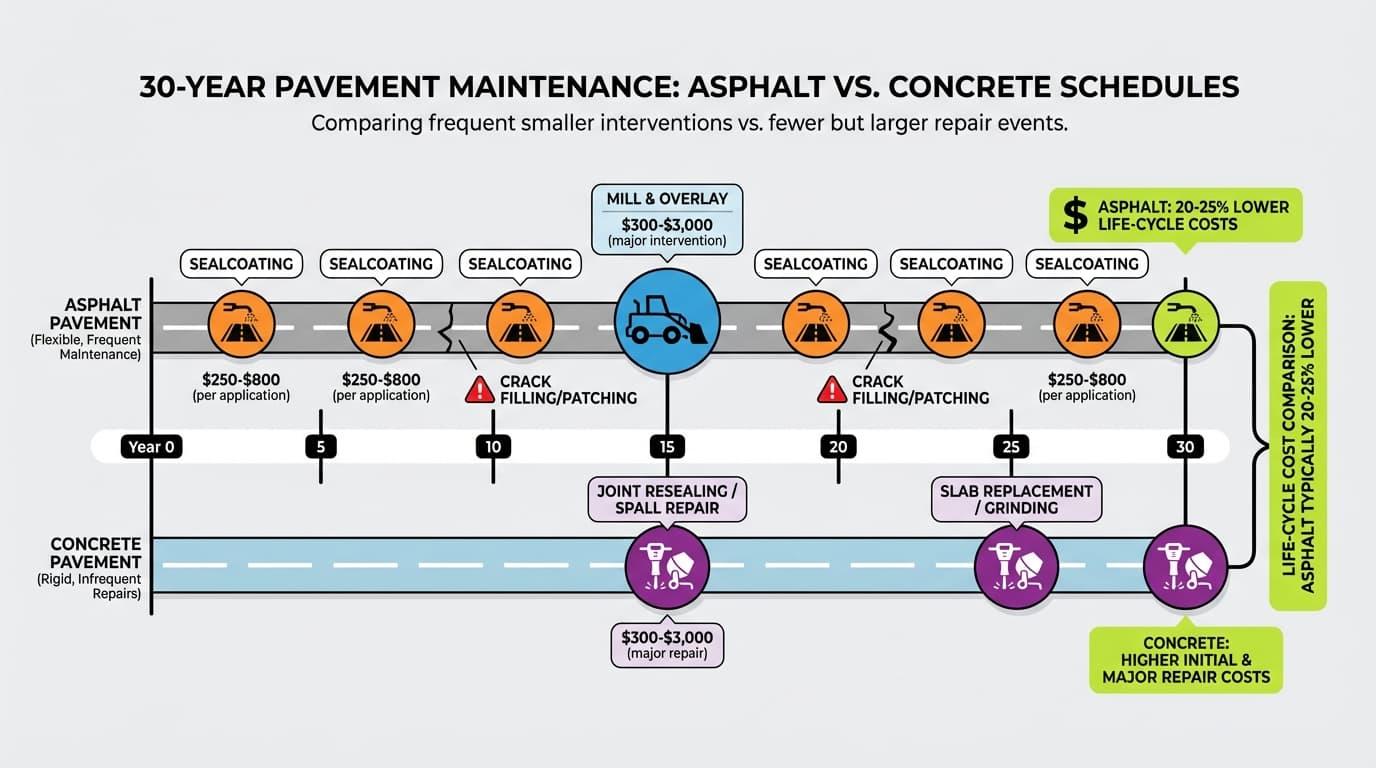
Many national and academic studies focus on highways and show concrete often winning on life-cycle cost. But highway results aren’t a one-to-one match for Michigan parking lots, where freeze–thaw cycles, salt exposure, and snowplow traffic create very different stress patterns.
Federal Highway Administration and SCB Construction Group data indicate that concrete pavements can have 20–25% lower life-cycle costs than asphalt pavements in some settings, due to fewer major rehabilitation cycles over decades. That’s a real advantage, in the right climate and with the right maintenance discipline.
A 30-year cost comparison for a 600-square-foot surface shows concrete at roughly $6,500–$8,000, while asphalt is approximately $8,000–$10,000. But these numbers shift significantly for larger commercial areas where maintenance intensity and Michigan’s climate can swing the overall cost math considerably.
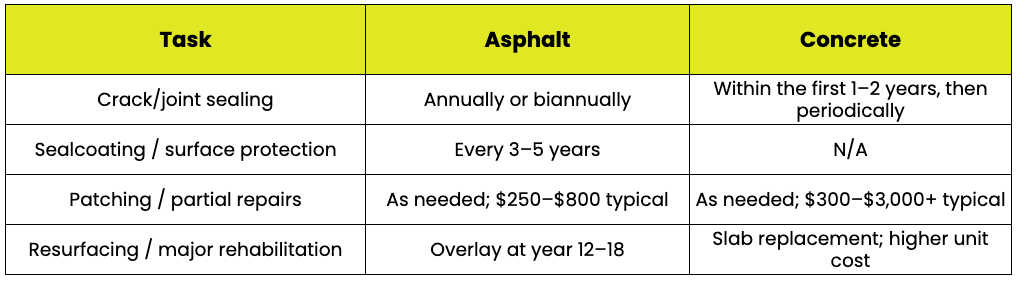
Asphalt requires more frequent maintenance, sealcoating every 3–5 years and periodic crack filling, but individual repair events are relatively inexpensive and quick. Common asphalt repairs run $250–$800, while concrete repairs often reach $300–$3,000 or more when slab replacement is needed.
Although asphalt maintenance is more frequent, it’s predictable. Sealcoating and crack repairs can be scheduled during off-hours, helping commercial properties spread costs and minimize disruption to tenants and customers.
The “cheaper long-term” argument for concrete depends heavily on assumptions about climate, load patterns, and how rigorously an owner sticks to a maintenance plan.
For Southeast Michigan commercial properties that budget for regular asphalt maintenance, the real question becomes less about the absolute lowest 30-year NPV and more about which surface lets you manage cash flow and avoid surprise downtime. That calculation often favors asphalt.
Want to see the 20-year math for your specific lot size and traffic load? Bart’s Asphalt builds multi-year cost projections for commercial clients across Southeast Michigan.
Schedule A Consultation Today!
Maintenance Schedules and Typical Interventions
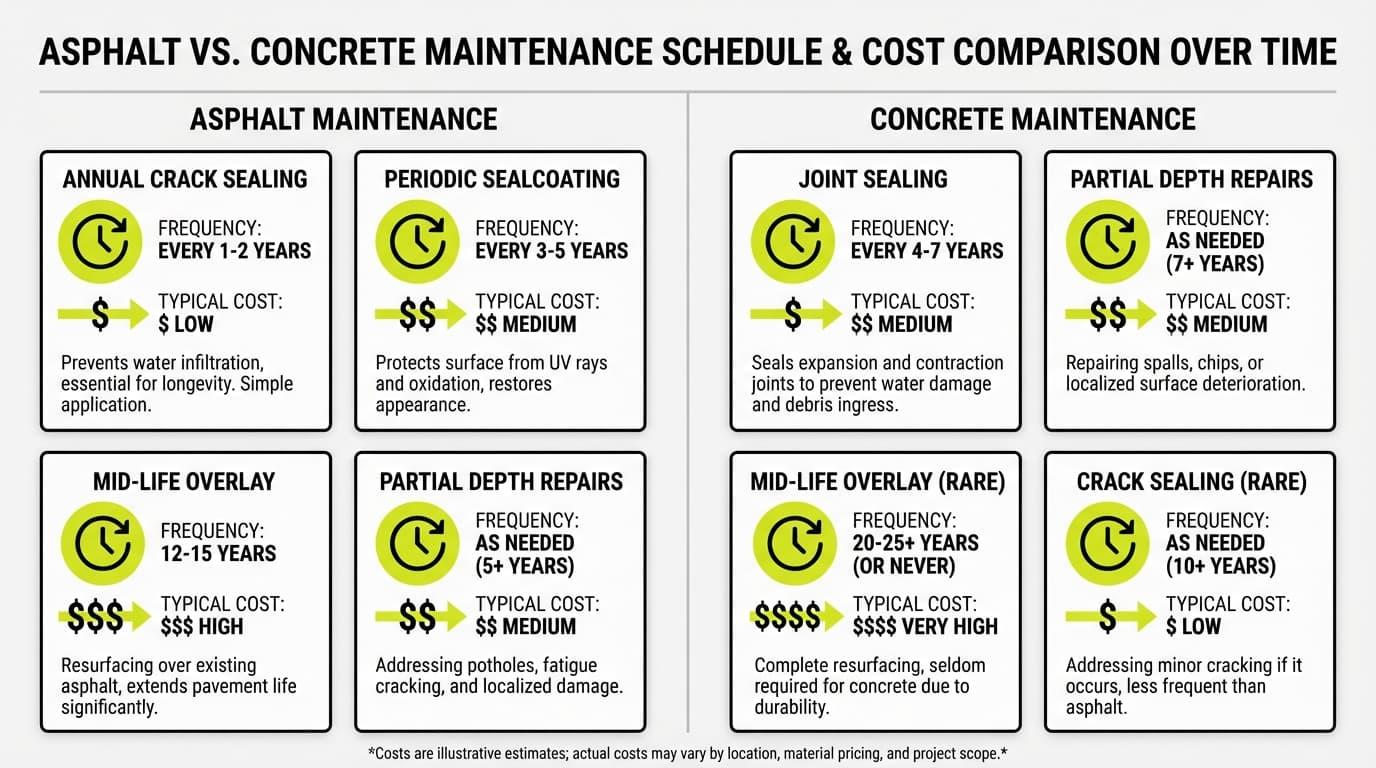
A realistic 20–30-year maintenance schedule for a Michigan commercial asphalt lot differs from that for a concrete lot in ways that matter both financially and operationally.
Asphalt maintenance timeline:
- Annual Crack Sealing: Injecting hot-rubberized sealant into surface fractures every 1-2 years to block water infiltration and prevent sub-base failure.
- Periodic Sealcoating: Applying a protective emulsion every 3-5 years to shield the asphalt binder from UV oxidation and automotive fluid degradation.
- Mid-Life Overlay: Milling and repaving the top wearing course at year 12-18, extending the pavement’s lifespan for an additional decade at a fraction of full reconstruction costs.
Concrete maintenance timeline:
- Joint sealing: within the first 1–2 years, then periodically
- Crack and spall repairs: as needed
- Partial depth repairs or slab replacements: typically later in life cycle, but expensive when required

The pattern is clear: asphalt tends to have more line items over 20–30 years, but at smaller, more manageable amounts. Concrete has fewer major interventions overall, but each one tends to be a larger financial hit.
Proper maintenance keeps asphalt’s total life-cycle costs competitive and prevents premature reclamation and rebuilding of the base.
Bart’s Asphalt offers commercial sealcoating and crack-sealing programs tailored to your lot’s age, traffic volume, and Michigan climate.
Explore Our Maintenance Services
Durability, Lifespan, and How Michigan Winters Change the Math
Typical lifespan ranges show asphalt commercial pavements lasting around 15–30 years and concrete around 30–50 years under proper maintenance (SCB Construction Group data). But Michigan’s climate can shorten or stretch these ranges dramatically based on design quality and how consistently the lot is cared for.
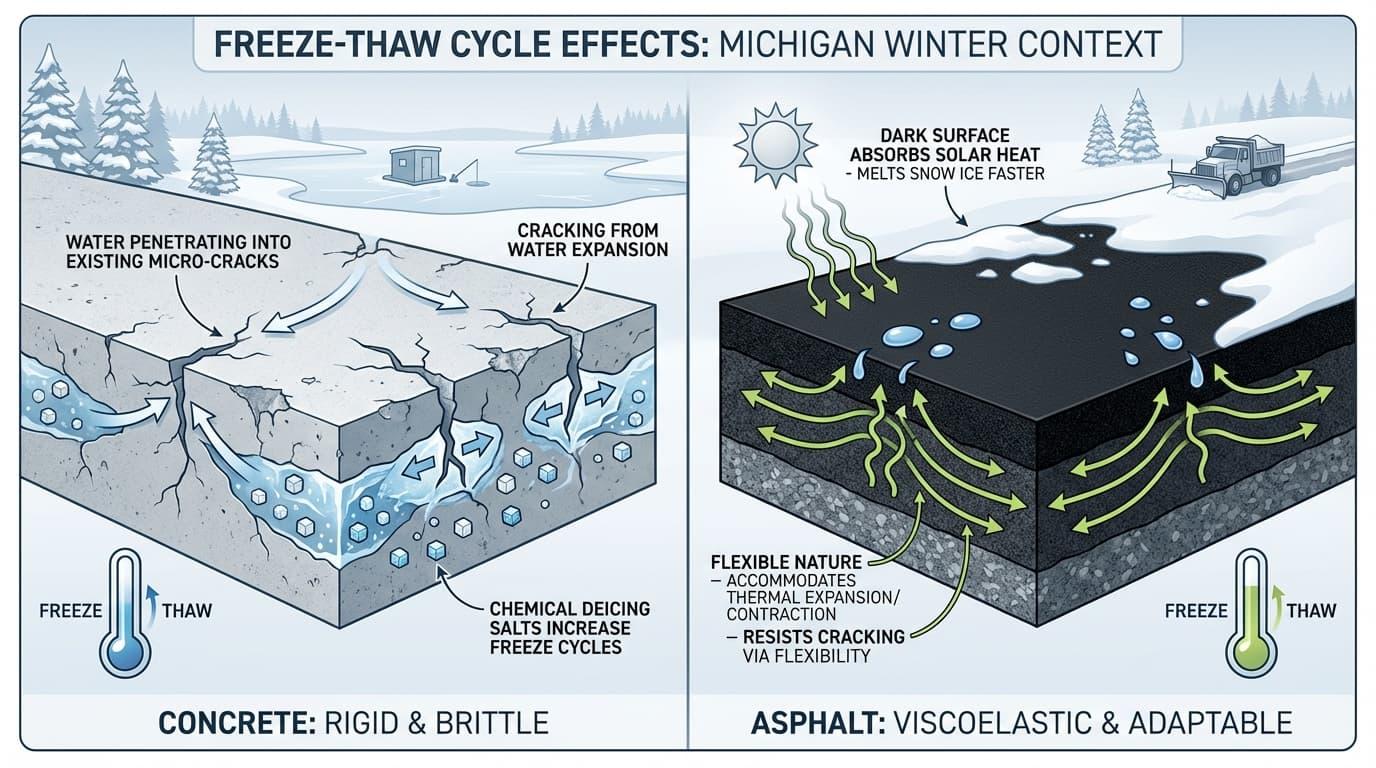
While concrete provides exceptional compressive strength, Michigan’s repeated freeze-thaw cycles and chemical deicing salts penetrate the rigid slab’s expansion joints, resulting in accelerated surface spalling, scaling, and structural cracking.
Water seeps into concrete’s pores and joints in freezing temperatures, freezes, expands, and slowly fractures the rigid slab. The structural integrity weakens with each cycle.
Asphalt’s flexible nature allows it to expand and contract with Michigan’s temperature swings. When paired with a strong base and proper drainage, this flexibility helps asphalt surfaces tolerate freeze–thaw stress better than concrete in this region. The dark surface also absorbs solar heat, helping snow and ice melt faster during January thaws.
In hot climates like the southern U.S., concrete often outperforms plain asphalt on heat resistance — asphalt can soften in extreme hot weather. But in Michigan, the bigger stressor is winter, not summer highs. Michigan’s typical temperatures rarely cause the rutting seen in southern states.
Snowplows and heavy salt use on commercial lots tend to be tougher on concrete surfaces. Metal plow blades chip edges and expose aggregate. Properly maintained asphalt wearing courses handle this abuse more gracefully.
Consider a practical example: a Southeast Michigan retail lot paved in asphalt in 2010, maintained with regular sealcoating and timely repairs, can still be in strong working condition in 2026. Nearby concrete sections often show joint deterioration and surface scaling from salt exposure by this point.
While concrete offers a longer lifespan under ideal conditions, Michigan’s real-world winters often narrow that gap considerably — especially for busy, salted commercial lots with frequent maintenance requirements.
How Should Commercial Properties Structure Pavement for Heavy Loads?
Different traffic patterns affect material choice significantly. Car-only parking fields have different requirements than bus and truck lanes, loading docks, dumpster pads, and fire lanes.
A smart approach uses a mixed-material strategy: asphalt for most of the parking field and drive aisles, with reinforced concrete pads only in the heaviest load zones. Dock aprons, trash enclosures, and areas with static heavy loads and turning forces benefit from concrete’s rigidity and resistance to shoving.
Steel reinforcement in concrete sections handles the concentrated stress of delivery trucks and dumpsters without the rutting that asphalt surfaces might develop under those specific conditions.
This hybrid approach captures asphalt’s lower initial installation costs over most of the acreage while leveraging concrete’s strength only where it’s structurally justified. Bart’s Asphalt regularly designs these blended solutions for industrial facilities, distribution centers, and multi-family properties across Southeast Michigan.
The key insight: accurate base design, drainage, and compaction are as critical to long-term performance and overall cost as the surface material itself.
How Do Asphalt and Concrete Installation Timelines Impact Commercial Downtime?
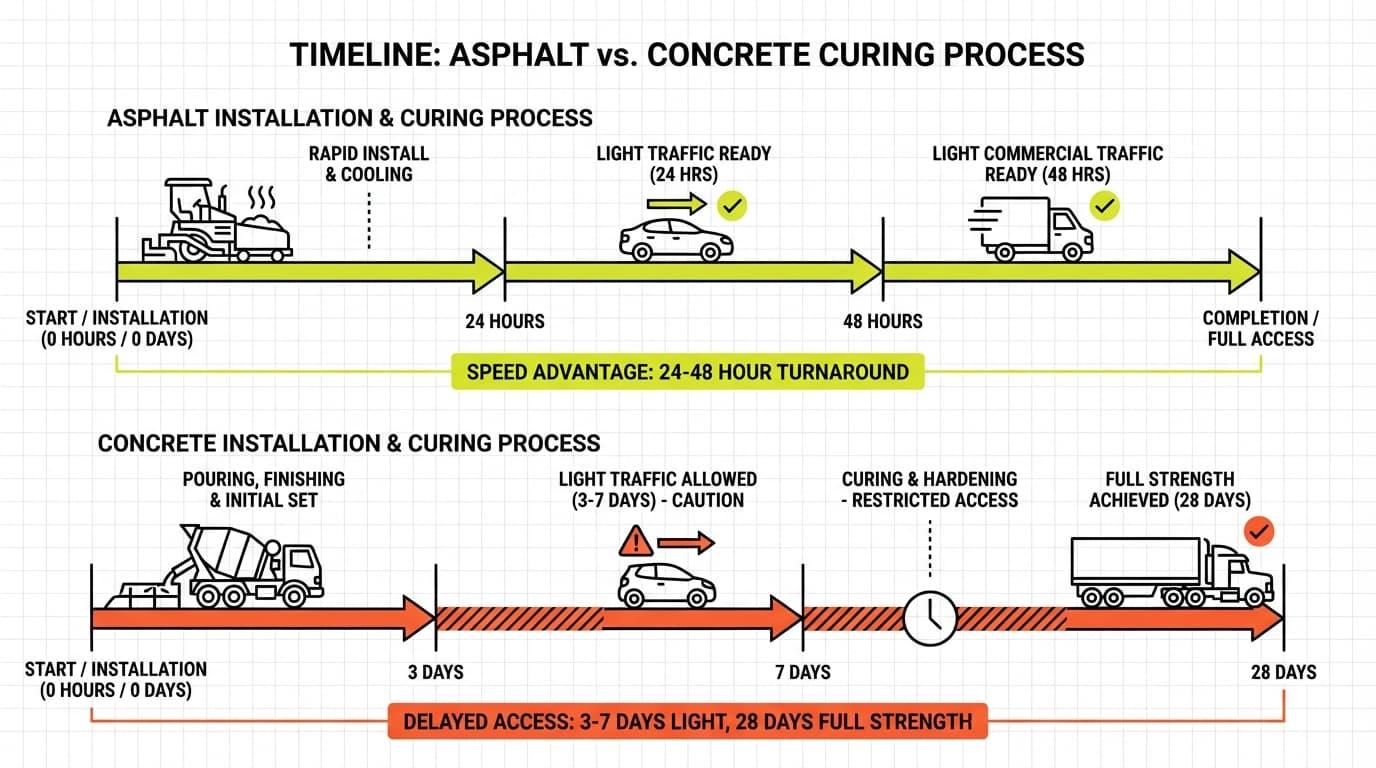
Commercial property managers care about more than material and labor costs. How long will the lot be offline? How does that affect tenants, customers, and deliveries? These operational costs can dwarf the financial implications of the material choice itself.
Hot-mix asphalt can typically be opened to light commercial traffic within 24–48 hours. This allows phased projects where half the lot remains open while the other half is paved. Tenants can still access their businesses. Customers can still park. Deliveries continue without interruption.
Unlike asphalt’s rapid 24-hour turnaround, commercial concrete requires 3 to 7 days of curing for light vehicular traffic and a full 28 days to achieve maximum compressive strength for heavy truck loads.
That extended installation process demands more complex phasing and potentially creates significant revenue disruption for commercial tenants.
According to 2025 life-cycle cost analyses by the National Asphalt Pavement Association (NAPA), indirect user costs—such as tenant delays, detours, and lost access—significantly impact the real economic comparison between paving materialsWhen you factor in lost business during paving, asphalt’s faster installation process often makes it more attractive, even when raw-material models look similar on paper.
Asphalt repairs and overlays are also faster and easier to schedule overnight or on weekends. For 24/7 operations like hospitals, manufacturing plants, or big-box retail centers, this flexibility matters enormously.
Consider a practical scenario: overlaying and restriping a 40,000-square-foot supermarket lot over two nights versus closing concrete sections for a week at a time for slab replacement. The difference translates directly into fewer customer complaints and less lost business for tenants.
When downtime and user costs are included in the calculation, asphalt often becomes the cost-effective choice even when theoretical life-cycle material models appear similar on paper.
Why Does Southeast Michigan’s Climate Favor Commercial Asphalt?
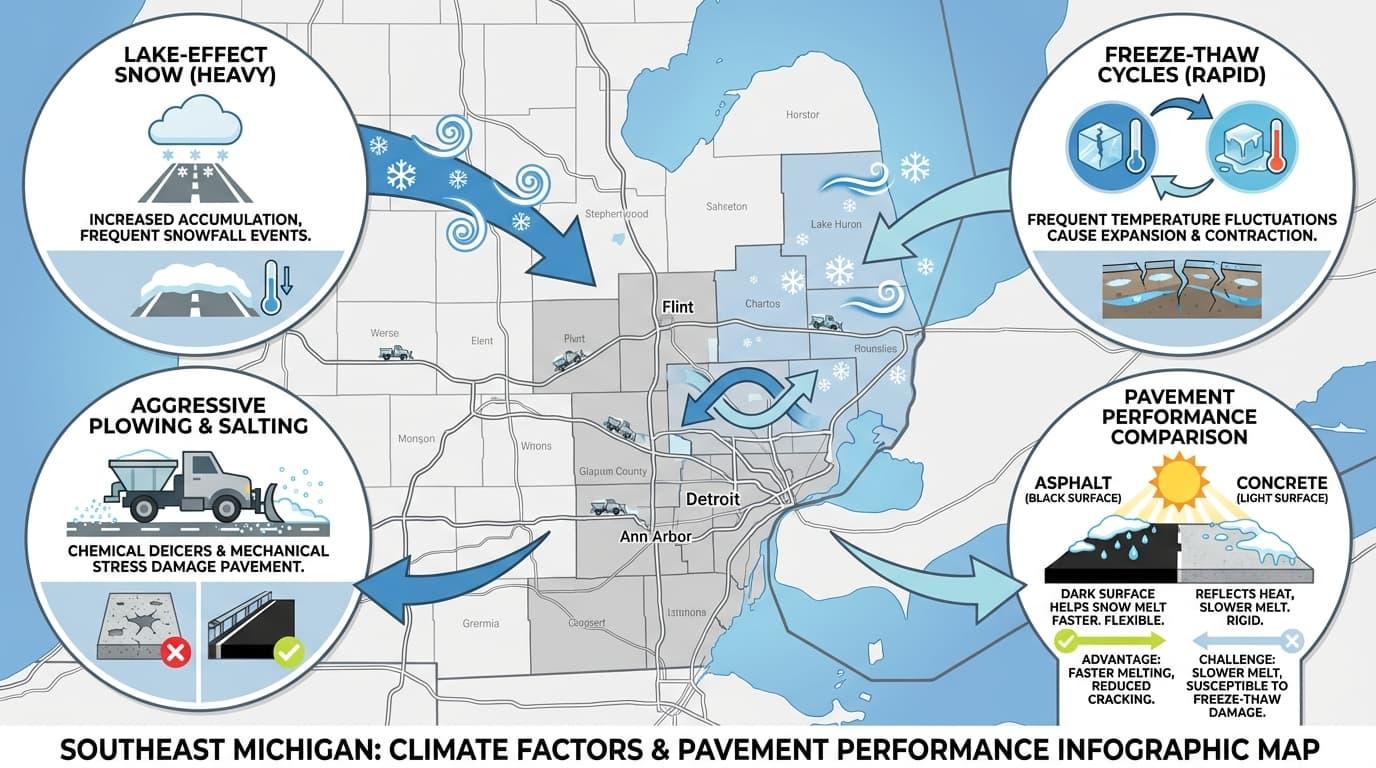
Many “asphalt or concrete” articles are written for mild or hot climates. They don’t fully account for Michigan’s lake-effect snow, repeated freeze–thaw cycles, and aggressive plowing and salting regimes that define commercial lot maintenance here.
The freeze–thaw mechanism in concrete works like this: water infiltrates pores and expansion joints, freezes, expands, and slowly fractures the rigid slab. Deicing salts — especially calcium chloride and magnesium chloride — accelerate surface scaling and promote rebar corrosion in sections with steel reinforcement.
Cold climates demand expansion joints to accommodate thermal movement, but even well-designed joints deteriorate under repeated salt exposure.
Asphalt behaves differently. Its dark surface helps snow melt faster. Its flexibility tolerates minor base movement from frost heaving. Surface cracks can be quickly sealed to keep water out of the base, limiting freeze–thaw damage when the lot is properly maintained. This adaptability makes asphalt surfaces more forgiving under Michigan’s harsh winters.
Michigan agencies and the Federal Highway Administration increasingly factor in climate-specific pavement design. In northern states and cold climates, asphalt is frequently chosen for local roads and commercial approaches because of its winter resilience and ease of repair.
Bitumen prices — and thus asphalt costs — are tied to crude oil markets. During high oil periods, asphalt costs can approach parity with concrete. But in most recent years, asphalt has retained a clear initial cost advantage of 20–30% according to industry sources, including Hahn Ready Mix (2025).
How does asphalt perform in summer? It can soften in extreme heat, but Michigan’s typical highs rarely cause the rutting problems seen in hot climates in the southern U.S. Summer performance is a secondary concern compared to winter survival here.
Bart’s Asphalt designs mixes and base structures specifically for Southeast Michigan’s climate — not generic one-size-fits-all sections. That regional expertise helps protect your long-term investment.
Environmental and Material Considerations
Many commercial owners now ask about sustainability and environmental impact alongside pure cost — especially school districts, municipalities, and corporate campuses with green building goals.
Asphalt’s composition includes aggregates bound with bitumen derived from crude oil, and it can incorporate Recycled Asphalt Pavement (RAP). High RAP content reduces material costs and significantly cuts landfill waste.
According to NAPA, modern hot-mix asphalt often contains 20–30% recycled content, making it one of the most widely recycled paving materials in North America. Concrete’s composition relies on aggregates bound with Portland cement. Cement production is energy-intensive and represents a major source of CO₂ emissions globally.
Concrete often carries a higher upfront investment in embodied carbon per cubic yard compared to asphalt. Both asphalt and concrete consume natural resources and energy during production. However, asphalt is commonly reclaimed and reused in new hot-mix at the end of its service life.
Crushed concrete typically becomes base material or fill rather than a new surface concrete; it is valuable but a step down in the materials hierarchy. Concrete’s lighter color can reduce the urban heat island effect and lower nighttime lighting requirements.
But asphalt’s dark surface helps winter snowmelt and ice control, providing safety and operational benefits that matter more in Michigan than heat reflection does.
The trade-offs are real: asphalt wins on recyclability and winter safety; concrete is favored in some green building frameworks for its reflectivity and longer potential lifespan. Bart’s Asphalt is willing to discuss RAP content, porous asphalt options, and responsible sourcing of base materials with sustainability-focused clients.
When Asphalt Is the Smarter Financial Choice in Southeast Michigan
For many commercial sites in Southeast Michigan, asphalt is not just cheaper upfront — it’s the more strategic choice when you combine cost, climate, and operational realities together.
Scenarios where asphalt excels: large parking fields at apartments, retail centers, and schools where square footage runs into the tens of thousands. Properties that need fast turnaround — open within 24–48 hours — benefit from asphalt’s quick cure time.
Sites that can commit to regular maintenance but want to avoid large, unpredictable capital hits find asphalt’s smaller, predictable expenses much easier to budget for.
Asphalt roads can be 30–40% cheaper per kilometer than concrete roads initially. Similar percentage savings often apply to parking lots, making asphalt especially compelling on multi-acre properties, where the cost difference can add up to hundreds of thousands of dollars.
Asphalt also allows phased overlays instead of total reconstructions. Owners can extend pavement life in affordable increments rather than facing complete replacement invoices. An existing asphalt lot that shows wear at year 15 can receive an overlay that adds another decade of service at a fraction of the cost of reconstruction.
In freeze–thaw climates like Michigan, asphalt’s flexibility and repairability often preserve its cost advantage over time, even when raw-life-cycle studies conducted in hot climates appear to favor concrete.
In a recent project managed by Bart’s Asphalt, we applied a structural overlay to a 100-unit apartment complex in Southeast Michigan, successfully delaying full concrete reconstruction for a decade and saving the property management firm 65% in immediate capital expenditures.
That’s real money returned to property operations, reserves, or improvements that tenants actually notice.
Bart’s Asphalt can walk you through a multi-year maintenance plan so the “cheaper” choice stays cheaper by design, not by chance. Whether it’s an apartment complex, school lot, retail center, or industrial yard, we can build a multi-year asphalt plan that protects your investment.
Talk To A Commercial Specialist Today!
When Concrete Still Makes Sense
Concrete remains the right choice for specific applications, and acknowledging that builds trust. Bart’s Asphalt will recommend concrete when it’s structurally or operationally superior—not because it costs more, but because it performs better in certain situations.
Common commercial applications where concrete is often preferred include curbs and gutters, sidewalk networks, dumpster pads with static loads, loading dock aprons handling heavy truck traffic, and decorative entry plazas where curb appeal matters.
Textured surfaces and architectural concrete finishes created with stamping techniques can make a strong first impression at entry points for residential settings and commercial campuses alike.
For very high load transfer areas, properly designed concrete may outlast an equivalent asphalt section and avoid rutting or shoving — even in Michigan’s climate. Brick pavers and natural stone can also serve decorative functions, though at a premium cost compared with standard concrete or plain asphalt.
Concrete offers more architectural options, including colored concrete and stamped textures using stamping techniques for accent areas. These treatments come at a higher upfront cost than standard gray concrete, but their visual impact can significantly enhance the curb appeal of commercial and residential settings.
Bart’s Asphalt can coordinate or advise on concrete components as part of an overall asphalt-focused site plan. This gives owners a single, integrated view of costs and life-cycle expectations across the entire property — fewer replacements, fewer surprises.
Explore Our Concrete Installation Services
How Should Property Managers Compare Commercial Asphalt and Concrete Quotes?
Moving beyond generic per-square-foot numbers requires evaluating the total picture for your specific property and traffic patterns. The driveway size, usage intensity, and your maintenance commitment all affect which material delivers better value over time.
When comparing quotes, work through this checklist:
- Capital Expenditure: Assess the upfront installation cost, including required sub-base improvements and ADA-compliant striping.
- Lifecycle Projection: Compare the expected lifespan under Michigan’s specific freeze-thaw and heavy salt conditions.
- Maintenance Liability: Evaluate the 20-year maintenance schedule and the realistic annual budget required for each material.
- Operational Disruption: Calculate the hidden cost of tenant or customer downtime during the 24-48 hour asphalt cure vs. the 7-28 day concrete cure.
Check what each quote actually includes. Does it cover sub-base improvements? Drainage corrections? Striping and ADA upgrades? Snowplow-ready edge details? Are future overlays or concrete panel replacements factored into any long-term maintenance plan?
RS Means cost data, national averages from HomeGuide, and publications from the Portland Cement Association provide useful baseline benchmarks.
A contractor who understands what works in residential settings may not grasp the demands of commercial lots with heavy loads, constant traffic, and aggressive winter maintenance.
Treat asphalt not as the “cheap alternative” but as one of two engineered systems. Choose concrete or asphalt based on total cost of ownership and site performance — not just the lowest line item. Minimal maintenance over decades is a fantasy for either material; the question is which maintenance regime fits your operations and budget.
A tailored consultation is the fastest way to cut through conflicting online advice and get numbers specific to your property.
Ready to compare your options with actual Michigan numbers? Bart’s Asphalt walks you through every line item — base work, mix type, drainage, striping — so you know exactly what you’re buying.
Request A Free Estimate Today!
Talk Through Your Options with a Commercial Asphalt Specialist
If you manage commercial property in Southeast Michigan, whether it’s an apartment complex, parking field, a school lot, a retail center, or an industrial loading yard, you’re dealing with real operational constraints that generic cost guides don’t address.
Bart’s Asphalt focuses on commercial work, not new residential driveways. That specialization means the team understands multi-tenant access requirements, ADA compliance, delivery route protection, and the realities of snow management that affect your actual operations.
Request a free on-site evaluation where Bart’s Asphalt will assess your existing driveway or lot condition, evaluate the base and drainage, estimate remaining service life, and provide side-by-side cost projections for asphalt rehabilitation, asphalt reconstruction, or a mixed asphalt/concrete solution.
Schedule Your Free On-site Evaluation!
Frequently Asked Questions
These questions address practical concerns commercial property managers often raise. The focus remains on Michigan commercial lots rather than residential settings.
Is asphalt always cheaper than concrete in Southeast Michigan?
Asphalt is almost always cheaper upfront for commercial lots — typically 20–30% less per square foot installed. However, long-term cost comparisons depend on design quality, traffic patterns, and your discipline in following a maintenance schedule.
In Michigan’s freeze–thaw environment, asphalt’s flexibility and easier repair process help keep life-cycle costs competitive with, or even better than, concrete, especially for parking lots and drive lanes. The lower initial cost, combined with manageable maintenance expenses, makes asphalt the financially rational choice for most commercial applications.
In rare cases — such as extremely heavy, static industrial loads or dock areas with constant truck turning — concrete may justify its higher initial cost with extended performance. We can analyze those situations case by case.
How often should I budget for asphalt maintenance on a commercial lot?
Plan for annual or biannual crack sealing, sealcoating every 3–5 years, and localized patching as soon as distress appears. This proactive approach prevents water infiltration that accelerates freeze–thaw damage and leads to costly repairs.
With consistent upkeep, many Michigan commercial lots can go 12–18 years before needing a major asphalt overlay — avoiding full reconstruction for decades. Setting aside a small amount per square foot per year for regular maintenance keeps costs predictable and manageable.
Bart’s Asphaltcan inspect your property and propose a multi-year maintenance budget tailored to your lot’s size, traffic volume, and current age. That planning prevents the “surprise” major repair that strains capital budgets.
Can I place new asphalt over my existing concrete lot to save money?
Asphalt overlays on existing concrete are sometimes possible but require careful evaluation. The concrete’s condition, joint patterns, and drainage all affect whether this approach will succeed or lead to reflective cracking that quickly damages the new asphalt surface.
In some cases, milling or breaking the existing asphalt and reusing it as a base under new asphalt proves more reliable long-term than simply paving over intact slabs. Each site needs a structural and drainage assessment before deciding between overlay, partial removal, or full reconstruction.
Cutting corners on prep to “save” money upfront often leads to higher repair costs later, negating asphalt’s initial cost advantage entirely.
Does asphalt or concrete handle snowplows and road salt better?
Both materials can be plowed, but road salt and metal plow blades tend to chip and scale concrete surfaces more noticeably over time. Concrete edges and expansion joints are particularly vulnerable to damage from aggressive winter maintenance.
Asphalt’s darker color helps melt residual snow and ice faster, which can reduce slip hazards and the amount of salt needed on commercial lots. Proper plow blade adjustment and rubber edges help both materials, but many Michigan property managers find asphalt surfaces more forgiving under aggressive winter maintenance regimes.
Bart’s Asphalt can advise on snow management considerations when designing or rehabilitating a lot — including edge treatments that minimize plow damage over time.
Is this information relevant if I’m only dealing with a residential driveway?
This article is written specifically for commercial, municipal, and institutional properties — parking lots, drive lanes, industrial yards, and multi-family complexes. Residential costs, installation costs, and maintenance requirements differ significantly from those for commercial work.
Bart’s Asphalt does not install new residential driveways, though the company provides residential sealcoating services where applicable. Homeowners should consult resources and contractors that specialize in residential work for single-family driveway projects.
Commercial and multi-family property managers in Southeast Michigan are the primary audience for the cost comparisons and maintenance requirements discussed in this guide.