

Are you a property manager, strip mall owner, or office complex operator, wondering how much sealcoating your commercial parking lot will cost?
For Michigan commercial properties, you can expect to pay $0.20 to $0.50 per square foot for professional sealcoating. Full maintenance packages, including crack sealing and line striping, range from $0.60 to $0.90 per square foot.
For property managers, the real concern often goes beyond the price per square foot of commercial parking lot and driveway sealing. It’s about budgeting wisely to maintain long-term pavement health and avoid costly repairs.
That’s where local expertise makes all the difference. At Bart’s Asphalt, we specialize in these commercial projects, drawing on our deep pavement expertise in Michigan’s freeze-thaw climate.
In this guide, we’ll help you discover:
- What drives sealcoating costs beyond just materials
- How lot size and condition affect your budget
- Why crack sealing and ADA updates matter for compliance and durability
- The pros and cons of different sealer types in Michigan’s climate
- How to plan a maintenance cycle that saves you money over time
Ready to get a clear, Michigan-specific sealcoating cost breakdown?
Keep reading to gain insights that help you make informed decisions for your commercial property’s pavement maintenance.
Key Takeaways
- Commercial sealcoating costs $0.20-$0.50 per square foot in Southeast Michigan.
- Full packages with crack sealing, striping run $0.60-$0.90 per square foot.
- Asphalt condition and prep work drive costs more than sealer materials alone.
- Seal every 3-5 years to avoid $3-$7 resurfacing costs in a freeze-thaw climate.
- DIY methods fail due to commercial lots’ equipment costs, liability risks, and tenant disruptions.
- Professional crews ensure compliance, quality work, and long-term pavement savings.
How Much Does Sealcoating Cost Per Square Foot?
This is a 2026 cost guide for commercial parking lots in Michigan, not residential driveways. If you manage a strip mall, office complex, or industrial site, these are the numbers that matter.
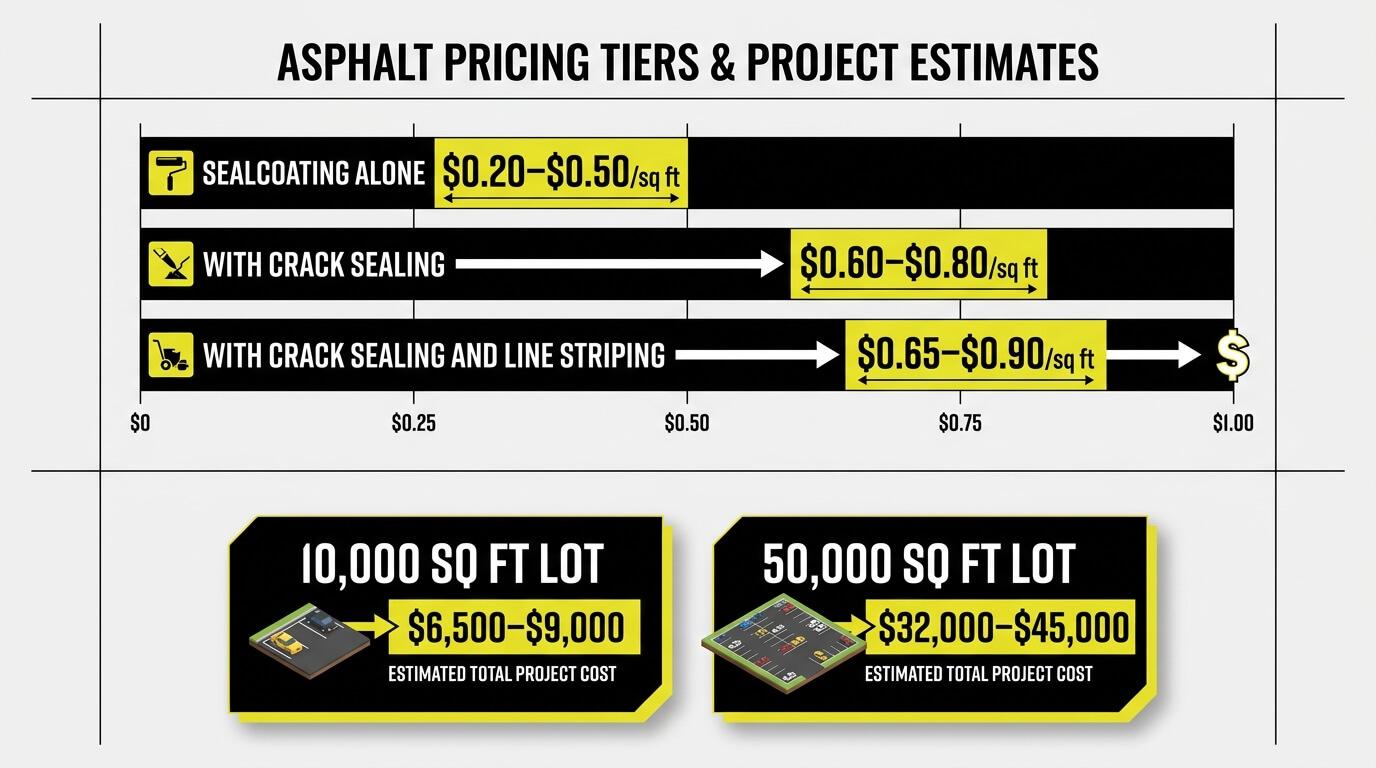
Commercial sealcoating alone typically costs $0.20–$0.50 per square foot, with most Michigan projects landing around $0.22–$0.38 per square foot for standard asphalt emulsion systems. That’s the fully installed price, including labor and materials.
When you add the prep work and finishing that commercial lots actually need, realistic “all-in” maintenance ranges look more like this:
- Sealcoating with Crack Sealing: $0.60–$0.80 per square foot.
- Sealcoating with Crack Sealing and Line Striping: $0.65–$0.90 per square foot.
Take a look at these two concrete examples for fast budgeting:
- 10,000 sq ft lot: This is about 30 parking stalls, and it costs $6,500 to $9,000 for full sealcoat, crack seal, and restripe cycle.
- 50,000 sq ft lot: About 150 stalls, and it costs $32,000 to $45,000, depending on condition and layout.
These figures assume a sound asphalt base. If your pavement has problems like base failures and alligator cracking or needs milling, you’re looking at repair costs of $4.00–$10.00 per square foot before any sealer touches the surface. That’s a different budget category entirely.
Average Commercial Sealcoating Costs by Lot Size
Property managers think in total project dollars, not abstract per-square-foot rates. Here’s how those unit prices translate into typical Michigan parking lot budgets.
Small Office or Retail Lot
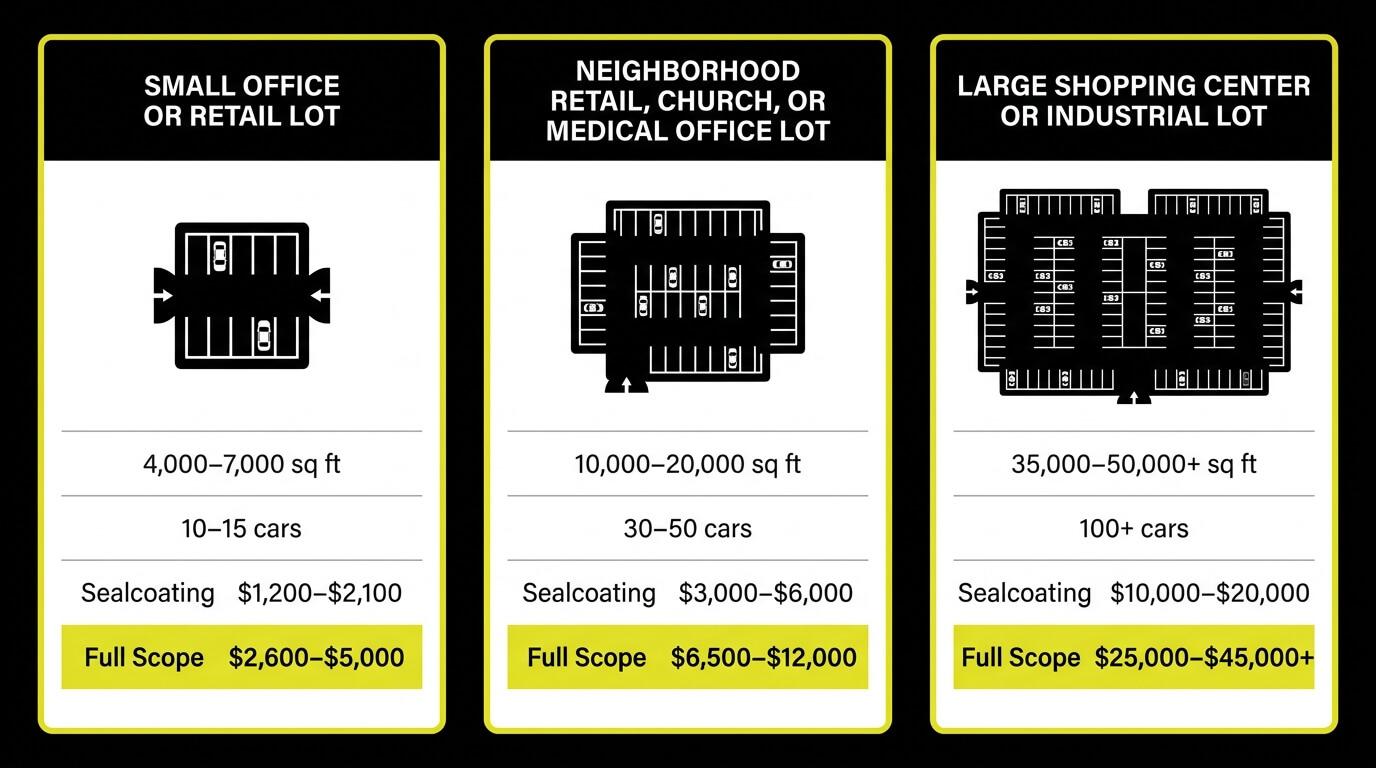
These lots typically range from 4,000–7,000 sq ft and accommodate 10–15 cars. Sealcoating alone costs $1,200–$2,100, while adding crack sealing and striping brings the total to $2,600–$5,000. Contractor minimums of $2,500–$5,000 often apply, making small lots appear expensive per square foot.
Neighborhood Retail, Church, or Medical Office Lot
These lots typically range from 10,000–20,000 sq ft and accommodate 30–50 cars. Sealcoating alone runs $3,000–$6,000, and with crack sealing and striping, expect $6,500–$12,000. This is the sweet spot where per-square-foot pricing becomes more predictable.
Large Shopping Center or Industrial Lot
These lots typically range from 35,000–50,000+ sq ft and accommodate over 100 cars. Sealcoating alone costs $10,000–$20,000, while a full maintenance scope reaches $25,000–$45,000+. Economies of scale apply, as crews can cover 100,000 sq ft per day with modern spray rigs.
Larger lots see lower cost per square foot but higher total ticket size. They also require multi-day phasing and multiple mobilizations, which adds 10 to 20% to the project cost.
In Southeast Michigan, contractor minimums make very small commercial areas (say, under 7,000 square feet) appear disproportionately expensive compared with nearby large-scale sites. For example, a 5,000 sq ft lot might pay close to the same as a 10,000 sq ft lot simply because of setup and mobilization costs.
What Actually Drives the Cost of Residential vs. Commercial Sealcoating?
A standard residential asphalt driveway, typically around 400 to 600 sq ft, costs $250 to $600 for professional driveway sealcoating. Simple surface, one coat, squeegee application, done in an hour.
Commercial asphalt parking lots, however, are far more complex and larger in scale. They demand extensive prep and coordination, which dramatically increases both labor and total project costs.
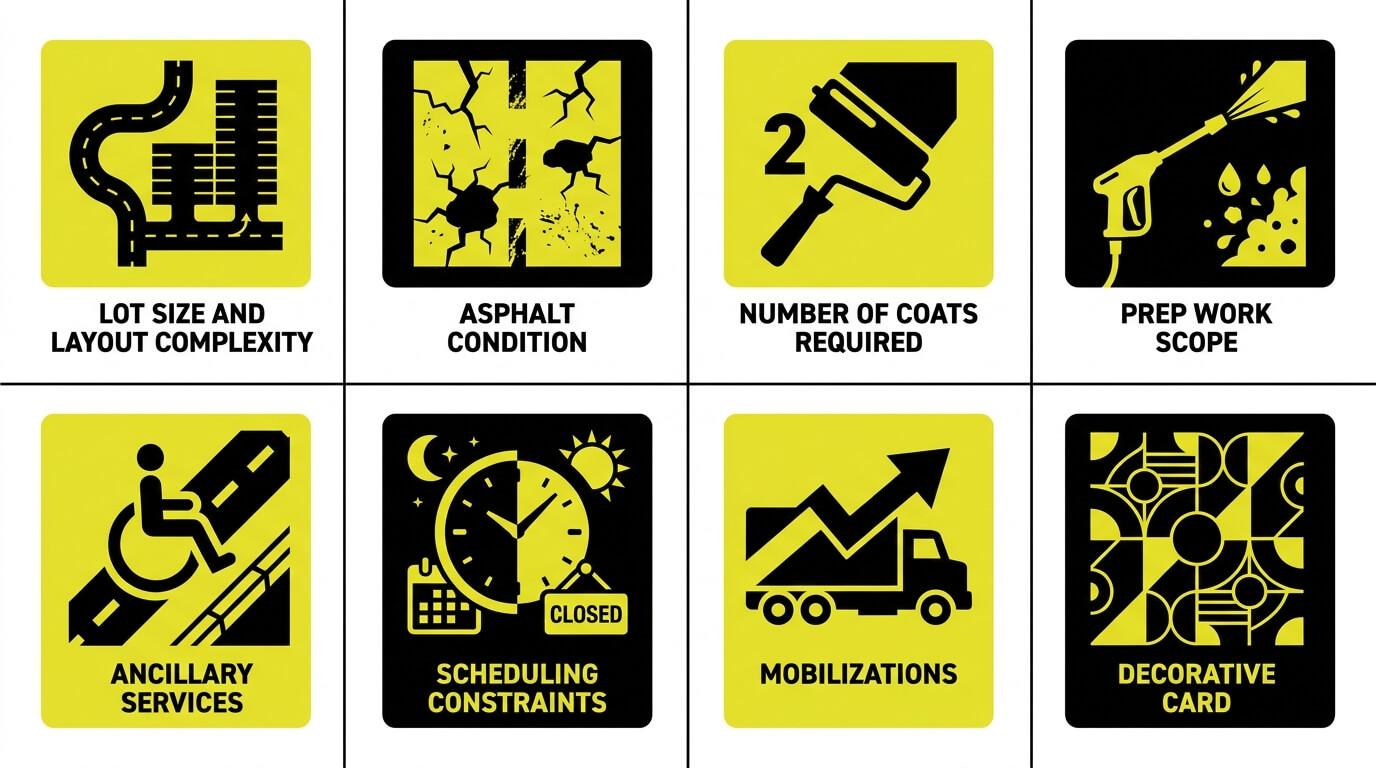
Key Commercial Cost Drivers
- Lot Size and Layout Complexity: Islands, loading zones, drive lanes, and tight corners all require more careful application and often multiple coats.
- Asphalt Condition: Oxidation, existing cracks, oil spills, and alligator cracking determine how much prep work is needed before sealer can go down.
- Number of Coats Required: Most commercial traffic lanes need two coats minimum; some high-traffic areas need three.
- Prep Work Scope: Power cleaning ($500 or more for large lots), oil-spot priming, crack routing, hot rubber filling ($1.00 to $2.00 per linear foot), and patching all add up.
- Ancillary Services: Line striping, ADA compliance updates, signposts, and wheel stops are often required but quoted separately.
- Scheduling Constraints: Night work, weekend phasing, and working around tenant businesses all increase labor costs.
- Mobilizations: How many separate trips crews need to complete the work affects the total cost.
These factors often matter more for your total budget than the sealer’s $0.08 or $0.12 per square foot cost. The difference between a $5,000 job and a $12,000 job is rarely the sealer type. It’s usually the condition of your asphalt and what prep the surface actually needs.
Sealcoating Cost Breakdown: Materials, Labor, and Sealer Types
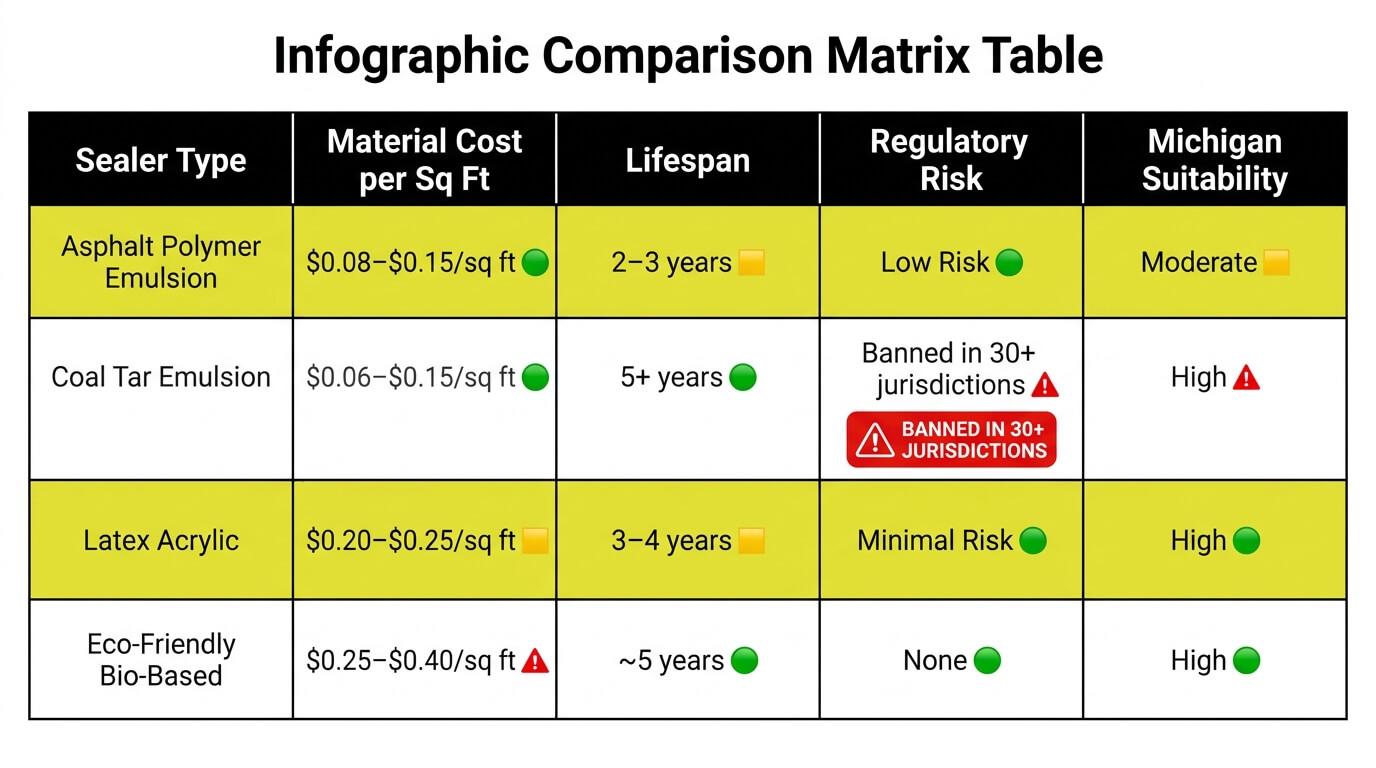
Here we’ll break down the per-square-foot math, covering what goes to materials versus labor and how sealer type affects your bottom line.
Material Costs by Sealer Type (Materials Only)
- Asphalt Polymer Emulsion: $0.08 to $0.15 per square foot ($4 to $15 per gallon). The Michigan default for commercial lots. Lifespan of 2 to 3 years under heavy traffic. Widely accepted by municipalities with no regulatory concerns.
- Coal Tar Emulsion: $0.06 to $0.15 per square foot ($3 to $15 per gallon). Longest-lasting at more than 5 years. However, it’s banned or restricted in over 30 U.S. jurisdictions, including Minnesota, Illinois, and Washington, D.C., due to high Polycyclic Aromatic Hydrocarbon (PAH) content. Growing scrutiny in Michigan municipalities like Traverse City, Ann Arbor, Grand Ledge, and Van Buren Township, where local bans on coal tar sealants are now in effect.
- Latex Acrylic: $0.20 to $0.25 per square foot ($10 to $25 per gallon). Higher material cost with good flexibility for crack-prone Michigan asphalt. Used selectively where appearance matters most.
- Eco-Friendly Bio-Based Products: $0.25 to $0.40 per square foot ($12.50 to $40 per gallon). Comparable 5-year lifespan to coal tar without the environmental risk. Increasingly specified for hospitals, schools, and properties with ESG requirements.
Labor Costs
Complex or small sites run $0.60 to $1.25 per square foot. Large, efficient sites with spray rigs come closer to the lower end of that range. Labor typically accounts for the majority of the total cost for anything under 20,000 sq ft.
Why Online Prices Seem Inconsistent
Many sources quote either materials-only or labor-only figures without clarifying. When LawnStarter quotes $0.15 to $0.23 per square foot, and Yelp quotes $0.80 to $1.50, the difference often comes down to what’s included. Always confirm whether a quote is for a fully installed (labor + materials) or just one component.
Michigan contractors typically favor asphalt emulsion or eco-friendly sealers over coal tar despite coal tar’s apparent cost and longevity advantages. Local stormwater regulations and concerns about PAH liability drive this preference.
Bart Asphalt specializes in these compliant sealers for Southeast Michigan properties. We understand Michigan’s unique pavement maintenance challenges and deliver services trusted by local property managers.
Get your free assessment from trusted local experts today.
Commercial Scope: What’s Usually Included (and What Isn’t)
Professional sealcoating bids typically focus on sealer application alone. However, a complete maintenance program requires surface preparation and problem resolution first for long-term results.
Elements of a Proper Commercial Sealcoating Scope
- Sealcoating Application: 2 coats on drive lanes, 1–2 coats on parking bays. $0.20–$0.50 per square foot, depending on lot size and sealer type.
- Crack Sealing: Hot-rubber crackfill on joints and working cracks. Often runs $0.60–$0.80 per square foot when averaged across the treated area. This is not optional in Michigan because unsealed cracks let water into the base, and freeze-thaw does the rest of the damage.
- Line Striping: Re-striping existing stall lines, arrows, and ADA symbols. Usually quoted per line or per stall, but roughly $0.05–$0.20 per square foot when rolled into a full-lot budget.
- ADA Compliance Updates: Reconfiguring accessible stalls, cross-hatching, signage, and curb ramps. Minor updates run $1,000; major reconfiguration on older, non-compliant sites can exceed $10,000.
- Patching and Localized Repairs: Cutting out failed areas, replacing the base, and patching are usually quoted separately per square yard and not included in sealcoat pricing.
What’s Mandatory vs. What Can Be Phased
Before any smart property manager applies sealer, crack sealing, and basic patching are essentially required. Sealing over hairline cracks traps moisture and accelerates failure, which essentially means you are paying to make the problem worse.
ADA layout changes and cosmetic upgrades can often be phased if current compliance is adequate.
Break your internal budgets into these distinct line items. When you compare sealcoating contractor proposals, you’ll immediately see who is quoting apples-to-apples and who is hiding scope to look cheap.
Michigan Climate, Maintenance Cycles, and Long-Term Cost
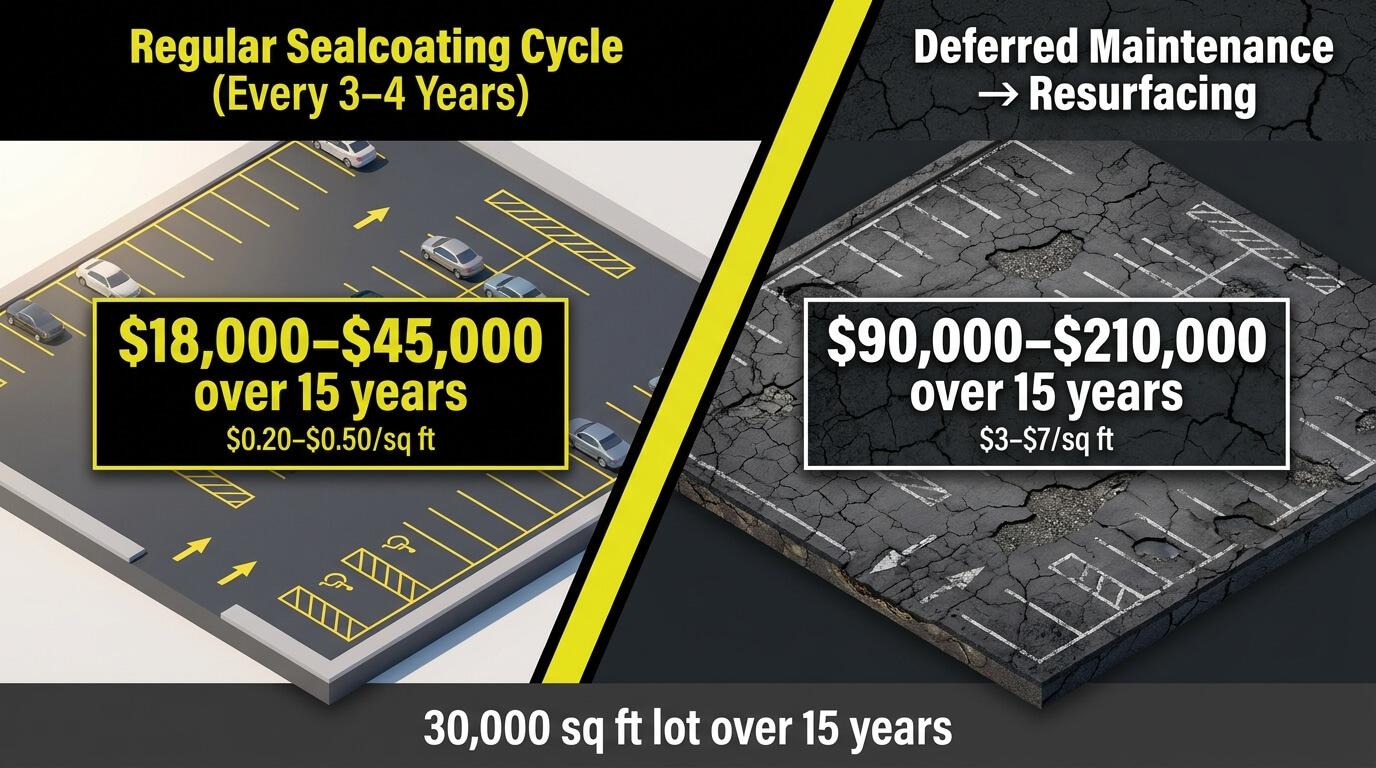
Southeast Michigan’s freeze-thaw cycles are the reason sealcoating is a maintenance cycle, not a one-time project. Water enters through unsealed cracks, freezes, expands, and breaks down asphalt base layers from within. Repeat this 40–50 times per winter, and you get alligator cracking and potholes that no amount of sealer will fix.
Recommended Commercial Sealcoating Frequency
- Every 2–4 years for most commercial parking lots using asphalt emulsion
- Up to 5 years for lots sealed with coal tar sealants or high-performance eco products, depending on traffic and UV exposure
The Math That Matters

Missing 2–3 sealcoating cycles on a busy lot can easily pull a six-figure repave forward by a decade.
Real-world Example: A 30,000-square-foot retail lot that spends $6,000–$9,000 every 3–4 years on sealcoating and crack filling extends asphalt pavement life by 10–15 years. Skip those cycles, and you’re looking at a $150,000 reconstruction when the base fails.
Smart property managers budget sealcoating and crack sealing as a recurring line item every 3–5 years across all properties. Doing this periodic budgeting is the most cost-effective way to avoid costly repairs and preserve curb appeal in the long term.
Comparing the Cost and Risk of Coal Tar vs. Asphalt Emulsion vs. Eco-Friendly Sealers
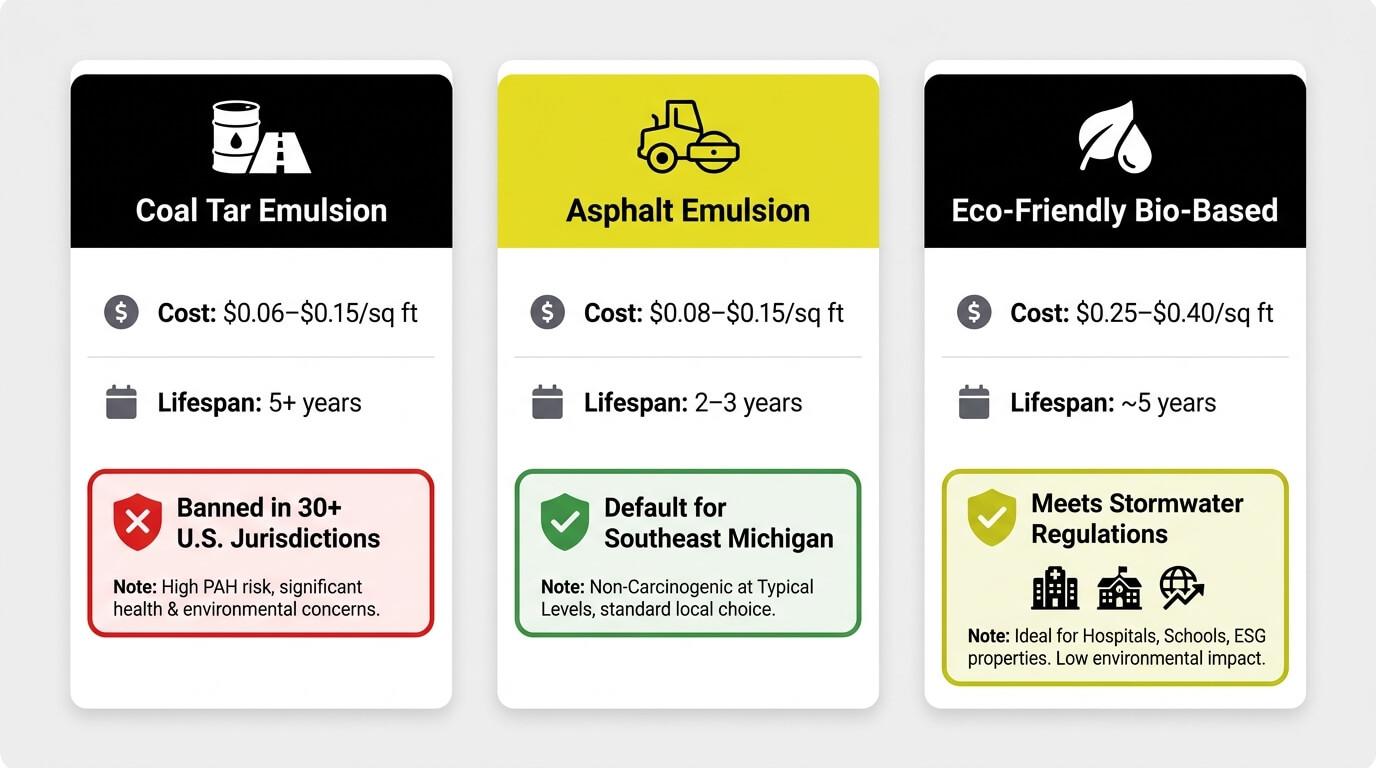
Material cost and lifespan matter, but regulatory and health risks are increasingly important for commercial property owners making sealer decisions.
Coal Tar Emulsion
- Material Cost: $0.06–$0.15 per square foot (lowest tier).
- Lifespan: 5+ years between applications.
- The Catch: High PAH content. PAH volatilization from freshly sealed pavement is tens of thousands of times higher than from unsealed asphalt. Documented links to skin, lung, kidney, and stomach cancers via dermal and respiratory exposure.
- Regulatory Status: Banned or restricted in Washington D.C., Austin, Minnesota, Illinois, and more than 30 other U.S. jurisdictions.
Unlike coal tar sealants, asphalt-based products don’t carry the same liability exposure.
Asphalt Emulsion
- Material Cost: $0.08–$0.15 per square foot.
- Lifespan: 2–3 years under Michigan commercial traffic.
- Risk Profile: Significantly lower PAH content, considered non-carcinogenic at typical exposure levels.
- Status: The default choice for most Southeast Michigan commercial lots. Widely accepted, no regulatory concerns.
The trade-off is more frequent applications, but many property owners prefer this to the liability questions around coal tar.
Eco-Friendly Bio-Based Products
- Material Cost: $0.25–$0.40 per square foot (highest tier). Uses plant-based oils instead of petroleum.
- Lifespan: Approximately 5 years, comparable to coal tar. Excellent in resistance to UV light through freeze-thaw cycles.
- Risk Profile: Designed to eliminate or dramatically reduce PAH exposure. Meets strict stormwater regulations for safety.
- Best For: Hospitals, schools, properties with stormwater compliance requirements, and brands with ESG programs.
The estimated cost is higher for eco-friendly bio-based products, but you’re buying comparable longevity without environmental or health concerns.
Bottom Line for Property Managers: Verify local regulations and stormwater requirements before specifying any sealer type. The apparent cost savings of coal tar may create liability exposure that outweighs the material savings.
DIY vs. Professional Sealcoating on Commercial Properties
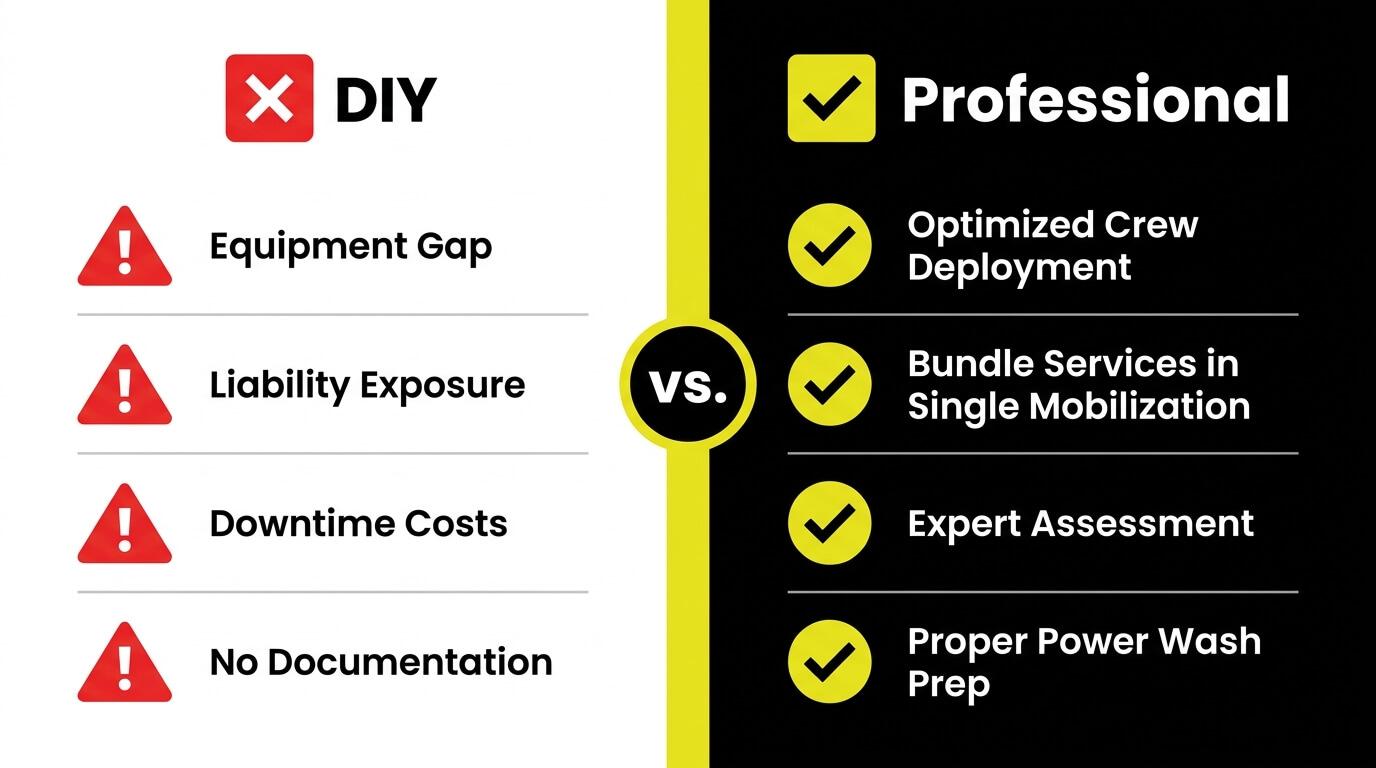
DIY driveway sealer makes sense on a small residential driveway. You buy a $15–$40 squeegee and a couple of buckets of driveway sealer, and save 40–60% compared to hiring out a 600-square-foot project.
That math doesn’t translate to commercial scale.
Why DIY Sealcoating Fails on Commercial Properties
DIY sealcoating creates risks too great for commercial property managers to ignore. They include:
- Equipment gap: Sprayers, mixing tanks, and traffic control gear are capital-intensive. Buying equipment for just one project doesn’t make sense financially.
- Liability exposure: Improper sealing, poor striping, or non-compliant ADA layouts expose owners to safety claims and ADA lawsuits.
- Downtime costs: Professional crews complete large jobs in 1–3 days with phased access. DIY drags across multiple weekends, disrupting tenants and businesses.
- Documentation: Professional sealcoating contractor services provide photos, application specs, and maintenance records useful for property documentation and insurance.
The Benefits of Hiring Professional Sealcoating Contractors
- Optimized crew deployment that reduces per-square-foot labor fees
- Ability to bundle crack filling, patching, and striping into a single mobilization
- Expert assessment of which areas can be preserved versus which need structural repair before the sealer goes down
- Proper power wash prep that removes oil stains, debris, and oxidized material
For commercial properties, hiring a professional isn’t even the real challenge; it’s finding the right sealcoating contractor who provides a transparent scope of work and high-quality materials.
Bart’s Asphalt delivers both with proven reliability. We specialize in Southeast Michigan commercial lots with 20+ years of experience.
How to Read and Compare Sealcoating Bids
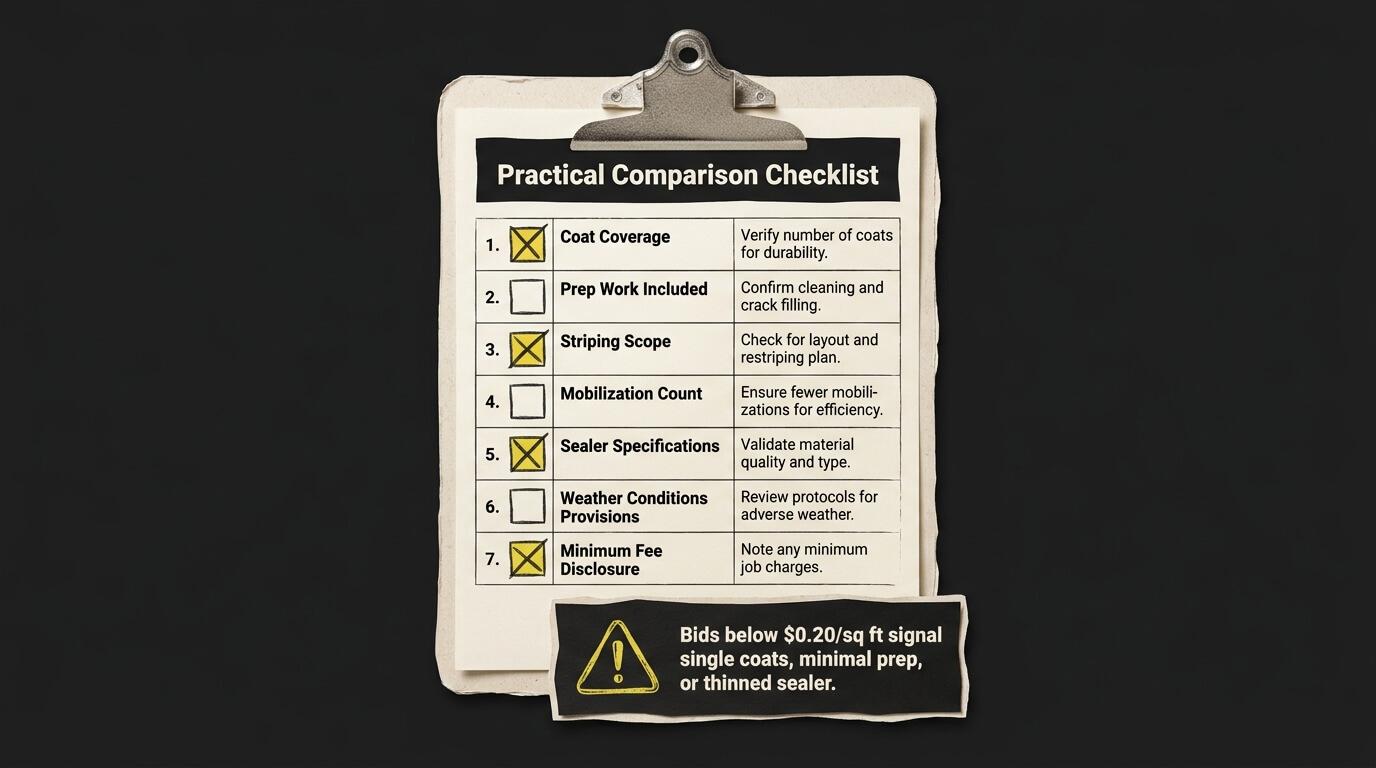
When you get bids for the “same” parking lot, the details can vary by 300% because they’re not actually quoting the same work. Knowing what to ask for creates apples-to-apples comparisons.
Practical Comparison Checklist
- Coat Coverage: Does the price include two coats on drive lanes, or just one coat everywhere? This matters more than most factors that affect the final quality.
- Prep Work Included: Confirm exactly which prep steps are included. Cleaning, oil-spot primer, crack routing, and hot rubber crack filling versus items quoted separately.
- Striping Scope: Are existing lines, arrows, and ADA markings included? What about layout changes?
- Mobilization Count: How many trips will crews make? Phased work around tenants costs more than single-mobilization jobs.
- Sealer Specifications: Type, brand, and application rate should be written in the proposal, not just “asphalt sealant.”
- Weather Conditions Provisions: What happens if weather delays the project? Who absorbs rebid costs?
- Minimum Fee Disclosure: Is there a minimum fee that applies regardless of square footage?
Red Flags
Be cautious of bids substantially below $0.20 per square foot for 2025 commercial work. This usually signals single coats, minimal prep, or sealer thinned beyond manufacturer specs. You’ll pay for the difference in premature failure.
Best Practice
Standardize your bid requests with a written scope that specifies total square footage, desired services (sealcoating, crack sealing, striping), and scheduling requirements. This scope lets you compare local contractors on equal terms rather than chasing the lowest number on incompatible scopes.
Final Thoughts on Commercial Sealcoating Costs and Maintenance Planning
The actual cost of commercial sealcoating isn’t really about the per-square-foot rate. It’s about what happens to your parking lot when maintenance gets deferred in Michigan’s freeze-thaw climate.
Property managers who treat sealcoating as a recurring 3–5 year line item save money over the long term, avoiding frequent repairs and six-figure reconstruction costs that hit deferred properties. The most expensive sealcoating mistake isn’t paying $0.35 per square foot instead of $0.25. It’s waiting until the base fails and resurfacing costs hit $3–$7 per square foot.
If you’re budgeting for a sealcoating project or trying to get an accurate estimate for multiple properties, start with an on-site assessment from a sealcoating business that serves commercial lots exclusively. That’s how you get numbers you can actually budget against, not internet ranges that tell you almost nothing about your specific situation.
Bart Asphalt specializes in commercial sealcoating across Southeast Michigan, with 20+ years serving property managers. We provide free on-site assessments, transparent scoping, 24-hour quotes, and minimal disruption scheduling. Get precise quotes, proven results, and experienced crews who understand your maintenance cycles.
Schedule your free assessment today.
Frequently Asked Questions About Sealcoating Cost
How often should a commercial parking lot be sealcoated in Michigan, and how does that affect the annual cost?
Most commercial lots using asphalt emulsion sealant need resealing every 2–4 years. That works out to roughly $0.04–$0.25 per square foot annualized, which is far less than the $3–$7 per square foot for full replacement when you skip routine sealcoating.
Can I sealcoat over cracks and potholes, or will that waste money?
Sealing cracks without first filling them wastes money and accelerates failure. Water trapped under the sealer freezes and expands, worsening the damage. Crack sealing is an essential mandatory prep in Michigan’s extreme climates.
Why are the online per-square-foot prices so different from the quotes I’m getting locally?
Online cost estimates often mix residential and commercial figures, or quote materials-only versus fully installed pricing. A national average cost for residential driveway size projects doesn’t reflect commercial labor costs, prep requirements, or Michigan-specific factors.
Does lot size really change the price that much?
Yes. A 50,000 sq ft lot will typically cost $0.22–$0.30 per square foot, while a 5,000 sq ft lot might run $0.40–$0.60 per square foot due to contractor minimums and fixed mobilization costs. Larger lots benefit from economies of scale.
Is there a point at which a lot is too far gone, and sealcoating is no longer worth the cost?
Absolutely. If your asphalt surface has widespread base failures, standing water, or alligator cracking covering more than 25–30% of the lot, sealcoating won’t help. You need asphalt resurfacing or reconstruction first. A professional assessment can tell you whether preservation or replacement makes more financial sense.
How long does a typical commercial sealcoating project take, and how does phasing affect price?
Small to medium lots (under 20,000 sq ft) typically complete in 1–2 days. Larger lots or projects requiring tenant access phasing can span 3–5 days or multiple weekends. Phasing adds 10–20% to the total cost due to additional mobilizations and traffic control.
What’s the difference in cost between basic sealcoating and a full “sealcoat + crack seal + restripe” scope?
Basic sealcoating runs $0.20–$0.50 per square foot. A full scope with crack sealing and line striping runs $0.65–$0.90 per square foot. The full scope is what well-maintained driveways and parking lots actually need because basic sealcoating alone just covers up problems temporarily.