
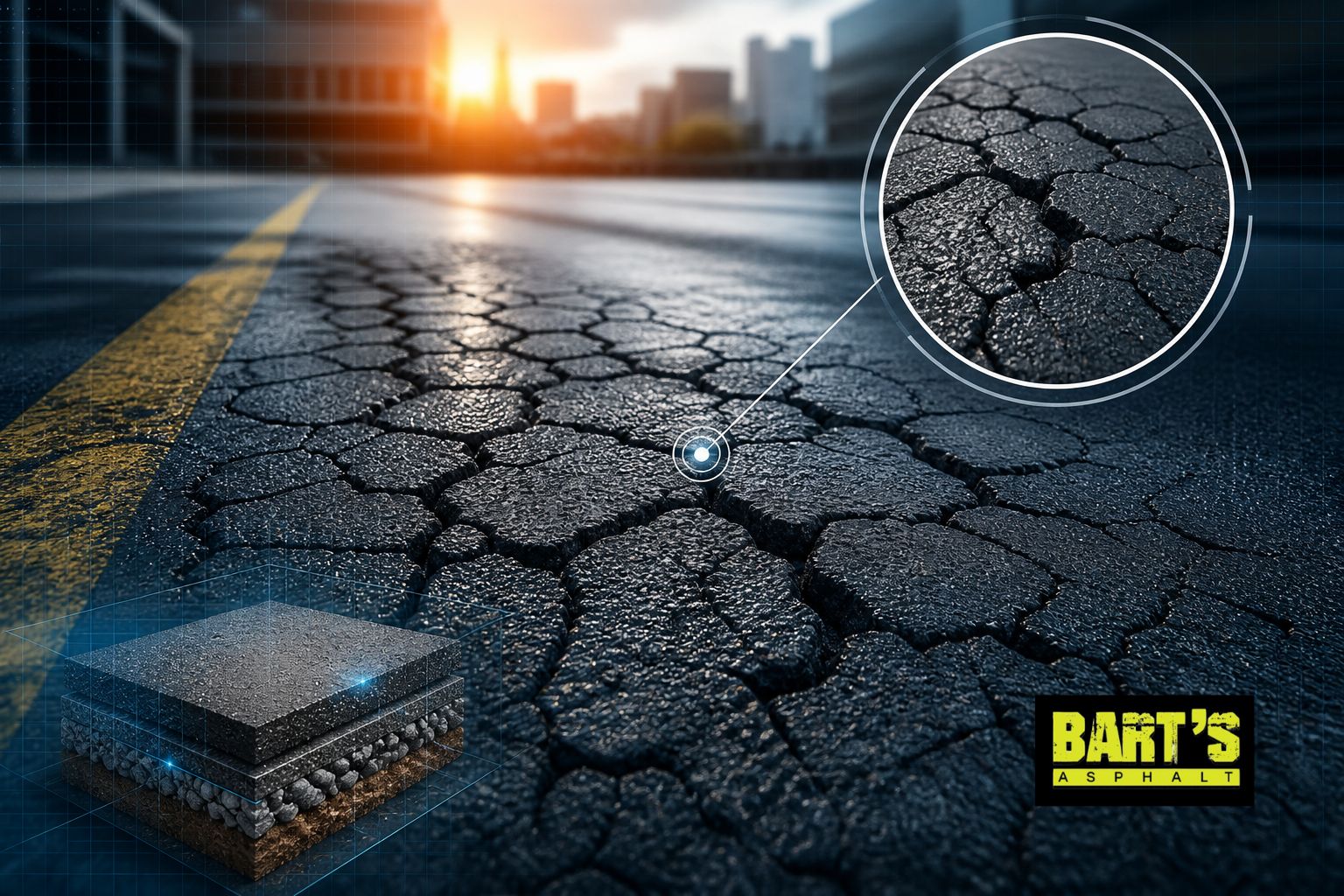
Alligator cracking asphalt is a network of interconnected cracks that points to structural damage below the pavement surface, often caused by repeated traffic stress, weak support, poor drainage, thin asphalt, or freeze-thaw cycles.
More than an eyesore, it’s a warning sign that the pavement is failing beneath the surface, especially when those cracks show up in wheel paths or after a harsh Michigan winter.
At Bart’s Asphalt, we see this type of damage regularly, and property owners, facility managers, and anyone responsible for asphalt maintenance need to know what caused it before choosing a fix.
Surface treatments alone will not solve structural cracking, and waiting too long can turn a manageable repair into a larger cost and a safety issue.
In this guide, we’ll show you how to identify alligator cracking, what causes it, how it differs from other crack types, how severity changes the repair approach, which repair options make sense at each stage, and what helps prevent it from coming back.
Key Takeaways
- Alligator cracking signals structural pavement damage, not a surface-level defect.
- Heavy traffic, weak support, poor drainage, thin asphalt, and freeze-thaw cycles can contribute to its development.
- Crack sealing and sealcoating cannot restore pavement that has already lost structural strength.
- The right repair may involve patching, full-depth repair, milling and overlay, or reconstruction, depending on the damage and base condition.
- Early inspection and proper drainage can prevent a localized failure from becoming a larger rehabilitation project.
How to Identify Alligator Cracking in Asphalt
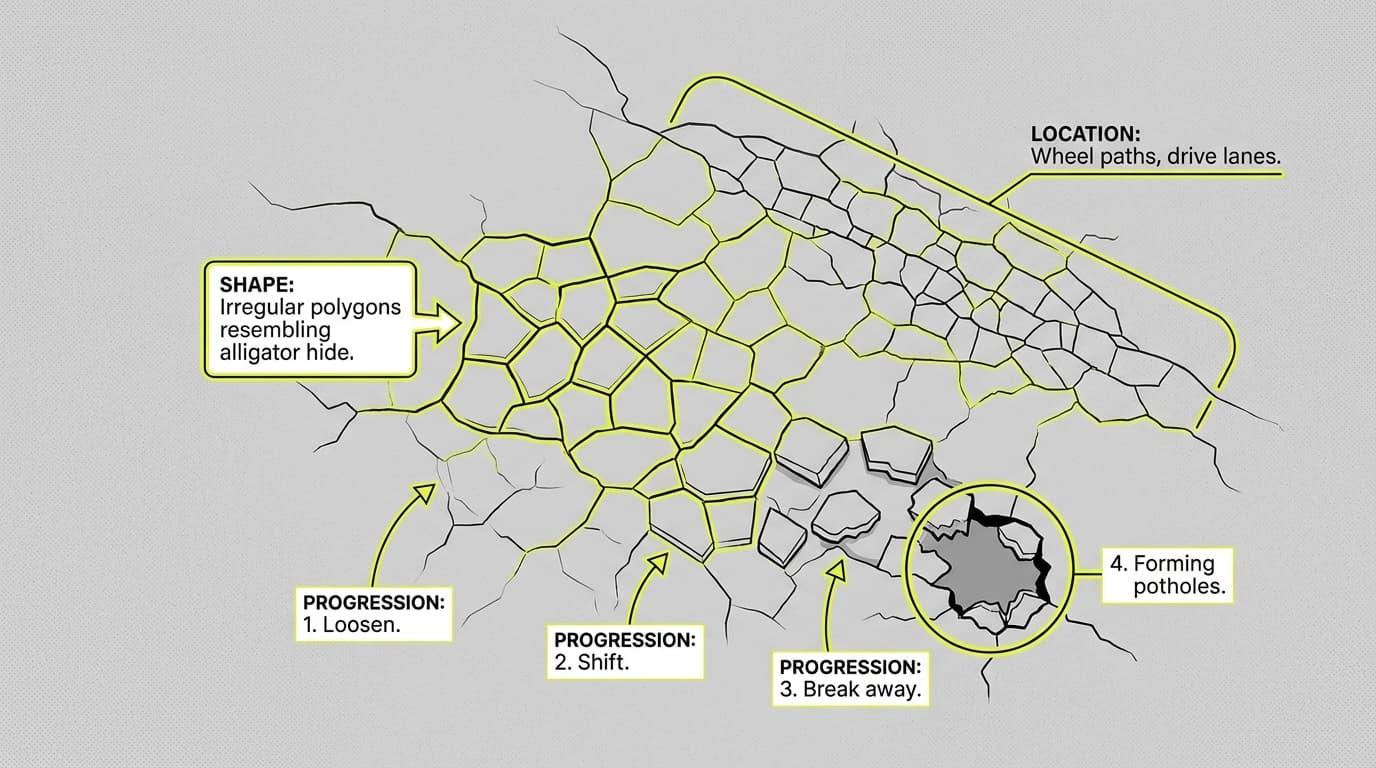
Alligator cracking is easy to recognize once you know what to look for. Instead of a few isolated lines, you’ll see a network of connected small cracks that breaks the asphalt into small, irregular shapes. It often appears in wheel paths, where repeated traffic puts the pavement under the most stress.
Identifying the pattern in the early stages gives you a better chance of addressing the underlying problem before loose pavement and potholes develop.
Signs of Alligator Cracking
A few simple clues can help you distinguish alligator cracking from ordinary pavement cracks:
- Shape: Cracks connect to form small, irregular polygons that resemble alligator hide or scales rather than running as individual lines.
- Location: The damage often follows wheel paths, drive lanes, and areas used by delivery or refuse trucks.
- Progression: As the damage worsens, individual pieces loosen, shift under traffic, and eventually break away, forming potholes.
If the cracking is concentrated where vehicles repeatedly travel while quieter areas remain relatively intact, that’s another strong sign you’re dealing with fatigue-related damage. At that point, sealing alone isn’t enough because the problem isn’t limited to the surface.
How Fatigue Cracking (Alligator Cracking) Starts
Every vehicle that crosses your pavement causes a small amount of flexing. Heavy trucks and repeated axle loads put even more strain on the asphalt. Over time, those repeated movements can create cracks at the bottom of the asphalt layer that gradually work their way upward.
Research on asphalt fatigue shows how repeated strain cycles can lead to this bottom-up cracking, while the Indiana DOT classifies alligator cracking as a load-related pavement distress.
What Causes Alligator Cracking in Asphalt Pavement?
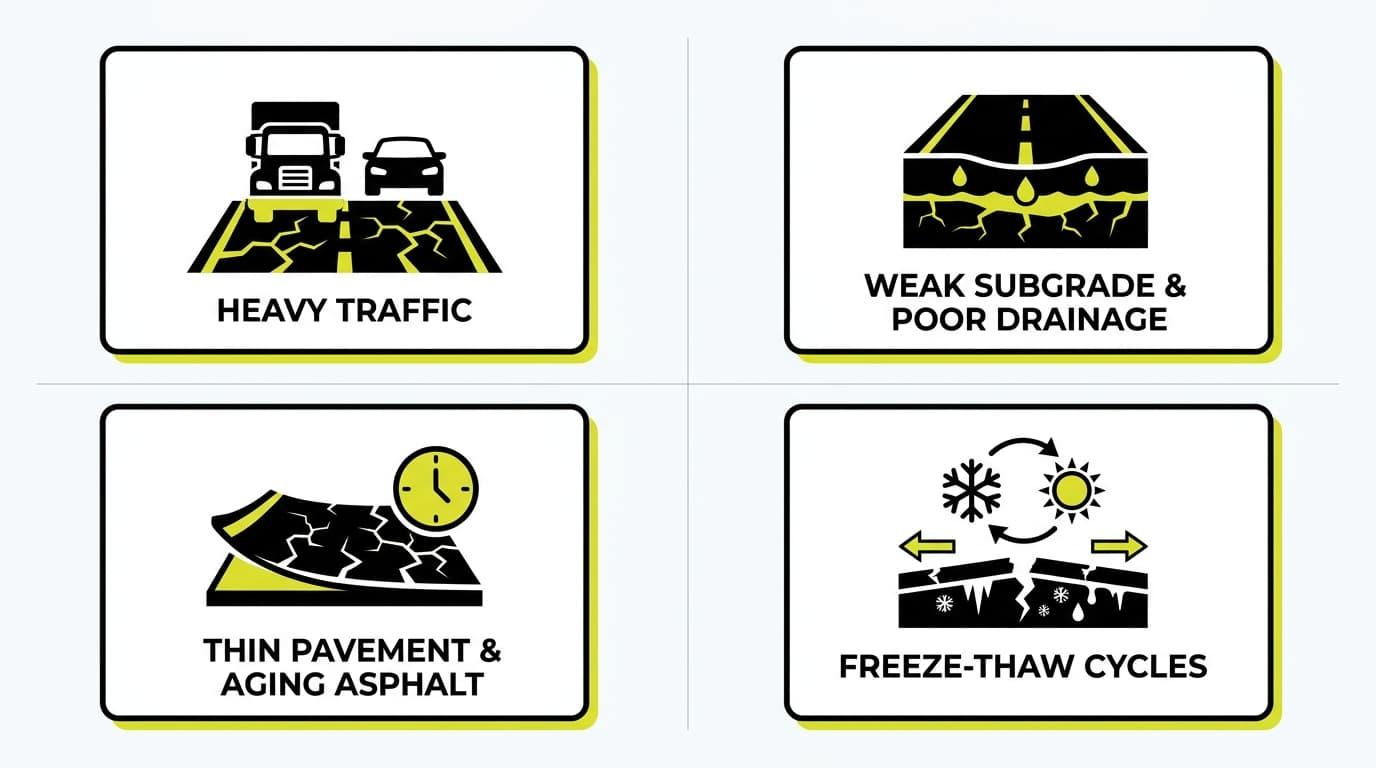
Alligator cracking usually indicates damaged asphalt caused by problems below the pavement surface. Heavy loading, weak support, trapped moisture, insufficient thickness, and aging can combine over time until the pavement can no longer withstand repeated traffic.
Identifying these primary causes helps determine the right repair method.
Heavy Traffic
Every loaded axle puts a small amount of stress on the pavement. Repeat that thousands of times along the same wheel path, and repeated heavy-vehicle traffic plus overloading eventually take a toll. Delivery trucks, refuse trucks, and other heavy vehicles can accelerate fatigue, especially when they follow the same routes every day.
The heavier and more repetitive the traffic, the more important it becomes to have enough pavement thickness and a strong base underneath it, sized to the expected traffic loads. Mapping your busiest vehicle routes can help identify where loading contributes to cracking.
Weak Subgrade and Poor Drainage
The asphalt surface depends on the pavement’s structural makeup and the support provided by the layers underneath it.
When the subgrade is weak or saturated, the pavement can flex more under each passing vehicle, increasing strain and leading to fatigue cracking. Subsurface moisture can also be a contributing factor when support layers remain wet.
Three common problems can weaken that support system, including the sub base:
- Weak Subgrade: Soft or organic soil can compress under repeated loads instead of providing stable support.
- Poor Drainage: Flat grades or clogged catch basins can leave water sitting against the pavement structure, and poor drainage contributes to the formation of alligator cracking.
- Water Infiltration: Open cracks can let moisture reach the base and subgrade, gradually weakening the layers below.
If moisture issues persist, failures can occur again even after surface work.
Before repaving, correct drainage and evaluate the base and subgrade. Rebuilding only the surface can allow the same failure to return if moisture or weak support remains.
Thin Pavement and Aging Asphalt
Pavement thickness directly affects the amount of repeated loading the asphalt can withstand. A section that’s too thin may fatigue under traffic that a properly designed pavement structure handles without trouble.
A study on asphalt cracking connects fatigue distress with inadequate pavement thickness. Aging asphalt can add another problem because oxidation makes the binder less flexible and more prone to cracking.
If you’re unsure how thick your existing pavement is, a core sample can provide a clearer picture before you invest in another overlay.
Freeze-Thaw Cycles
Southeast Michigan’s freeze-thaw cycles can add stress to already vulnerable pavement. Water enters cracks and voids, freezes and expands, then leaves more space after thawing. Repeated cycles can widen defects and weaken support, particularly where drainage is poor.
A review of the effects of climate on asphalt pavement discusses how temperature fluctuations and freeze-thaw cycles can accelerate pavement deterioration.
Repeated freeze-thaw damage can eventually lead to costly reconstruction if the pavement base begins to fail.
How to Tell Alligator Cracking From Other Crack Types
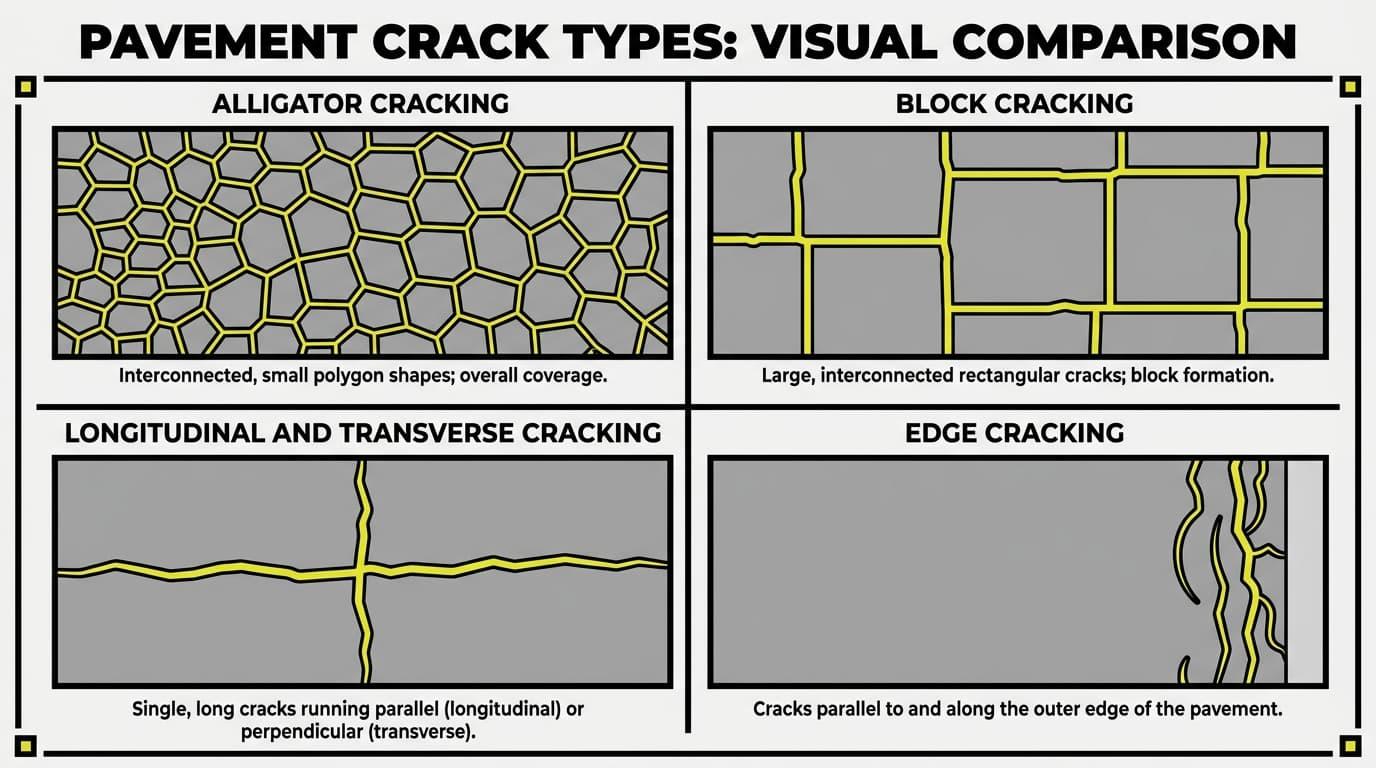
Not every crack pattern points to the same pavement problem.
Alligator cracking forms a connected web, while other types follow different shapes, locations, or directions. Knowing those differences can help you avoid treating a structural problem with a surface-level repair.
Block Cracking
Block cracking divides the pavement into large, rectangular sections, often appearing in areas that see little traffic. Unlike alligator cracking, it usually develops as the asphalt binder shrinks and expands with temperature changes rather than from repeated vehicle loading.
Because traffic isn’t the primary cause, you’ll often find block cracking across parking stalls, quiet sections, and other areas outside the main wheel paths. Crack sealing and sealcoating can help manage this type of cracking when the pavement underneath remains structurally sound.
Longitudinal and Transverse Cracking
Longitudinal cracks run in the direction of travel, while transverse cracks run across the pavement. Both typically appear as individual lines rather than the interconnected pattern associated with alligator cracking.
Cracking mechanisms research links these cracks to factors such as construction joints, reflective cracking, and temperature-related movement. When they’re still narrow, routing and sealing can help keep water from reaching the pavement layers underneath.
Edge Cracking
Edge cracking develops near the pavement edge, often where the shoulder provides less support. You may see it along the outside edge of a parking lot, driveway, or roadway while the pavement farther toward the center remains intact.
The repair usually focuses on restoring that edge support rather than rebuilding the entire pavement section. Drainage corrections, edge repairs, or curb work can address the underlying problem. A machine learning crack prediction study also demonstrates how different crack patterns can be distinguished when pavement distress is properly classified.
How Alligator Cracking Progresses

Alligator cracking doesn’t stay at the same stage. As traffic continues to flex the pavement, the cracks widen, the pieces between them break apart, and the damage eventually reaches the point where the pavement section needs structural repair.
The FHWA pavement damage report documents how load-related distress develops as cracks widen and deepen. For property owners, recognizing the severity early can help determine the extent of the necessary repairs.
Low Severity
At the low-severity stage, the pavement shows a tight network of interconnected cracks, but the pieces remain firmly in place. You shouldn’t see loose fragments, noticeable movement, or major differences in elevation.
Look for:
- Fine, closely spaced cracks
- Intact pavement between the cracks
- No loose pieces or surface displacement
- Little to no movement underfoot
At this stage, document the damage, inspect drainage, and evaluate the supporting layers before choosing a treatment. Nearby non-structural cracks may still be sealed, but filling the alligator pattern itself will not restore structural support.
Moderate Severity
Moderate alligator cracking becomes easier to recognize because the edges of the cracks start to break apart. Small pieces may loosen under traffic or even move when you step on them.
Once pavement pieces begin to break loose, surface treatments are no longer reliable because the failure extends beyond the surface.
High Severity
High-severity cracking indicates that the pavement section has lost significant structural strength. The cracked pieces can move under vehicle loads, break loose, and eventually leave potholes behind.
At this point, you’ll typically see:
- Large, interconnected cracks
- Loose or displaced pavement pieces
- Significant movement under traffic
- Potholes forming within the damaged area
Restoring the affected area may require repairs that replace failed material and rebuild structural integrity, moving the project from routine maintenance into patching potholes in asphalt or full-depth repair. A core sample can help confirm how much of the pavement structure has failed before you commit to a larger rehabilitation project.
Why Surface Treatments Won’t Fix Alligator Cracking
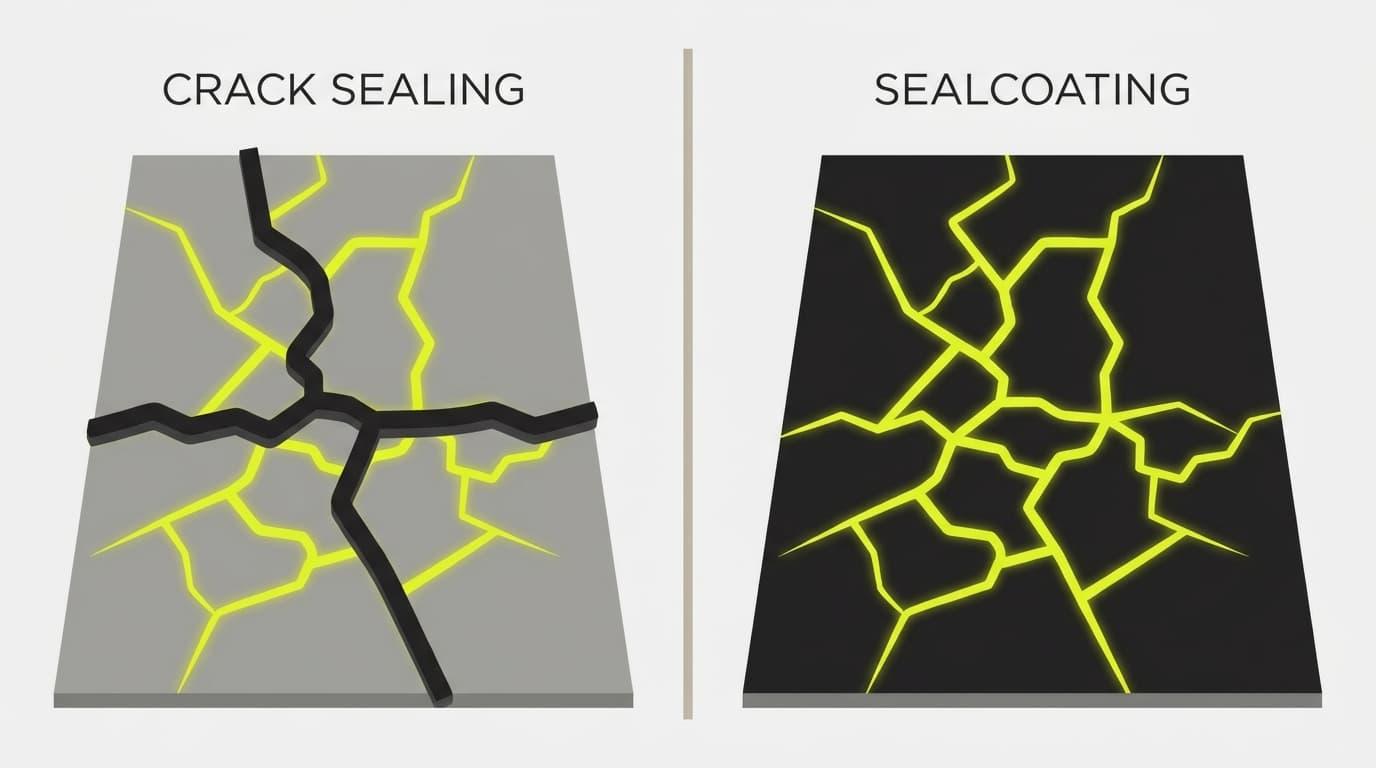
Crack sealing and sealcoating can protect sound asphalt from water and weather, but they cannot rebuild a weakened pavement structure.Once alligator cracking appears, the repair needs to address what is happening below the surface rather than simply covering the cracks.
Crack Sealing
Crack sealing fills individual cracks and keeps water from reaching the pavement layers below. It works well for narrow longitudinal, transverse, and other non-structural cracks.
Alligator cracking is different. Its interconnected pattern points to repeated pavement fatigue and weakened support underneath. Sealing each crack may slow water infiltration, but it cannot restore the strength the pavement has already lost. If the surface has turned into a widespread web, a deeper repair is usually needed.
Sealcoating
Sealcoating adds a protective layer that helps shield sound asphalt from water, UV exposure, and oxidation. It can also refresh the pavement’s appearance and extend the life of a surface that is still structurally intact.
It cannot, however, add structural strength or stop an existing fatigue failure. The alligator pattern will continue to move and reopen as vehicles flex the pavement. If you’re looking into how long sealcoating takes to dry, that’s generally a maintenance question, not a solution for pavement that’s already breaking apart underneath.
Choosing the Right Repair Method for Alligator Cracking
The appropriate repair depends on the severity and extent of the cracking, as well as the condition of the base beneath it, and the table below gives the general steps for matching severity to repair type. A small area of sound support may be patchable, while widespread failure or a weak base can require full-depth repair or reconstruction.
| Severity and Extent | Typical Method |
|---|---|
| Low, isolated areas | Surface patching |
| Moderate, localized | Full-depth repair |
| Moderate to high, widespread | Milling and overlay |
| High, across the section | Reconstruction |
Surface Patching
Surface patching may be appropriate for a small, isolated area only when the base and surrounding pavement remain sound. The repair method depends on the condition of the failed asphalt: crews may remove and replace the damaged material, or use infrared repair for a suitable shallow defect. Neither approach corrects a weak base.
Once cracking becomes widespread, patching individual spots only treats the symptoms. A broader asphalt repair approach may be needed, reserving surface patching for localized repairs only when the surrounding pavement remains sound.
Full-Depth Repair
When alligator cracking is concentrated in a defined area but extends into the pavement structure, full-depth repair goes deeper.
Crews remove the failed asphalt and compromised aggregate using the right equipment for excavation and compaction, then rebuild the section over a stable, compacted base.
The inspection may involve digging or coring to confirm how deep the failure extends. It costs more than a surface patch, but fixes the support problem while limiting the work to failed areas.
Milling and Overlay
For moderate-to-high cracking over a larger area, milling and overlay may be appropriate if testing confirms the base remains structurally sound.
Milling removes the failed upper layer, and a tack coat is applied before the new asphalt overlay to bond the layers and restore the driving surface. This liquid asphalt glue also helps create a moisture-tight seal in the repair.
Bart’s Asphalt’s milling and patching services follow the same basic principle: remove failed material while preserving pavement layers that remain structurally usable.
Reconstruction
When alligator cracking covers much of the pavement and the base has lost strength, reconstruction may be the most durable option. Crews remove the failed pavement, correct foundation or drainage problems, and rebuild the section over stable support.
The NCHRP rehabilitation strategies report includes reconstruction as one of the strategies for extensive pavement distress. Core samples and site testing can confirm whether reconstruction is necessary or if milling and overlay can still work; for example, crews may core the pavement or open a pit to assess support conditions.
What Happens When Alligator Cracking Goes Untreated?
Leaving an alligator cracking untreated rarely keeps the damage contained. Continued traffic loosens fragments, while water can reach and weaken the supporting layers. A localized repair can then grow into a larger rehabilitation project.
Potholes and Trip Hazards Develop as Cracking Worsens
Once the interconnected cracks begin breaking apart, potholes can form quickly. That creates more than a pavement problem, especially when the damage reaches areas used by tenants, customers, or employees.
Watch for:
- Loose asphalt fragments that shift underfoot or vehicle tires
- Potholes forming within or around the cracked area
- Uneven surfaces along walking routes or ADA-accessible areas
- Increasing complaints from tenants, customers, or delivery drivers
Photographing the damage and documenting when it appears provides a useful record as you determine the appropriate repair. Waiting for an incident to force the issue leaves you with less control over both the timing and the budget.
Delayed Repairs Can Expand the Rehabilitation Scope
The longer alligator cracking remains exposed, the greater the opportunity for water to enter the pavement structure. Once the underlying aggregate or subgrade becomes saturated and loses support, a localized repair can spread into a much larger rehabilitation project.
That expansion affects both the amount of pavement removed and the depth of the repair. Material and labor costs can also rise over time. The FHWA construction cost index tracks changes in highway construction costs, providing useful context for why postponing a repair can make future work more expensive.
Comparing the current repair area with asphalt cost per square foot can also help put the potential cost of waiting into perspective. The key is catching the damage before a surface-level repair turns into a structural one.
How to Prevent Alligator Cracking From Coming Back

Preventing alligator cracking starts with addressing the conditions that caused it in the first place. A durable pavement section needs enough support, a reliable path for water to leave, and timely maintenance to protect long-term durability before minor cracks become structural damage. Good design, proper drainage, and timely maintenance are key parts of prevention.
Build for the Loads
Preventing alligator cracking starts with correcting its causes. The pavement needs adequate structural support, effective drainage, and timely maintenance to prevent minor defects from allowing water to weaken the layers below.
- Expected traffic volume and vehicle weight
- Asphalt layer thickness
- Base and subgrade strength
- Compaction requirements
Getting these details right during installation gives the pavement more room to absorb repeated loading without developing fatigue cracks.
Keep Water Moving
Proper drainage is essential to prevent water from weakening the pavement structure. If runoff sits on the surface or reaches a weakened base, repeated traffic can push the pavement toward deeper failure.
Keep an eye on:
- Standing water after rainfall
- Clogged or slow-draining catch basins
- Low areas where runoff collects
- Open cracks that allow water into the pavement structure
Drainage corrections should be part of the repair plan when these conditions appear, rather than something added after the pavement starts failing again.
Seal Cracks Early
Not every crack signals structural failure. Narrow longitudinal, transverse, and thermal cracks can often be sealed before water reaches the underlying layers. Once those cracks develop into an interconnected fatigue pattern, however, surface sealing no longer addresses the underlying problem.
Regular inspections give you a chance to catch cracks before they become too severe to repair. The right treatment also depends on the pavement surface and site conditions, making an asphalt-versus-chip-seal comparison useful when planning long-term maintenance.
Alligator Cracking Starts With a Diagnosis
Alligator cracking is more than a surface defect. It signals that something beneath the asphalt may no longer be carrying traffic the way it should. The right response depends on how far the damage has progressed, from localized repair to full reconstruction.
At Bart’s Asphalt, we’ll help you find out what’s happening below the surface before you commit to a repair. We assess the damage, explain your options, and recommend the approach that fits your property and budget.
Schedule an Asphalt Assessment
Frequently Asked Questions About Alligator Cracking
What is the best product for repairing alligator cracks in asphalt?
There is no single product for alligator cracking because the damage is structural. Isolated low-severity areas may need hot-mix asphalt patching, while widespread or deeper damage requires full-depth repair or reconstruction.
Can you pave over alligator cracks?
You can pave over alligator cracking only when an inspection confirms that the base remains structurally sound. If the base has failed, the cracks can reflect through the new overlay, so the failed layers must be repaired first.
What is the average lifespan of an asphalt driveway?
A properly built and maintained asphalt driveway can last for decades, but lifespan varies with pavement thickness, drainage, traffic, compaction, and maintenance. Poor support or water problems can shorten that lifespan considerably.
Is 2 inches of asphalt enough for a driveway?
Two inches can work for a driveway carrying light passenger traffic when the underlying base is strong, stable, and well-drained. Heavier vehicles or weak support may require a thicker asphalt section.
Can sealcoating fix alligator cracking?
Sealcoating cannot repair alligator cracking because it only protects the pavement surface. It may improve appearance temporarily, but structural cracking requires an assessment of the asphalt and supporting layers before choosing a repair.
How do you know if alligator cracking needs a full-depth repair?
Full-depth repair becomes more likely when cracking is widespread, pavement pieces move under traffic, or the underlying base is soft or saturated. A core sample or pavement inspection should assess the pavement’s structural makeup and determine whether or not subsurface moisture is present before choosing full-depth repair.