

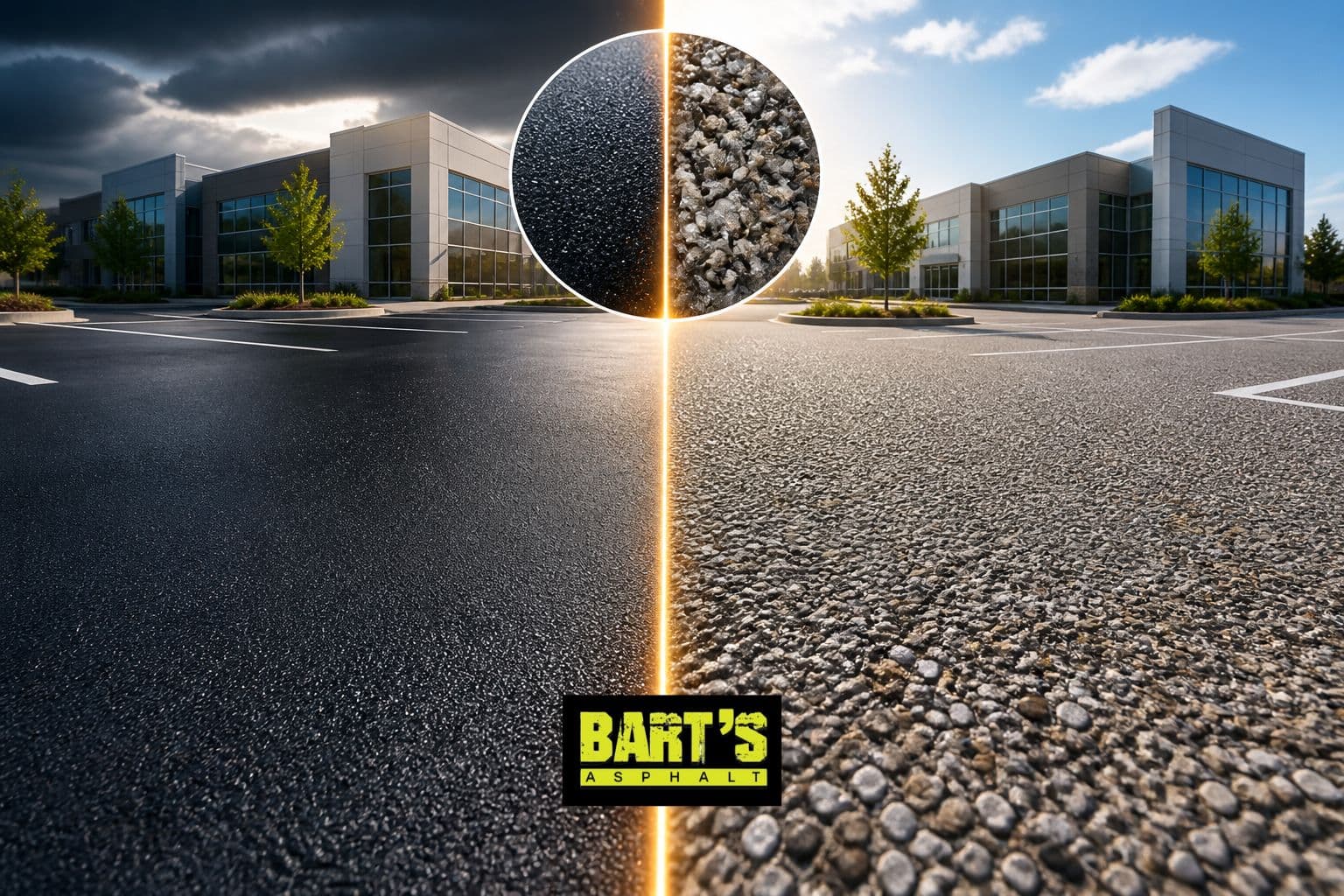
Choosing between asphalt and chip seal can feel like a simple price comparison. It is not. The two systems solve different pavement problems, so the right choice starts with what your property needs now.
Asphalt can form a new structural pavement or replace a failed surface. Chip seal is usually placed over pavement that is still sound to protect it and add a new wearing course. That difference affects traffic capacity, finish, construction scope, maintenance, and long-term value.
For most busy parking lots, loading areas, and commercial drives, asphalt offers the smoother and more adaptable surface. Chip seal may still make sense on private roads and paved areas with simpler traffic and marking needs. This guide explains where both options fit so you can compare them on performance, not price alone.
Key Takeaways
- Asphalt and chip seal are not equal construction alternatives. Asphalt can provide a structural pavement layer, while chip seal usually preserves an existing surface.
- Chip seal needs a stable base and pavement with no major structural failure. It cannot correct deep rutting, widespread base movement, or drainage problems.
- Asphalt is often the stronger fit for parking lots, loading zones, frequent turning, detailed pavement markings, and sites where a smooth finish matters.
- Chip seal can be a practical preservation option for suitable private roads and paved areas with simpler traffic and marking needs.
- Michigan weather does not automatically rule out either surface. Drainage, base condition, preparation, material selection, and installation timing matter more.
Asphalt vs Chip Seal at a Glance
The fastest way to understand the choice is to compare what the two systems are designed to do.
| Decision factor | Hot-mix asphalt | Chip seal |
| Primary role | Creates or renews a compacted pavement layer | Preserves a suitable existing surface |
| Structural contribution | Can add pavement thickness and load capacity when properly designed | Adds little to no structural capacity |
| Best starting condition | New construction, reconstruction, or a planned overlay | Stable pavement with surface-level wear |
| Surface character | Smooth, dense, and well suited to markings | Textured and initially more prone to loose aggregate |
| Typical commercial fit | Parking lots, drives, loading areas, and access lanes | Selected private roads and preservation-focused applications |
| Main limitation | Higher initial scope when base repair or reconstruction is needed | Cannot solve structural failure beneath the surface |
What Hot-Mix Asphalt Actually Does
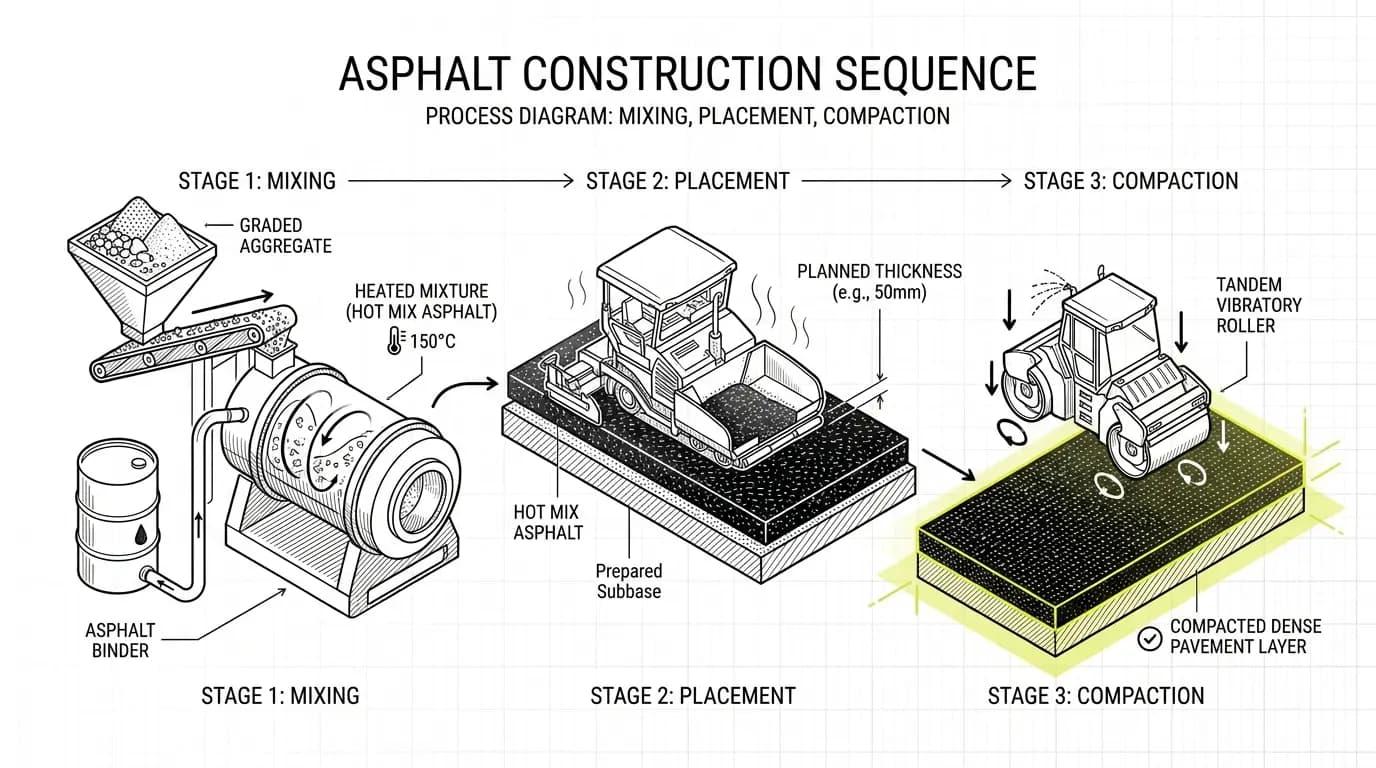
Hot-mix asphalt combines graded aggregate with asphalt binder. Crews place the heated mixture in a planned thickness, then compact it into a dense pavement layer. The finished system depends on the asphalt mix, base, drainage, thickness, compaction, and expected traffic.
That structural role makes asphalt useful for new parking lots and failed surfaces. It also lets a contractor adjust the project to the property. A light-duty parking bay, a fire lane, and a truck route do not need the same pavement design.
A sound commercial asphalt paving plan should account for vehicle weight, turning movement, drainage, transitions, markings, and future maintenance. The surface is only one part of that system.
At Bart’s Asphalt, we plan commercial paving around how the property works, not just how many square feet it covers. We review traffic zones, drainage, access, and pavement thickness before recommending the scope. That gives property managers a plan built around real operating demands.
Build Your Commercial Asphalt Plan
What Chip Seal Actually Does
Chip seal begins with a layer of asphalt emulsion or binder placed over an existing surface. Aggregate chips are spread into the binder and rolled into place. After the binder sets, excess stone is swept away.
The critical point is simple: chip seal adds little to no structural capacity. It can seal minor surface openings, improve texture, and protect pavement that still has structural life. It cannot rebuild a weak base or correct deep pavement movement adds no structural pavement value.
This does not make chip seal inferior. It makes the treatment specific. A preservation tool performs well when the pavement is a good candidate, and the site can accept its texture, curing process, and maintenance needs.
What the Research Adds to the Comparison
Pavement studies can get technical fast. The useful part is not memorizing every test value. It is knowing which findings should change the decision on your property.
A lower price can reflect a smaller job
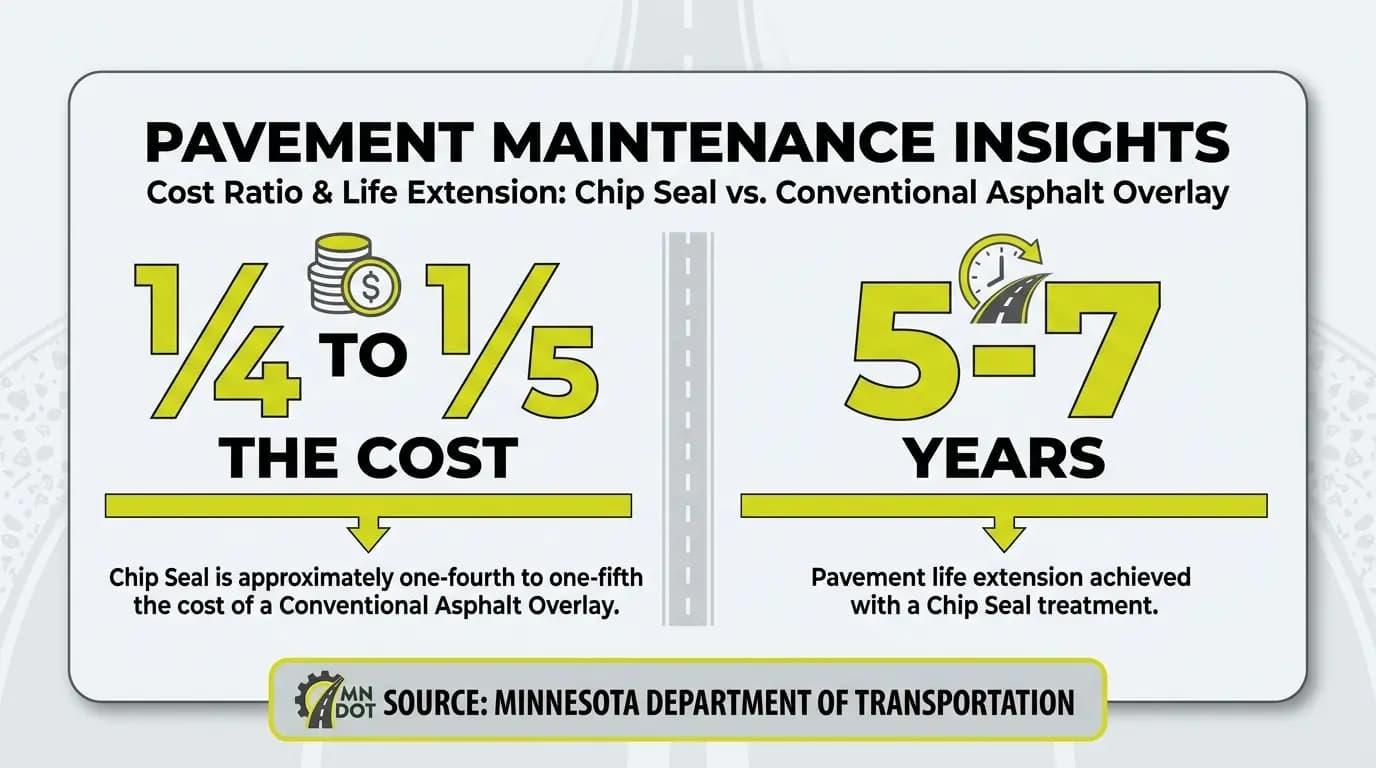
The Minnesota Department of Transportation reports that chip sealing is about one-fourth to one-fifth the cost of a conventional asphalt overlay on its roads. It also says the treatment can extend asphalt pavement life by five to seven years, depending on traffic.
Those are useful public-road benchmarks, not universal commercial quotes. Chip seal costs less partly because it does less structural work. If a parking lot needs base repair, drainage correction, or new pavement depth, comparing its reconstruction price with a surface-treatment price is like comparing a roof replacement with a fresh coat of paint.
Warm weather is part of the specification
The Asphalt Institute says chip seals are ideally placed when the pavement surface is at least 70°F. That temperature should hold for the next three to five days so the binder can set and cure properly. Humidity, rain, traffic control, aggregate condition, rolling, and sweeping can still change the result.
In other words, a sunny afternoon is not the whole weather plan. A contractor needs a suitable window after placement, too. On an active property, that curing period must fit deliveries, customer access, and the way traffic will be controlled.
Long-term testing supports a condition-first choice
A Federal Highway Administration analysis found that thin overlays and chip seals outperformed slurry seals, crack seals, and untreated control sections for fatigue cracking.
That also depends on weather conditions during the curing window, not just the reading at the time of installation, since rain and traffic control after placement still affect how well a chip seal sets. The same research found that thin overlays did more to slow roughness in freeze zones, under high traffic, and on pavement that began in poor condition.
That is a much more useful takeaway than saying one material always wins. Chip seal can preserve the right surface. A thin asphalt overlay becomes more compelling when smoothness, traffic, freezing conditions, or poorer starting condition carries more weight.
More texture does not create a universal safety winner
An FHWA safety evaluation covered 2,448 miles and 6,158 crashes in its combined two-lane chip-seal results. Researchers found a small overall crash benefit, including a small wet-road benefit, but results varied by state and road type, with thin asphalt overlays gaining an advantage in freeze zones and under heavy traffic.
That nuance matters. A road study can show how texture and friction perform across a network, but it cannot choose the surface for a loading dock or shopping center. A commercial decision must also account for turning stress, pedestrians, carts, striping, sweeping, snow removal, and early loose aggregate.
Existing Pavement Condition
The condition below the visible surface is the first decision point, and chip seal’s textured surface can improve skid resistance, but that still does not make it the universal safety winner. If the base is unstable, the pavement is breaking into connected pieces, or wheel paths have deep ruts, a new surface treatment will not remove the cause.
When asphalt fits
Asphalt fits projects that need a new pavement layer, full-depth replacement, or a designed overlay. Failed areas can be removed and rebuilt before paving. That gives the contractor room to correct localized base problems, reshape drainage, and create a surface for the property’s current traffic.
On a worn site, the real choice may be between repairing or replacing a parking lot, not between two surface finishes. An inspection can separate isolated failures from damage that has spread through the pavement system.
Bart’s Asphalt can trace visible damage back to the likely depth of failure. We assess whether targeted repairs, an overlay, or reconstruction fits the condition instead of jumping to the largest project. That keeps the recommendation tied to what the pavement actually needs.
When chip seal fits
Chip seal fits pavement that remains stable but shows oxidation, minor surface wear, or small openings that have not become structural failures. The treatment can refresh the wearing surface while helping keep water out of shallow defects.
A few cracks do not automatically disqualify a site. They do need to be assessed and prepared. Wide moving cracks, potholes, soft areas, drainage failures, and severe rutting call for repair before any preservation treatment is considered.
Traffic Loads and Vehicle Movement
Vehicle count tells only part of the story. A busy passenger-car lot creates different stress than a route used by refuse trucks, delivery vehicles, forklifts, or tractor-trailers. Slow turns, braking, and standing loads can be more demanding than vehicles moving steadily in a straight line, and chip seal works best on stable pavement or sound existing asphalt.
Why asphalt often suits commercial sites
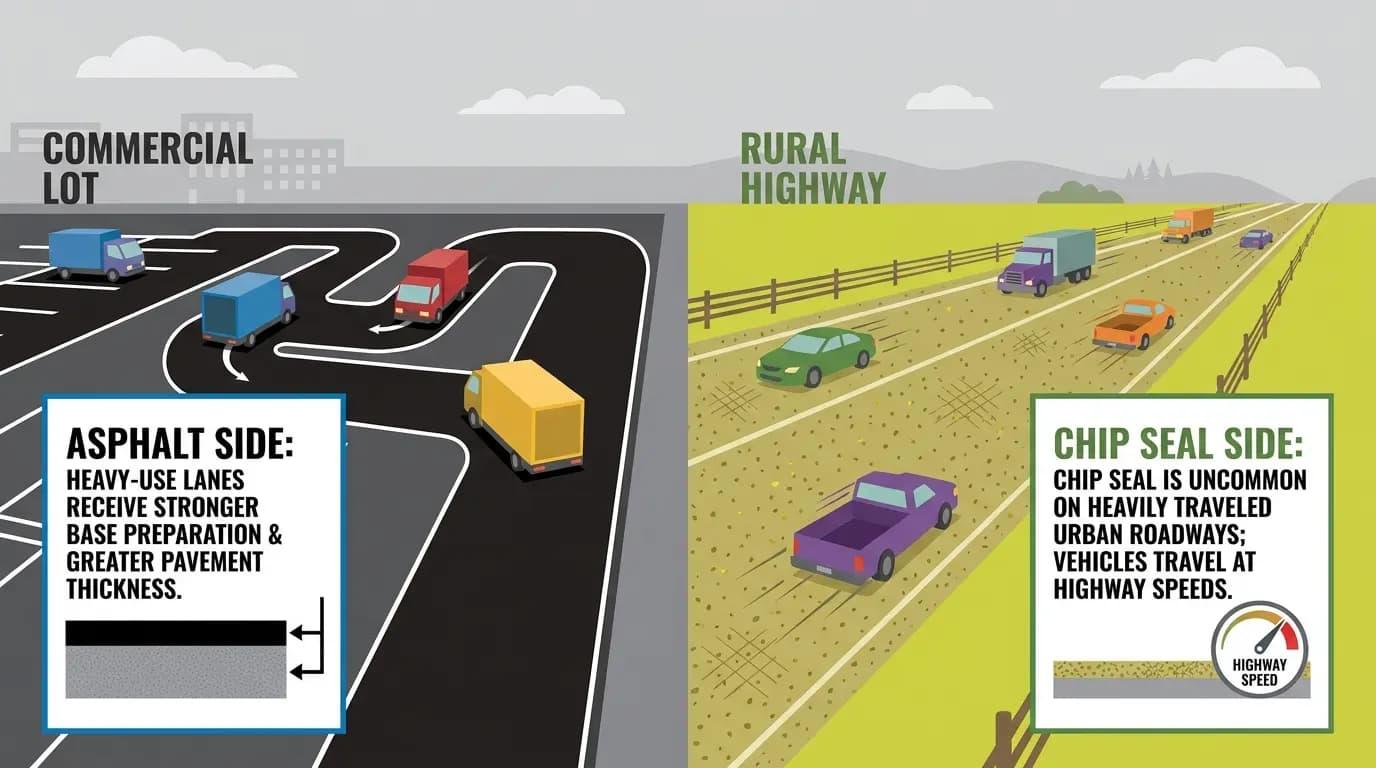
A properly designed asphalt section can be adjusted for the loads on the property. Heavy-use lanes can receive stronger base preparation or greater pavement thickness than standard parking stalls. Crews can also phase the work around entrances, loading docks, and tenant access.
The dense surface works well where vehicles turn sharply or stop often. It also supports detailed striping, directional arrows, accessible spaces, crosswalks, and fire-lane markings that guide drivers and pedestrians.
Where chip seal can perform
Chip seal is not limited to tiny, slow roads. It is used on many rural routes where vehicles travel at highway speeds, but the more important limit is the combination of surface stress, heavy loads, urban traffic volume, loose-chip risk, and the operational demands of the site.
Federal guidance notes that chip seal is uncommon on heavily traveled urban roadways because chip loss can create operational concerns. That distinction matters for retail entrances, dense business parks, and other sites with constant turning and close vehicle spacing, where asphalt’s dense surface holds up better under higher traffic volumes and repeated stopping stress.
Surface Finish and Daily Property Use
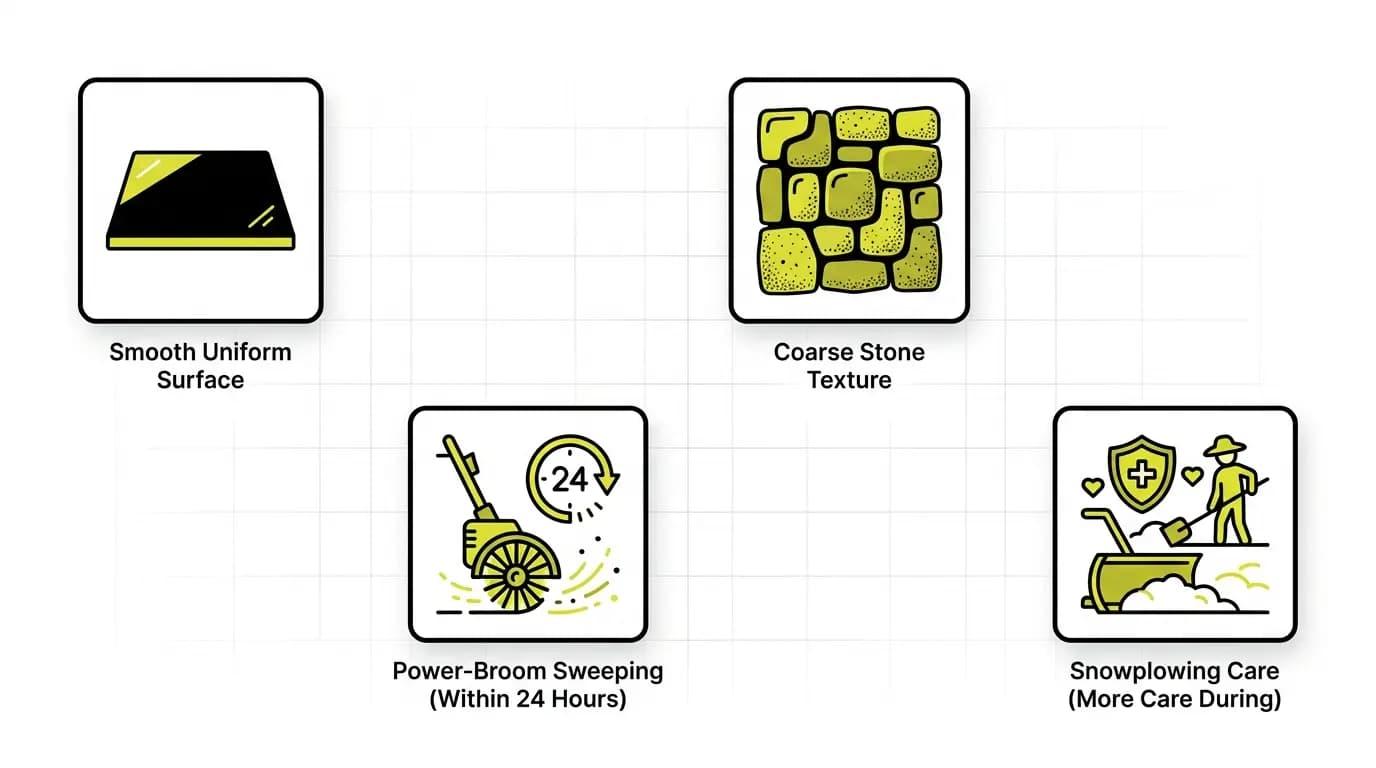
Property managers live with the finished surface long after the crew leaves. Texture, noise, sweeping, snow removal, markings, pedestrian routes, and customer expectations should be part of the decision.
Smoothness and appearance
Asphalt creates a smooth, uniform black surface when it is placed and compacted correctly. That clean finish can support the appearance of retail, medical, office, multifamily, and industrial properties. It is also easier to pair with crisp pavement markings and planned traffic flow.
Chip seal has a coarser, stone-textured appearance. Some owners prefer that look on private drives or rural settings. Others may find it less suitable for a polished customer-facing lot or a space that uses carts, small wheels, frequent sweeping, or dense markings.
Loose aggregate and opening the site
A new chip seal needs time for the binder to hold the aggregate. Some loose stone should be expected during the early stage, and sweeping is part of proper construction. Temporary speed control may also be needed while the surface settles.
The Asphalt Institute calls for power-broom sweeping within 24 hours of application. It also lists poor traffic control during the first 24 hours as one possible cause of chip-seal trouble. That first day is not background noise. It belongs in the property’s access plan.
Asphalt has its own opening requirements. When placed and compacted correctly, it creates a smoother surface with a more uniform finish. The mix must cool, and the contractor must coordinate traffic, markings, and access. The key difference is that loose cover aggregate is not part of the final asphalt surface.
Snow, sweeping, and markings
A textured chip-seal surface can require more care during snowplowing and sweeping, especially soon after installation, when chip seal surfaces may still have some loose stone. Plow setup, blade pressure, and operator technique can affect the surface. Asphalt’s smoother finish usually makes routine sweeping and marking work more straightforward.
Some commercial owners also apply a fog seal after sweeping to help lock down stone and reduce dust, if the site and specification allow. That step is typically used over a fresh chip seal rather than as a default for every property.
For a commercial property, this is not a cosmetic detail. A surface must work with delivery schedules, winter service, accessibility routes, pedestrian movement, and the way the maintenance team operates.
Michigan Weather and Drainage
Michigan’s freeze-thaw cycles challenge every pavement type. Water enters openings, freezes, expands, and can accelerate damage when drainage or the base is already weak. Neither asphalt nor chip seal can overcome poor site drainage by itself.
Chip seal can work in the state. In fact, MDOT scheduled chip sealing across 27 highway miles in Berrien and Van Buren counties in 2026. That real-world use shows why climate alone should not decide the material.
Project timing still matters. Chip seal relies on suitable surface temperatures, dry conditions, proper binder application, rolling, and sweeping. Asphalt paving also needs a workable weather window, plus correct mix temperature and compaction.
The stronger Michigan decision starts below the surface. Inspect drainage paths, catch basins, low areas, pavement edges, cracks, and base movement. A well-drained, well-prepared system has a better chance of lasting than a surface selected from a climate slogan.
Bart’s Asphalt works with the freeze-thaw cycles and seasonal scheduling challenges found across Southeast Michigan. We inspect drainage, cracking, edges, and weak areas before matching the asphalt work to the site. That local review helps prevent a surface-level fix from hiding a deeper problem.
Initial Cost and Total Ownership Cost
Chip seal often has a lower initial construction cost than removing and replacing asphalt. That comparison is useful only when the existing pavement is sound, and the chip-seal application fits the site’s use. If the base has failed, a lower-cost surface treatment can delay the repair without solving it.
Asphalt may carry a larger initial scope because the project can include excavation, aggregate base, grading, drainage correction, multiple lifts, transitions, and markings. Those items are not extra decoration. They are part of building a pavement for the loads it must carry.
Avoid generic price-per-square-foot claims that ignore site conditions. Access, project size, asphalt thickness, repair quantity, drainage, traffic control, phasing, fuel and material markets, and striping can all change a proposal.
A useful comparison should cover the same scope for both options. Ask what preparation is included, what defects remain, how the site will reopen, what maintenance follows, and how the surface fits the expected traffic.
The public-road ratio above offers a helpful reality check, but it should not become a shortcut. A bargain stops being a bargain when it preserves pavement that needed structural work. Compare like with like, then decide.
Use this cost checklist
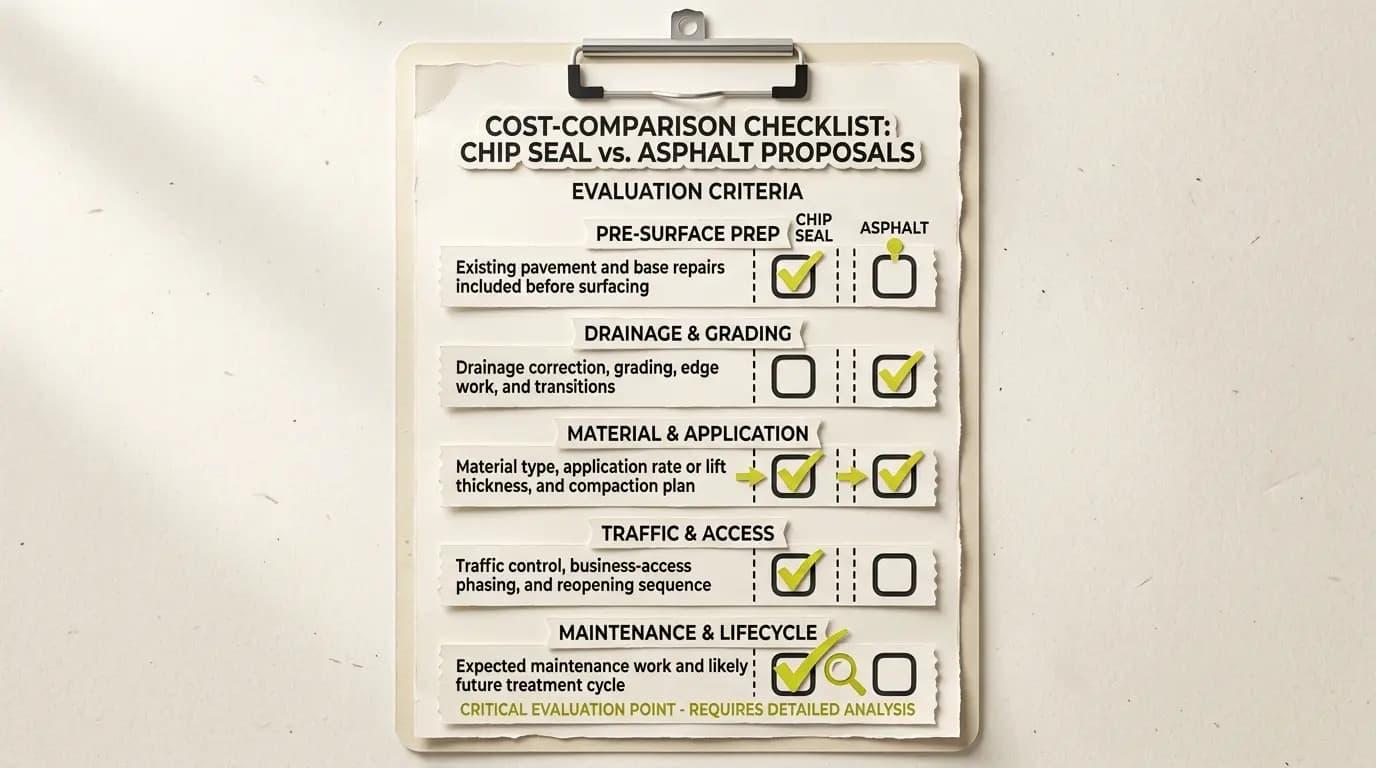
Before choosing the lower bid, property owners should compare the following items line by line to weigh total ownership cost. Chip seal is usually the more cost-effective option upfront when the existing pavement is sound, but like-for-like scope is what shows the real cost effectiveness.
- Existing pavement and base repairs included before surfacing
- Drainage correction, grading, edge work, and transitions
- Material type, application rate or lift thickness, and compaction plan
- Traffic control, business-access phasing, and reopening sequence
- Sweeping, cleanup, pavement markings, and accessible-space layout
- Expected maintenance work and likely future treatment cycle
Maintenance After Installation
Both surfaces need inspection and maintenance. The work is different because asphalt is a compacted pavement layer, while chip seal is a surface treatment.
Asphalt maintenance
Asphalt should be checked for open cracks, isolated failures, drainage problems, surface wear, and damaged markings. Timely crack sealing and patching can help prevent small defects from spreading. Sealcoating may be used later when the pavement condition and maintenance plan support it.
Chip-seal maintenance
Chip seal should be watched for aggregate loss, exposed binder, cracking from the pavement below, edge problems, and drainage-related damage. Reapplication is normally part of its lifecycle because the treatment wears with traffic and weather.
If structural failure appears beneath a chip seal, another surface treatment is not enough. The failed area must be repaired at the correct depth before the wearing surface is restored.
Business Disruption and Project Phasing
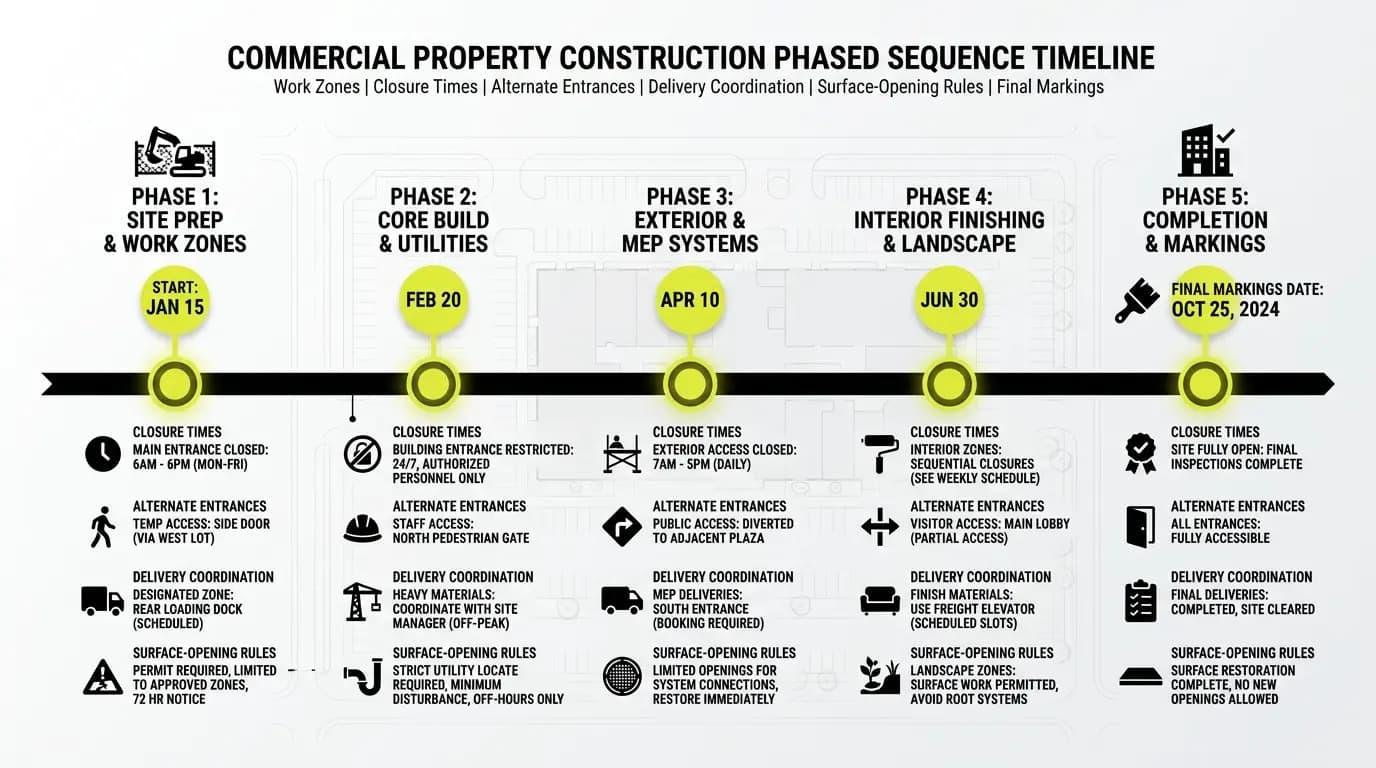
The best pavement is not useful if construction blocks the site at the wrong time. Commercial owners should compare how both options affect entrances, tenant access, deliveries, emergency routes, customer parking, and striping.
Chip seal can move quickly on a suitable road, but the early loose-stone period, sweeping, and temporary speed control still need a plan. Asphalt paving can require more preparation and cooling time, yet it can be divided into phases that keep parts of a lot open.
Ask the contractor for a written sequence. It should show work zones, closure times, alternate entrances, delivery coordination, surface-opening rules, and the date for final markings. A clear plan protects operations and reduces last-minute confusion.
Bart’s Asphalt can phase commercial work around active entrances, parking areas, tenants, and delivery windows. We offer evening and weekend scheduling when the project and site allow it. A defined sequence gives everyone a clear answer about where to park, drive, and work during construction.
When Asphalt Is Usually the Better Choice
Asphalt is often the stronger option when the project requires structural work or a smooth commercial finish. It is also easier to adapt across zones with different traffic demands, while chip seal can be a fit for the right low-speed areas when quick installation matters, even though loose stone and speed control still need to be managed.
Look closely at asphalt when your property has one or more of these needs.
- A new parking lot, drive, or access lane must be constructed
- The existing surface has widespread failure, deep rutting, or base movement
- Delivery trucks, refuse vehicles, buses, or other heavy vehicles use the site
- Vehicles brake, queue, or turn sharply in concentrated areas
- The property needs crisp striping, accessible spaces, or detailed traffic markings
- Customers, carts, small wheels, snow removal, or frequent sweeping favor a smooth surface
Some deteriorated lots do not need full reconstruction. If the base remains stable, removing the worn top layer and placing a new asphalt course may restore the surface with less disruption.
At Bart’s Asphalt, commercial milling and overlay work can provide a middle path between isolated patching and full replacement. We review elevations, drainage, failure depth, and the pavement structure that remains before recommending it. When the site is a good candidate, the approach can renew the driving surface without rebuilding areas that still perform well.
When Chip Seal May Be the Better Choice
Chip seal deserves consideration when the goal is to preserve a sound paved surface, not rebuild it, especially since asphalt is often the better fit for demanding commercial use because of its smoother finish, heavier-duty performance, and longer lifespan. It can suit a long private road, a rural access route, or another area where a textured finish and short early curing controls are acceptable.
A promising chip-seal candidate usually has a stable base, limited structural distress, manageable traffic patterns, and enough space to control speed and sweep excess aggregate. The owner should also accept that the finish will not look or feel like a smooth asphalt lot.
Do not choose chip seal simply because the first proposal is lower. Choose it because the pavement condition, surface expectations, traffic, construction window, and maintenance plan all support the treatment.
Choosing the Right Surface for Your Commercial Property
A visual walk-through is useful, but a professional assessment should guide a commercial pavement decision. When the goal is to protect a sound surface rather than rebuild it, chip seal can be a more cost-effective preservation option. Cracks, rutting, drainage patterns, patched areas, edge movement, and traffic zones reveal whether the problem is at the surface or deeper in the system.
Ask every contractor to explain the recommended treatment in plain language. The answer should connect the proposed scope to observed site conditions. If a proposal skips base condition, drainage, traffic, preparation, or phasing, it is not yet a complete comparison. That matters even more when considering treatments for private roads, rural access routes, low traffic areas, and rural roads, where fit-for-use often matters more than maximum lifespan.
At Bart’s Asphalt, we focus on commercial asphalt paving, repairs, milling, sealcoating, crack sealing, and pavement markings across Southeast Michigan. Our licensed and insured team has completed more than 576 commercial projects. We assess the failure pattern, traffic, drainage, and business needs before recommending a practical asphalt scope.
Schedule Your Pavement Assessment
Frequently Asked Questions About Asphalt and Chip Seal
These quick answers cover the questions property managers often ask before requesting a pavement assessment, including how to choose the right material based on traffic, drainage, and long-term upkeep.
What are the cons of chip sealing?
Chip seal has a lower upfront cost, but it also comes with trade-offs. It adds little to no structural capacity, has a coarser finish, and can release loose aggregate during its early service period. It may also be a poor fit for commercial sites with frequent turning, dense markings, carts, or demanding access requirements.
Can you put asphalt over chip seal?
Yes, but only if the existing pavement is structurally sound. Before installing an asphalt overlay, the base should be inspected to identify any structural problems that need repair to ensure the new surface performs properly.
How long does chip seal last?
Chip seal typically lasts about 5 to 10 years, depending on traffic, climate, drainage, and pavement condition. On busy commercial properties, heavier vehicle loads often shorten its service life and increase maintenance requirements.
Is chip seal suitable for commercial parking lots?
It can suit selected private roads, overflow areas, and other commercial surfaces with a stable pavement structure and manageable operating demands. In commercial settings, chip seal surfaces typically last about 5 to 10 years depending on traffic, climate, drainage, and the condition of the underlying pavement. Busy lots with frequent turning, detailed markings, carts, or heavy standing loads usually benefit more from a properly designed asphalt surface.
Is chip seal cheaper than asphalt?
Chip seal generally costs less initially when the existing pavement is a suitable candidate, especially for a commercial lot with limited operational demands. The comparison changes if the property needs base repair, drainage work, added pavement depth, detailed markings, or extensive traffic control, so both proposals should cover the same scope before costs are compared.